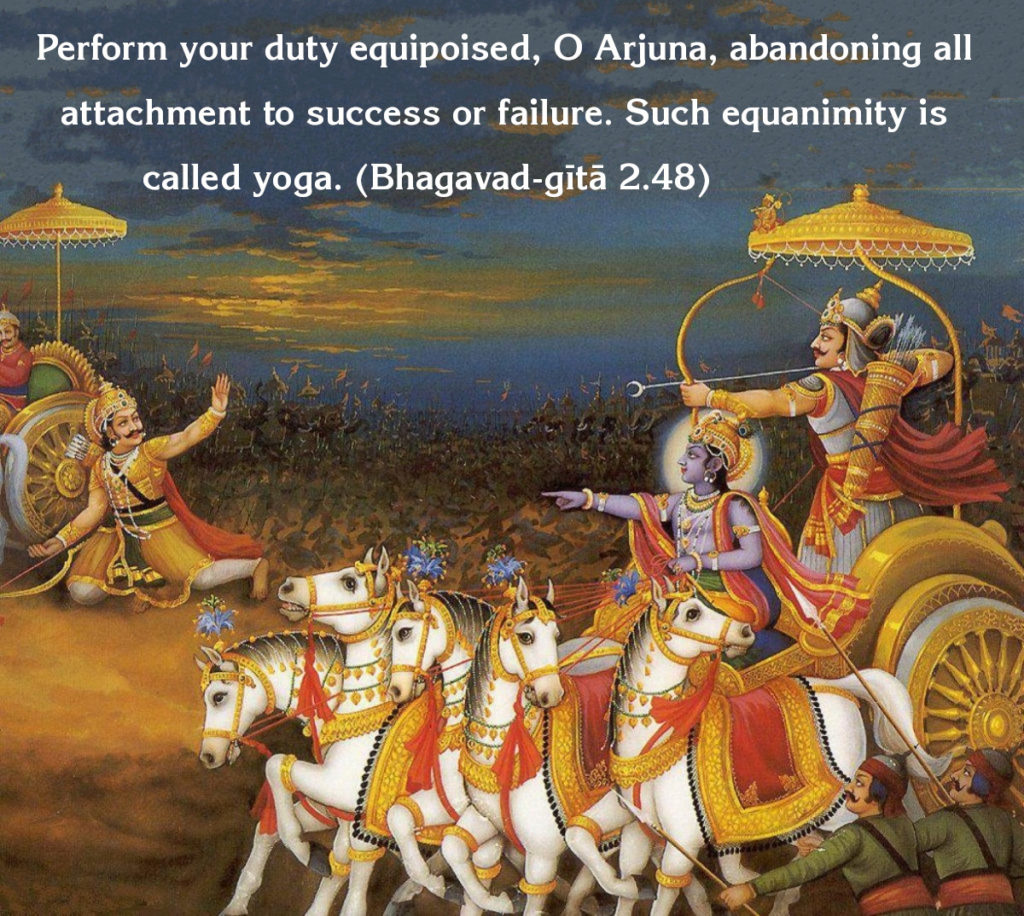
योगस्थ: कुरु कर्माणि सङ्गं त्यक्त्वा धनञ्जय |
सिद्ध्यसिद्ध्यो: समो भूत्वा समत्वं योग उच्यते || 48||
yoga-sthaḥ kuru karmāṇi saṅgaṁ tyaktvā dhanañjaya
siddhy-asiddhyoḥ samo bhūtvā samatvaṁ yoga uchyate
yoga-sthaḥ—being steadfast in yog; kuru—perform; karmāṇi—duties; saṅgam—attachment; tyaktvā—having abandoned; dhanañjaya—Arjun; siddhi-asiddhyoḥ—in success and failure; samaḥ—equipoised; bhūtvā—becoming; samatvam—equanimity; yogaḥ—Yog; uchyate—is called
Translation:
O Arjuna! Steadfast in Yoga, giving up all attachment, unmindful of success or failure, do your work. Such equanimity of mind is called Yoga.
Commentary:
The Lord’s command is that man should work, having established himself firmly in Yoga. What is Yoga? Equanimity of mind in success and failure is Yoga. The definition of Yoga should be carefully noted. How can one acquire such perfect mental equilibrium? Such a state can be had only when one transcends the mind and enter the Atmic state. That is the yogic position. The merging of the mind in Atma is Yoga. As this state alone can bring about perfect equanimity, the word Yoga is here applied to samatvam (i.e.) equal-mindedness under all circumstances. Free from any kind of desire, realizing one’s unity with Atma, man should work.
One should cultivate the habit of remaining steadfast in Atma before plunging into work. Godliness and spirituality should permeate the mind. One should feel his identity with the universal Being. Otherwise, the work he does will bind him to the world. The success and failures, losses and failures of his worldly activities disturb the mind by throwing it up in waves of momentary elation and depression and of pride and despondency. So one should deeply think of the Self and discriminate the real from the unreal. Then only a man can work with real detachment and with a steady mind. That is why the Lord first teaches the yoga of self-realisation and next speaks of Karma Yoga.
Sri Ramakrishna Says —
“Go forward. A wood-cutter once entered a forest to gather wood. A brahmachari said to him, ‘Go forward.’ He obeyed the injunction and discovered some sandal-wood trees. After a few days he reflected, ‘The holy man asked me to go forward. He didn’t tell me to stop here.’ So he went forward and found a silver-mine. After a few days he went still farther and discovered a gold-mine, and next, mines of diamonds and precious stones. With these he became immensely rich.
“Through selfless work, love of God grows in the heart. Then, through His grace, one realises Him in course of time. God can be seen. One can talk to Him as I am talking to you.” (Source: Gospel of Sri Ramakrishna)
KarmaYoga is defined as doing one’s duty while maintaining equanimity under all circumstances. Pain and pleasure, birth and death, loss and gain, union and separation are inevitable, being under the control of one’s past deeds or Karma, like the coming of day and night. Fools rejoice in prosperity and mourn in adversity, but a KarmaYogi remains tranquil under all circumstances (Tulasi Ramayan 2.149.03-04). The word ‘yoga’ has also been defined in the following verses of the Gita: 2.50, 2.53, 6.04, 6.08, 6.19, 6.23, 6.29, 6.31, 6.32, and 6.47. Any practical technique of understanding the Supreme Reality and uniting with Him is called spiritual practice, or yoga.
DO NOT FORGET YOUR REAL NATURE
When Annamalai Swami, a devotee of Bhagavan Ramana Maharshi, resolved to stay alone in a nearby jungle to do tapas, he asked his Master to give him upadeśa. Maharshi said, “Whatever you may do, do not forget your real nature.” This is yogasthaḥ kuru karmāṇi. (Source: Srimad Bhagavad Gita – Elixir of Eternal Wisdom | Vol 1)
“GANDHIJI IS DOING HIS DHARMA”
Many years ago, a scholarly Brahmin lived in a village. He was always very peaceful and remained absolutely unruffled in all situations. He was a man of few words. Every day, he would go about performing his prescribed disciplines. In addition to this, he would also teach the śāstras to his students. Thus he would go about his day, carrying out his duties perfectly. Everyone used to wonder at his perfectly balanced state.
One day, Mahatma Gandhi happened to visit a nearby town. At that time, the whole country was gripped with the fervour of the freedom struggle, and a huge crowd thronged to hear Gandhiji speak. Everyone from the village, including the Brahmin’s son, attended the talk. The only one who did not participate in this event was this Brahmin. He continued with his day as usual—chanting the Vedas and his daily meditations. His young-blooded and modern-educated son was furious. He questioned his father, “Father, what are you doing! Are you not concerned about the freedom of our country? Mahatma Gandhi himself has come here, and here you are, doing your petty rituals! I do not understand you. You are selfish.”
Hearing this, the sagely person smiled and said: “Dear son! What will I do by coming there? Gandhiji is doing his dharma, and I am doing mine.”
“But don’t you want freedom?”
“Yes.”
“Then, don’t you want to fight for it?”
“Yes, that is what I am doing. Peace cannot be had by becoming agitated. Peace can be had only by abiding in it. Would it have helped in any way if I had gone there? In doing so, I would have given up my dharma. And I would also be just one among the mob that had gathered there. This outer freedom that you are talking about—driving out one set of people and bringing another set to rule—will it solve all your problems? Let the politicians take care of it. But, even if we attain political freedom, until we become peaceful within, where is freedom for us?”
The son, who greatly respected his father’s intelligence, listened to these powerful words quietly. Soon, the words started working on him. He too was intelligent and understood the import of those words. The impact was so deep that later, he renounced, undertook Vedānta-śravaṇa from a great Swami and was himself established in that state. (Source: Srimad Bhagavad Gita – Elixir of Eternal Wisdom | Vol 1)
CHANAKYA ON SUCCESS
Chanakya, the powerful Brahmin who was the kingmaker behind the Maurya dynasty, once revealed a master plan to his disciples—King Chandragupta and a few others—on how to unleash a most unexpected form of attack on an enemy. This most unique plan, never heard of before, caught the youngsters’ imagination, and they rushed to execute it. But their plan fell through, and they had to flee to escape from the clutches of the enemy. They came rushing back to their Master and complained, “Master, we failed miserably. Why?” Chanakya seemed delighted and exclaimed, “Ho! Wonderful! Exactly as I had expected! Victory didn’t figure anywhere in my plan. I just wanted to make you see your faces in the mirror of this situation. Now that it is over, come on, let us execute the second plan.”
With renewed hope, Chandragupta asked, “Will it be successful, O Master?”
“Who wants success!” laughed Chanakya.
This is the way of great men. (Source: Srimad Bhagavad Gita – Elixir of Eternal Wisdom | Vol 1)
Related Articles:
- Verily these acts should be performed leaving aside attachment (doership) and the fruits; this is my certain and best opinion. (BG 18.6)
- In this, no effort is ever lost and no harm is ever done. Even very little of this dharma saves a man from the Great Fear. (BG 2.40)
Question: What is yoga?
Answer: Equanimity of mind is yoga.
Question: What is the method of work?
Answer: Steadfast in yoga, free from attachment, and equal-minded in success and failure, man should work.
Bhagavad Gita: Chapter 2 🔻 (72 Verses)
| 01 | 02 | 03 | 04 | 05 | 06 | 07 | 08 | 09 | 10 |
| 11 | 12 | 13 | 14 | 15 | 16 | 17 | 18 | 19 | 20 |
| 21 | 22 | 23 | 24 | 25 | 26 | 27 | 28 | 29 | 30 |
| 31 | 32 | 33 | 34 | 35 | 36 | 37 | 38 | 39 | 40 |
| 41 | 42 | 43 | 44 | 45 | 46 | 47 | 48 | 49 | 50 |
| 51 | 52 | 53 | 54 | 55 | 56 | 57 | 58 | 59 | 60 |
| 61 | 62 | 63 | 64 | 65 | 66 | 67 | 68 | 69 | 70 |
| 71 | 72 |
See also: