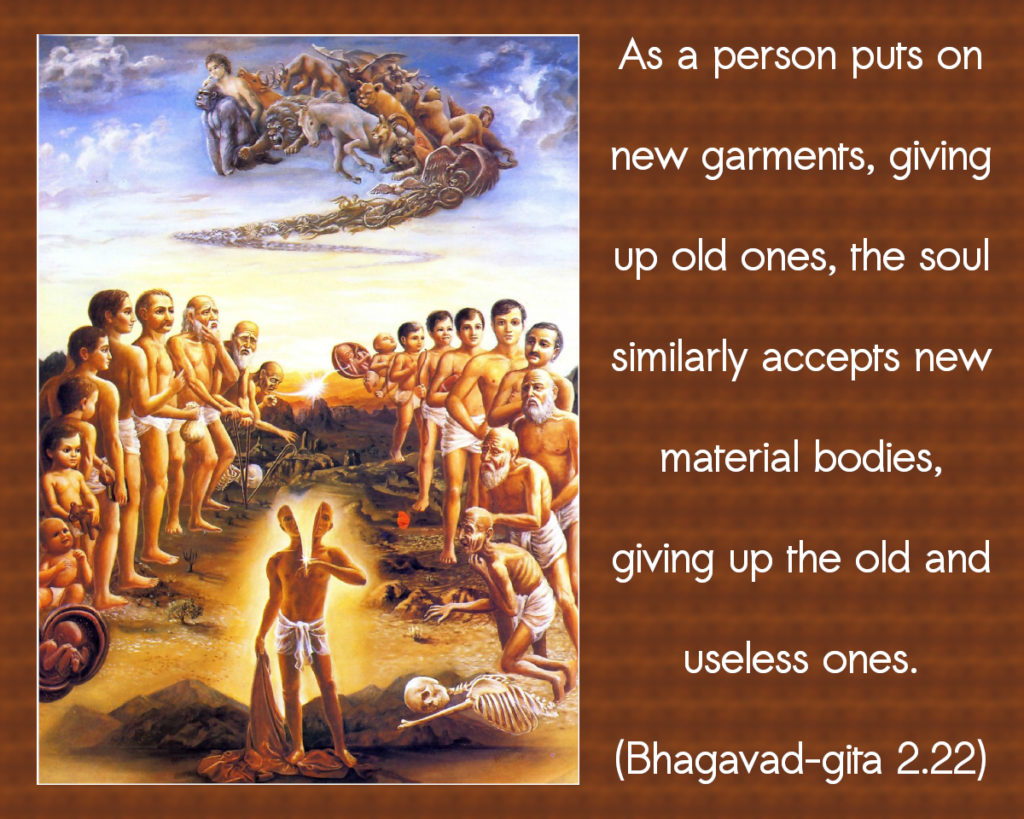
वासांसि जीर्णानि यथा विहाय
नवानि गृह्णाति नरोऽपराणि |
तथा शरीराणि विहाय जीर्णा
न्यन्यानि संयाति नवानि देही || 22||
vāsānsi jīrṇāni yathā vihāya
navāni gṛihṇāti naro ’parāṇi
tathā śharīrāṇi vihāya jīrṇānya
nyāni sanyāti navāni dehī
vāsānsi—garments; jīrṇāni—worn-out; yathā—as; vihāya—sheds; navāni—new; gṛihṇāti—accepts; naraḥ—a person; aparāṇi—others; tathā—likewise; śharīrāṇi—bodies; vihāya—casting off; jirṇāni—worn-out; anyāni—other; sanyāti—enters; navāni—new; dehī—the embodied soul
Translation:
Just as a man casts off his worn-out clothes and puts on new ones so also the Self throws away its worn-out bodies and takes other fresh bodies.
Commentary:
The Lord adopts the method of explaining his ideas by means of vivid similes. Such comparisons help to make the idea clear to the common man. We have here a familiar simile to explain a very high vedantic doctrine that the body is just like a garment worn by man and just as these garments are changed from time to time, even so, the Jiva goes on changing the physical body birth after birth. No one grieves when he casts off dirty and torn clothes and puts on other fresh garments. No one grieves when the autumn-withered leaves fall off from the branches. There is always the knowledge that fresh leaves come up with the arrival of spring. The whole of Nature presents such alternate pictures of bareness and beauty according to the changes of seasons. The Lord points out that death is no more than the rejection of the old and decayed body. The Jiva drops off the decayed body by death and adopts a fresh one. So there is absolutely no cause for grief. But of course, to destroy the past karma by supreme jnana, and escape from the cycle of birth and death is the reward of the highest realisation.
Bodies:- The plural is used here to show that man has to pass through innumerable bodies, birth after birth, so long as he remains ignorant of his real nature.
Worn out:- We have to interpret this word as bodies whose karmic force is exhausted. We see that people die in child and youth. When the physical body is not supposed to be old or worn out. In such cases, the karmic force for that particular body is exhausted and it falls off accordingly.
The Vedantic doctrine is that the Self remains deathless, passing from one body to another, according to the force of Karma done with the body. These bodies(upadhis) continue to change but the real man, Atma, remains unaffected and changeless.
Swami Vivekananda Says —
So far [we have discussed] God and nature, eternal God and eternal nature. What about souls? They also are eternal. No soul was [ever] created; neither can [the] soul die. Nobody can even imagine his own death. The soul is infinite, eternal. How can it die? It changes bodies. As a man takes off his old, worn-out garments and puts on new and fresh ones, even so the worn-out body is thrown away and [a] fresh body is taken.[Source]
There are two sorts of races, the divine and the demonic. The divine think that they are soul and spirit. The demonic think that they are bodies. The old Indian philosophers tried to insist that the body is nothing. “As a man emits his old garment and takes a new one, even so the old body is [shed] and he takes a new one.”[Source]
Sri Ramakrishna Says —
DOCTOR (to the Master): “I was much worried about you last night at three o’clock. It was raining. I said to myself, ‘Who knows whether or not the doors and windows of his room are shut?'”
“Really?” said Sri Ramakrishna. He was much pleased at the doctor’s love and thoughtfulness for him.
MASTER: “As long as there is the body, one should take care of it. But I find that the body is quite separate from the Self. When a man rids himself entirely of his love for ‘woman and gold’, then he clearly perceives that the body is one thing and the Self another. When the milk inside the coconut is all dried up, then the kernel becomes separated from the shell; you feel the kernel rattling inside when you snake the coconut. Or it is just like a sword and its sheath. The sword is one thing and the sheath is another.
“Therefore I cannot speak much to the Divine Mother about the illness of the body.”
GIRISH (to the devotees): “Pundit Shashadhar said to him [meaning the Master]: ‘Please bring your mind to bear on the body during samadhi. That will cure your illness.’ And he, the Master, saw in a vision that the body was nothing but a loose mass of flesh and bones.” (Source: Gospel of Sri Ramakrishna)
—
The Master was in a state of intense divine intoxication. In the well-lighted room the Brahmo devotees sat around the Master; Latu, Rakhal, and M. remained near him. He was saying to himself, still filled with divine fervour: “The body and the soul! The body was born and it will die. But for the soul there is no death. It is like the betel-nut. When the nut is ripe it does not stick to the shell. But when it is green it is difficult to separate it from the shell. After realizing God, one does not identify oneself any more with the body. Then one knows that body and soul are two different things.” (Source: Gospel of Sri Ramakrishna)
SWAMI VIVEKANANDA — “I HAVE SPAT OUT MY BODY”
When Swami Vivekananda passed away on July 4, 1902, at Belur Mutt near Kolkata, a little after 9 pm, Swami Ramakrishnananda (known as Sasi and one of Swamiji’s brother disciples), who was in Chennai at that time, had a dream that very night. In that dream, he heard Swamiji telling him, “Sasi, Sasi, I have spat out my body.” The very next day, he received a telegram announcing Swamiji’s passing away. (Source: Srimad Bhagavad Gita – Elixir of Eternal Wisdom | Vol 1)
And just as a leech moving on a blade of grass reaches its end, takes hold of another and draws itself together towards it, so does the self, after throwing off this body, that is to say, after making it unconscious, take hold of another support and draw itself together towards it. (Brihadaranyaka Upanishad 4.4.3)
See also: