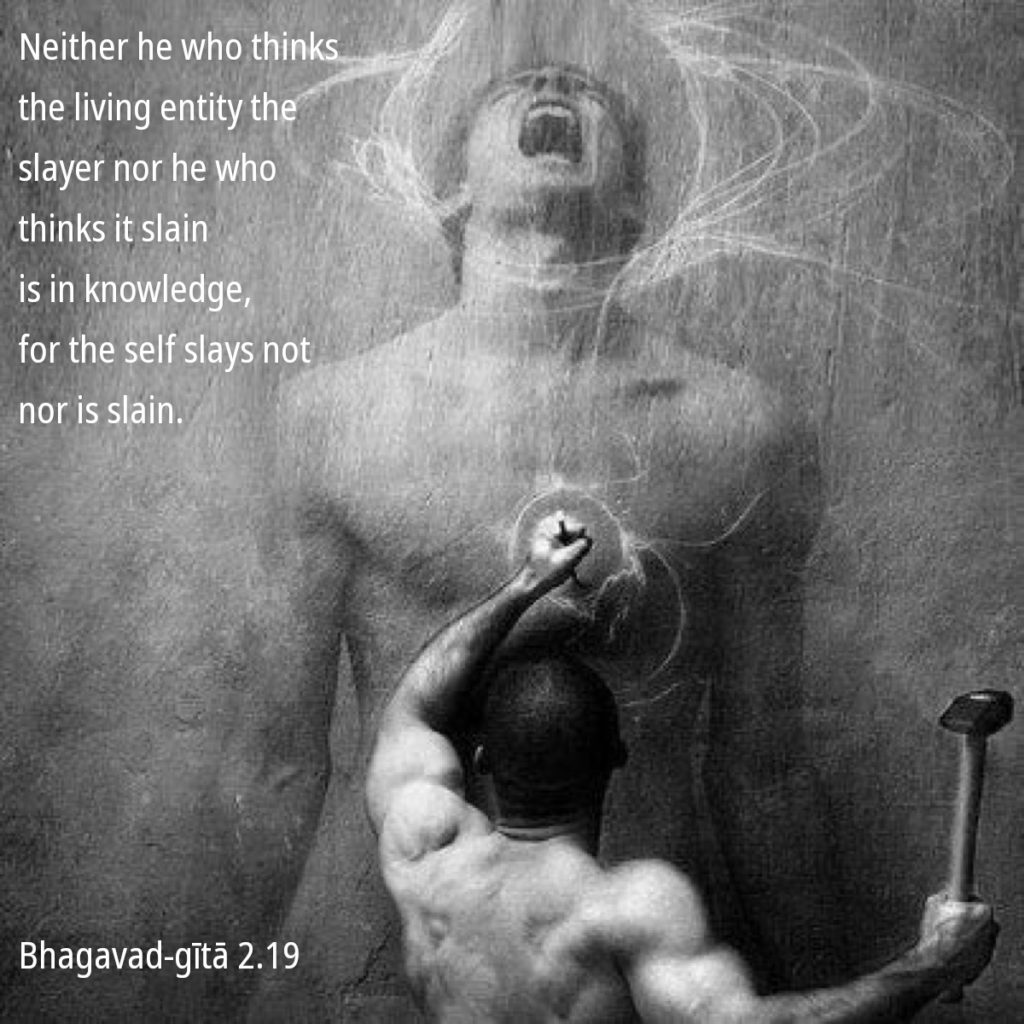
य एनं वेत्ति हन्तारं यश्चैनं मन्यते हतम् |
उभौ तौ न विजानीतो नायं हन्ति न हन्यते || 19||
ya enaṁ vetti hantāraṁ yaśh chainaṁ manyate hatam
ubhau tau na vijānīto nāyaṁ hanti na hanyate
yaḥ—one who; enam—this; vetti—knows; hantāram—the slayer; yaḥ—one who; cha—and; enam—this; manyate—thinks; hatam—slain; ubhau—both; tau—they; na—not; vijānītaḥ—in knowledge; na—neither; ayam—this; hanti—slays; na—nor; hanyate—is killed
Translation:
He who thinks that Atma slays, or he who thinks that Atma is Slain, both these do not know the Truth. Atma does not slay, nor is slain.
Commentary:
1. Since Atma does not slay, it follows that Atma does not perform any action. It is actionless. It does not do anything, nor does it prompt anything to do. The sense of action and the feeling of activity belong to Buddhi only and do not touch Atma which is beyond Buddhi. He is an ignorant man who ascribes action to Atma.
2. Atma is imperishable and so it cannot be slain. It is eternal and unchanging. Therefore, the spiritual aspirant should persistently contemplate that he is the immortal Atma, the witness of the physical and subtle bodies, the ever pure and perfect.
Swami Vivekananda Says —
Any action that you do for yourself will bring its effect to bear upon you. If it is a good action, you will have to take the good effect, and if bad, you will have to take the bad effect; but any action that is not done for your own sake, whatever it be, will have no effect on you. There is to be found a very expressive sentence in our scriptures embodying this idea: “Even if he kills the whole universe (or be himself killed), he is neither the killer nor the killed, when he knows that he is not acting for himself at all.” Therefore karma-yoga teaches, “Do not give up the world; live in the world, imbibe its influences as much as you can; but if it be for your own enjoyment’s sake, work not at all.” Enjoyment should not be the goal.[Source]
EQUIPOISE OF THE SAGE
During the Second World War, when each moment brought some disturbing news about the war, devotees beheld the profoundly peaceful and unruffled nature of the Sage of Arunachala. One devotee asked, “Bhagavan! How is it possible to be peaceful like this when such colossal destruction is taking place?” Maharshi said, “What else to do? No one dies; no one kills. Who sees the world? The Seer alone is the truth. Know the Self, then you will not see any body or world in it.” This indeed is the uncompromising Truth. One who knows this will never swerve from samādhi. “Ever established in samādhi, Siva dances the dance of destruction,” says Sankaracharya in Śivānandalahari. Krishna and Rama too have fought many wars, but no one considers them murderers. (Source: Srimad Bhagavad Gita – Elixir of Eternal Wisdom | Vol 1)
—–
BHAGAVAN RAMANA’S EXPERIENCE WITH ‘DEATH’
When he was only seventeen years of age, Sri Ramana had an intense feeling that he was going to die. This fear of death drove his mind deep inward. He enquired, “Who is dying? The body dies. It will, of course, be burnt. With that, will I die? No. The ‘I’ is felt clearly distinct from the body. It is within as the pure conscious principle. This ‘I-I’ is the deathless Atman.” This momentous insight established him in Brahman instantaneously and firmly. You see, he tried to taste death but could not see anything as death. He could only taste the ever-existing eternal being-ness. That is our real nature. (Source: Srimad Bhagavad Gita – Elixir of Eternal Wisdom | Vol 1)
Question: What is the nature of Atma?
Answer: It is free from all action. It does not slay, nor is it slain.