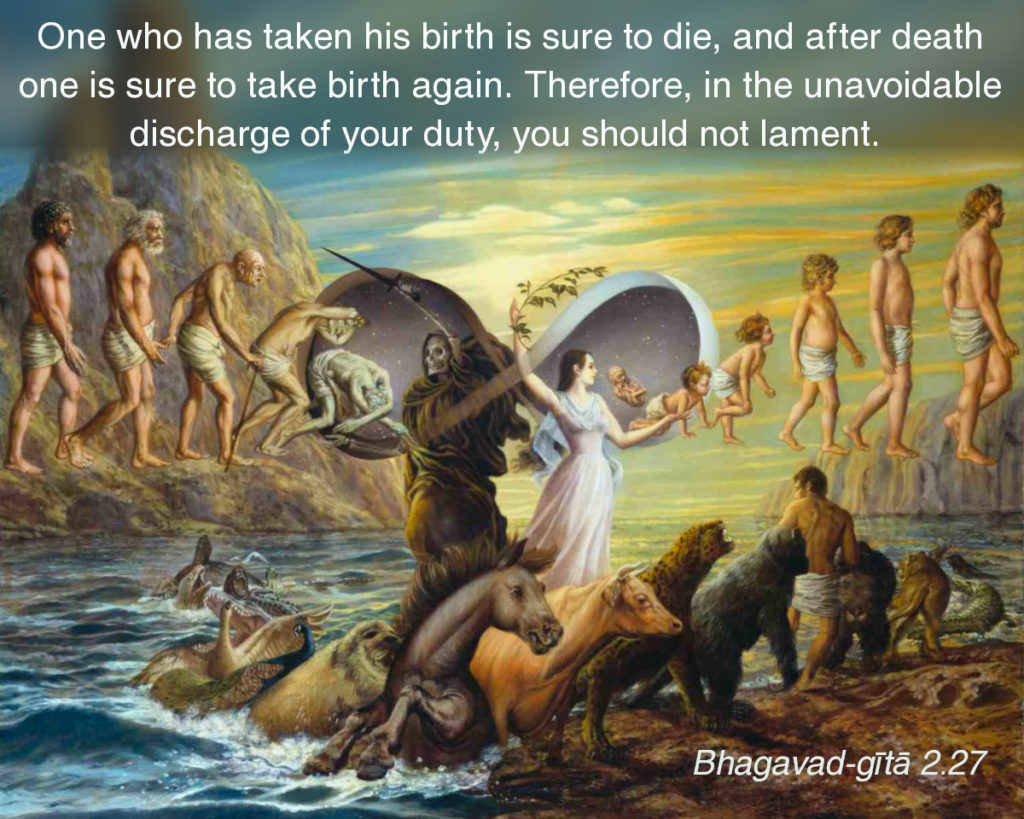
जातस्य हि ध्रुवो मृत्युर्ध्रुवं जन्म मृतस्य च |
तस्मादपरिहार्येऽर्थे न त्वं शोचितुमर्हसि || 27||
jātasya hi dhruvo mṛityur dhruvaṁ janma mṛitasya cha
tasmād aparihārye ’rthe na tvaṁ śhochitum arhasi
jātasya—for one who has been born; hi—for; dhruvaḥ—certain; mṛityuḥ—death; dhruvam—certain; janma—birth; mṛitasya—for the dead; cha—and; tasmāt—therefore; aparihārye arthe—in this inevitable situation; na—not; tvam—you; śhochitum—lament; arhasi—befitting
Translation:
For to that which is born, death is certain, and to that which is dead, birth is certain. Therefore you should not grieve over the unavoidable.
Commentary:
The Lord continues the argument. For that which is born, there is death, and for that which dies there is birth. This is the unalterable law for the body and all material things. The Self (Atma) as declared above, is not the body and is not the composition of material elements, and so it has neither birth nor death. So long as man remains in a state of ignorance and identifies with the body, he inevitably passes through the cycle of birth and death. The same man, when he realises his identity with the Self, the procession of birth and death stops for him. The Lord here speaks of the common man who has not understood the secret of his real nature. The purpose of the Lord is to rouse Arjuna from the slough of despondency into which he sank in that hour of test and trial. So He employs every argument both of spiritual Truth and common understanding with equal force and conviction. But the ultimate spiritual law remains unchanged by the mundane considerations brought forward to drive home a particular aspect of the Truth.
THE INSCRUTABLE NATURE OF LIFE BEYOND
When the question ‘Will a person be reborn within two years after his demise?’ was put to Bhagavan Ramana Maharshi, the sage replied, “Quite possible. He may have taken birth somewhere, and he may also be seventy-five years or older.” This answer of the Sage is quite baffling, is it not? It reveals the inscrutable nature of the life beyond. Many are the incomprehensible stories of this kind in Yoga Vasishtha. Life, as we know it here, is only a speck; the remaining part is ocean-like. Do not try to dip your brain into the unfathomable. Quieten your intellect. Still your thoughts. Mourning over the passing phenomena is sheer folly. The intelligent man will seek the Truth within and find joy here and now. That is the only worthy purpose. (Source: Srimad Bhagavad Gita – Elixir of Eternal Wisdom | Vol 1)
KRISHNA’S POWER TO LAUGH AWAY DESTINY
parihāra means remedy. “When you do not have a remedy, O Arjuna, just laugh it away.” We can see this power demonstrated in the life of Krishna many a time. Never did he grieve over anything in his life. Out of her unbearable sorrow over her children’s death, Gandhari cursed Krishna thus, “Thirty-six years hence your Yadava race will fight amongst themselves and perish. O Vāsudeva, You too will die, shot by an arrow!” The whole world shuddered at the horror of the curse. Vāsudeva, the Lord, being cursed! But how did Krishna take it? He just laughed—a laughter of the Omniscient. His voice soft like the notes from his flute, eyes moist with compassion, he gazed at the grief-struck Gandhari and said, “Mother! Are you content now? Is your mind at peace now? Your curse is just a prediction of what is to happen. You have given voice to destiny, that is all.” This was Krishna’s answer. What he lived and knew, He taught Arjuna. No trace of sorrow was present in him; only compassion for the suffering soul. (Source: Srimad Bhagavad Gita – Elixir of Eternal Wisdom | Vol 1)