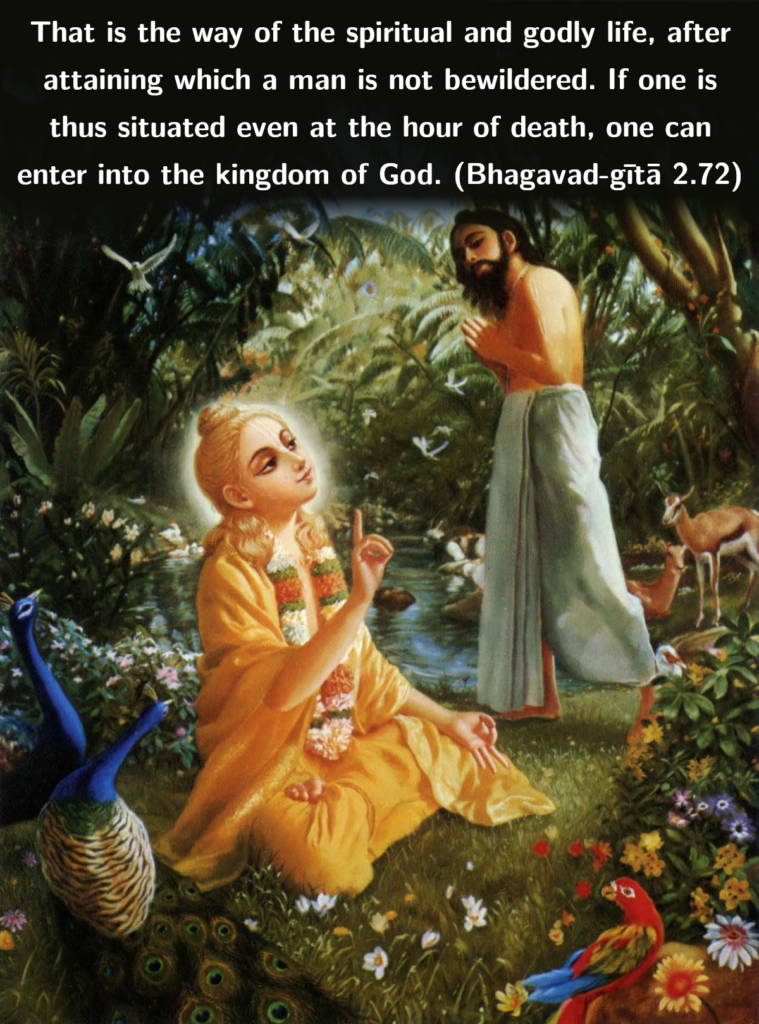
एषा ब्राह्मी स्थिति: पार्थ नैनां प्राप्य विमुह्यति |
स्थित्वास्यामन्तकालेऽपि ब्रह्मनिर्वाणमृच्छति || 72||
eṣhā brāhmī sthitiḥ pārtha naināṁ prāpya vimuhyati
sthitvāsyām anta-kāle ’pi brahma-nirvāṇam ṛichchhati
eṣhā—such; brāhmī sthitiḥ—state of God-realisation; pārtha—Arjun, the son of Pritha; na—never; enām—this; prāpya—having attained; vimuhyati—is deluded; sthitvā—being established; asyām—in this; anta-kāle—at the hour of death; api—even; brahma-nirvāṇam—liberation from Maya; ṛichchhati—attains
Translation:
Having obtained this Brahmi state man is not deluded. Being established in this even at the end of life man attains oneness with Brahman (Moksha).
Commentary:
The final goal of Vedanta is set forth here. All the practices – restraint of the senses, mind control, abandoning all ego-centric thoughts and feelings, having no consciousness of me and mine lead to the ultimate union of the individual being with the Supreme Self. The individual who thought of himself, as a separate entity now realises that he is no other than the Self, which is the Reality in himself and in all beings. This is the Brahmi-state. By constant meditation on the Self, the individual being becomes that, even as the worm becomes the bee by contemplating on it deeply and continuously. When the Brahmi-state is reached, all delusions cease, all doubts are cleared. The absolute Truth is realised.
The Lord declares that the sage who has attained this state, will not be subject to delusion at any time thereafter.
Even at the end of life: It does not mean that man attains the Brahmi-state in the last moments of his life. It means that he retains the supreme state even at the end of life. Such a man attains Moksha, the highest state of freedom and bliss. It is not possible to reach that state in the last moments of life if one had not struggled for it through a whole lifetime by performing sadhana. Even in old age, one should retain the memory of the supreme realisation. What is acquired by long practice should be kept fresh in the mind, even in the last moments of one’s life. The body and the mind are weak in old age. So the practice (sadhana) should begin when one is young and strong. The bad tendencies (samskaras) should be gradually eliminated. The mind should be purified and turned towards the Self, and constant meditation on the Self will lead to samadhi, and in samadhi, man realises his oneness with Brahman.
The Lord declares that He should be remembered at all times, not simply at the time of death. Moreover, what one thinks of and practices during a whole lifetime would be in the mind at the last moments. So continuous practice is necessary. No one can say when the end may come. So uninterrupted sadhana should go on from day to day, even from childhood. Then it does not matter when the end comes. He will be ready to face it because he knows the Truth.
So, instead of wasting time in foolish pursuits and vain endeavors, let the seeker start the sadhana at once and realise the Truth.
SRI RAMANA MAHARSHI — DEATH EXPERIENCE
Sage Ramana was an embodiment of that state. At the age of seventeen, he dealt a death-blow to death. That momentous day, he broke into the portal of death only to discover its absence. Though outwardly, there was not much quest or striving or any conscious preparation, the whole practice and inquiry unfolded in him unconsciously.
That sacred event happened when he was studying at the American Mission School in Madurai. One day, he was sitting alone in a room on the first floor of his uncle’s house. He was a healthy boy. Suddenly, a violent fear of death overpowered him. There was nothing in his state of health to account for it. He just had a strong feeling, ‘I am going to die.’ It was as if death had possessed him. Though outwardly, there was no cause for it, a few months before, he had heard the name ‘Arunachala’ from someone. And, like a key, that name had unlocked an ethereal realm in him, and some process was activated within. The conclusion of that process unfolded as this mystic vision of death.
He felt that he had to solve the problem of death then and there. He lay himself down. His mind became completely introverted, and he enquired within, ‘What is death?’ ‘What is happening to me?’ ‘Who is dying?’ His body became stiff, and he had a vision of his body being taken to the cremation ground and being burnt. His breath stopped. No sound escaped his mouth. Even the mind stopped, and the ‘I’-‘I’, which is the force of personality, expressed itself in his heart as Pure Consciousness. He sought the ‘I’ as the ego, and the ego disappeared, and what remained was the dance of Pure Awareness as ‘I-I’. Tattva-niścaya happened in him—‘I am the Atman. I am the Spirit. I am not this body.’ His intellect was established there. The intellect, mind, everything melted into that experience, and there remained only pure unalloyed bliss.
हृदयकुहरमध्ये केवलं ब्रह्ममात्रं ह्यहमहमिति साक्षादात्मरूपेण भाति।
In the Heart-cave, Brahman alone shines forth as ‘I-I’, as the Self.
That was his experience which he revealed later. All this took place in half an hour. Just imagine the simplicity of it for the prepared. The person comes with preparation from his past births, and it just explodes in a moment. In a matter of half an hour, he was established in that brāhmī sthitiḥ. It so happened that there was no one else at home when this sacred experience unfolded. When the relatives had left the house, there was only Venkataraman, the boy, but when they came back, there was a Sage, an Illumined Being, who did not belong to this earth. It was as if they saw the infinite sky, the infinite blueness of the space, through that body. There was something inexpressible, immeasurable in that boy.
This is brahma-nirvāṇa. The ego was completely annihilated. He was established in Brahman. Even his mauna, silence, was eloquent. It emanated the highest teaching. From that blessed day up to his last day, every day, every moment, he remained in the Brāhmī state. Never ever did he swerve from ‘That’. (Source: Srimad Bhagavad Gita – Elixir of Eternal Wisdom | Vol 1)
Question: What is the Brahmi-state?
Answer: Oneness with Brahman, acquired through the conquest of desires, self-control, meditation on Atma, is the Brahmi state.
Question: When should a man possess this state?
Answer: At all times, including the moments of death, man should retain this experience.
Question: What will it lead to?
Answer: The individual being attains Moksha, the state of supreme freedom and bliss.