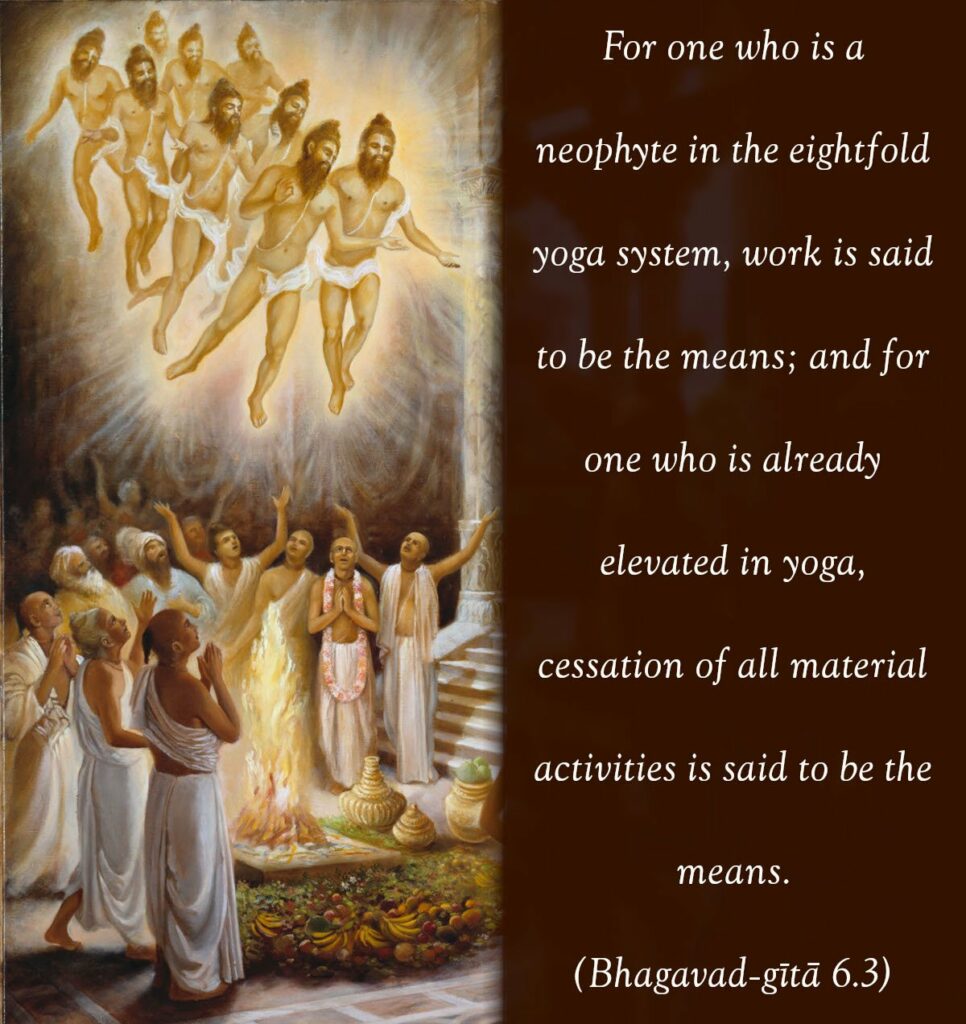
आरुरुक्षोर्मुनेर्योगं कर्म कारणमुच्यते |
योगारूढस्य तस्यैव शम: कारणमुच्यते || 3||
ārurukṣhor muner yogaṁ karma kāraṇam uchyate
yogārūḍhasya tasyaiva śhamaḥ kāraṇam uchyate
ārurukṣhoḥ—a beginner; muneḥ—of a sage; yogam—Yog; karma—working without attachment; kāraṇam—the cause; uchyate—is said; yoga ārūḍhasya—of those who are elevated in Yog; tasya—their; eva—certainly; śhamaḥ—meditation; kāraṇam—the cause; uchyate—is said
Translation:
For the sage aspiring to ascend to yoga, action is said to be the means; and for the same sage enthroned in yoga serenity is called the means.
Commentary:
To achieve success in Jnanayoga or Dhyana yoga, action (Nishkamakarma) is said to be the means. When success is attained in yoga and the mind approaches steadiness in the Self, a quiescent state free from action (sama) is said to be the means for deeper union with the Self. Therefore in the early stages of meditation purity has to be acquired by the practice of Nishkama karma. Afterward, as the mind becomes firm and steady by its purity, action should be gradually reduced. It means that as the aspirant approaches the Self nearer and nearer, action drops off of its own accord, even as dry leaves fall from the tree. The field of activity is thus transferred from the external world to the inner realm of the human personality. Hearing of Atma, thinking of Atma, meditating on Atma (sravana, munana, nidhidhyasa) – the seeker is disinclined to come out of the inner pursuit to active functions of the outer world with the body and the senses. He finds supreme satisfaction in being absorbed in the Self. The turbulence of the bodily organs and the senses is quelled. The seeker has no use for them because the mind and the intellect are turned within and the ascent towards the Self is maintained steadily. Such quietude of the physical and mental mechanism will enable him ultimately to reach the state where there are no thought modifications, and the Self is directly realised.
Let the seekers understand the position correctly. Hasty attempts to go into meditation will be of no avail. The mind rarely falls quiet for the common man. The inherent ‘vasanas’ pull him out into the external world of action. It requires great effort to purify the mind before it can attain a calm and peaceful state when meditation becomes possible. So the seeker should first engage himself in righteous and devotional acts. Otherwise, he remains dull and inactive, and dullness of the brain is certainly not meditation. Meditation is an intensely active state when all the energies of man are gathered together and centered in the one thought of the Self. To stop action by force and drive the mind by violent effort would unhinge the personality and render it more restless and distracted. When the wound is healing, a layer of skin covers it, but if one scratches it away before the wound is completely cured, it causes another blister. The layer should drop off naturally. So also, all actions are reduced by a natural process when the mind gathers momentum in its inward pursuit of the Self.
The path of progress may be divided into three stages: 1. The aspirant who is seeking yoga comes under the first stage – (the High – School Course). 2. The second stage is reached when meditation becomes possible by the purity of mind (Graduate Course). 3. Undisturbed absorption in the Self is the final stage (Post-Graduate Course). So the progress is gradual, not sudden and violent. First, through Nishkamakarma the mind should be purified. Then the practice of meditation should start. Then meditation should become deeper and deeper till the Self is realised. As a man reaches the third stage, all actions appear burdensome, and his only aim would be to get firmly established in the Self. He is the ‘Yogarudha’.
—-
Sri Ramakrishna frequently used the analogy of a mother cooking fish in different ways to explain how God provides various religious paths to suit the unique temperaments and capacities of different individuals. Here are the passages from the sources related to this:
- God provides different forms of worship for different stages of knowledge: “The mother cooks different dishes to suit the stomachs of her different children. Suppose she has five children. If there is a fish to cook, she prepares various dishes from it—pilau, pickled fish, fried fish, and so on—to suit their different tastes and powers of digestion“.
- People worship according to their own capacity: “People worship God according to their tastes and temperaments. The mother cooks the same fish differently for her children, that each one may have what suits his stomach. For some she cooks the rich dish of pilau. But not all the children can digest it. For those with weak stomachs she prepares soup. Some, again, like fried fish or pickled fish. It depends on one’s taste”.
- Differences in the capacity to comprehend: “The mother brings home a fish for her children. She curries part of the fish, part she fries, and with another part she makes pilau. By no means all can digest the pilau. So she makes fish soup for those who have weak stomachs. Further, some want pickled or fried fish. There are different temperaments. There are differences in the capacity to comprehend”.
- All religions seek the same object: Speaking to members of the Brāhmo Samāj, Sri Ramakrishna explained that Hindus, Muslims, Christians, and various other sects all seek the same God. “A mother prepares dishes to suit the stomachs of her children. Suppose a mother has five children and a fish is bought for the family. She doesn’t cook pilau or kāliā for all of them. All have not the same power of digestion; so she prepares a simple stew for some. But she loves all her children equally“. He further noted that “God has made different religions to suit different aspirants, times, and countries“.
- The Guru gives instructions suited to the disciple: When a devotee jokingly complained that the guru enjoys all the “good mangoes” himself and gives the bad ones to the disciples, the Master replied: “The mother knows what food suits the stomachs of her different children. Can all of them digest pilau and kāliā? Suppose a fish has been procured. The mother doesn’t give pilau and kāliā to all the children. For the weak child with a poor stomach she prepares simple soup. But does that mean she loves him the less?“.
Excerpt from ‘Spiritual Treasures: Letters of Swami Turiyananda’ —
We obstruct the path of our progress by limiting ourselves with rules. Of course, I am not saying there is no need for rules. It is important to know when rules are necessary and when they are not.
With great effort we invoke the deity in an image; yet we immerse the image after the worship. It is like a change of arrangement according to the change of situation. But, undoubtedly, it is difficult to ascertain. This is certain: If we can surrender ourselves fully to the Lord, we will not have to repent for anything. By God’s grace, everything will be all right. Don’t worry. Take refuge in God. Take refuge in God. (See also: Bhagavad Gita 5.10)
Related Articles:
- The Blessed Lord said: O sinless Arjuna! In ancient times two paths of spiritual description were spoken by me – the Jnana yoga for the followers of the path of knowledge, and Karma yoga for the followers of the path of action. (BG 3.3)
- But he who rejoices, who is contented, who finds happiness in Atma only, has no work to perform. (BG 3.17)
Bhagavad Gita: Chapter 6 🔻 (47 Verses)
See also: