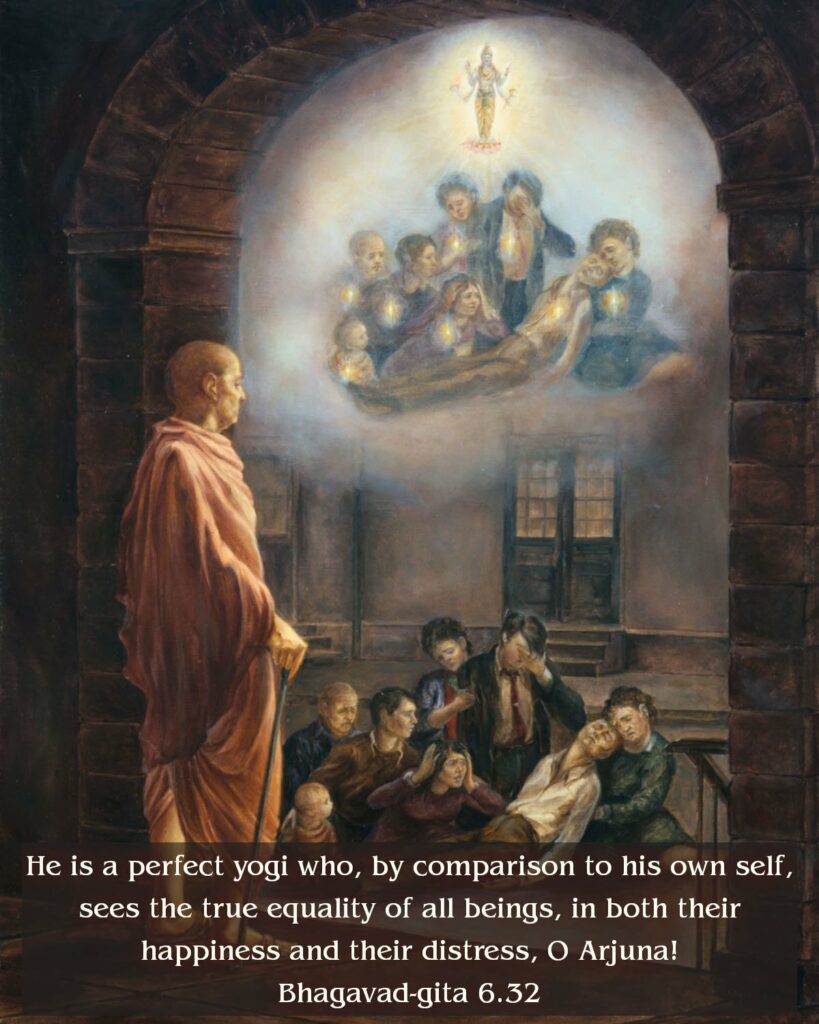
आत्मौपम्येन सर्वत्र समं पश्यति योऽर्जुन |
सुखं वा यदि वा दु:खं स योगी परमो मत: || 32||
ātmaupamyena sarvatra samaṁ paśhyati yo ’rjuna
sukhaṁ vā yadi vā duḥkhaṁ sa yogī paramo mataḥ
ātma-aupamyena—similar to oneself; sarvatra—everywhere; samam—equally; paśhyati—see; yaḥ—who; arjuna—Arjun; sukham—joy; vā—or; yadi—if; vā—or; duḥkham—sorrow; saḥ—such; yogī—a yogi; paramaḥ—highest; mataḥ—is considered
Translation:
He who judges pleasure or pain everywhere, by the same standard as he applies to himself, that yogi is thought to be the highest.
Commentary:
The practical aspect of Vedanta is emphasised here. It is in action that philosophy has to be tested and proved. It may be easily said, “All is Self, the Lord is all.” How then should he act in the world? That is the question. The sincere aspirant should be true to himself in word and deed. He should speak only that which he knows, and practise that which he speaks. So should religious spirit permeate all the words and actions of its votaries. Otherwise, their words are of no use. It is the divergence between theory and practice that brings disrepute to a person. The man who speaks religion should be exemplary in his conduct. When it is accepted that Atma is the reality in all beings, what should be the practical conduct of the yogi? How should he think, feel and act? He should intimately feel that the joys and sorrows of all beings are just the same as his own. The pangs of hunger and the bereavement of other people are of the same nature as his own. He understands the sufferings of others not only of men but of animals and other beings in the same spirit as his own suffering. He shares the gladness of others, and he suffers the pains of others. Such universality of feeling distinguishes the yogi of the highest perfection. This is religion brought into the field of practical action.
The Lord exhorts mankind – “Oh Ye mortals desirous of attaining me! Love others as you love yourself, feel for others as you feel for yourself. Be full of kindness and compassion, and then only are you one with Me.” Thesis like ‘All is Brahman’ (Sarvam Khalvidam Brahma) has no meaning if the heart of man remains closed to the pains and pleasures of others. Man must be able to identify himself with others and partake of their joys and sorrows. The brotherhood of man taught in all religions is good. But here, the truth is enlarged to embrace all creation. The Gita and the Upanishads declare the unity of the whole universe by the presence of the Supreme Lord in everything. The teachings of the Gita have broken up all barriers not only between man and man, but also between man and all other beings. The yogi should see the same Atma everywhere. He is the best of yogis who has attained this intimate identity with every being in the universe.
Swami Vivekananda Says —
We cannot remain without action for a moment. Act! But just as when your neighbour asks you, “Come and help me!” have you exactly the same idea when you are helping yourself? No more. Your body is of no more value than that of John. Don’t do anything more for your body than you do for John. That is religion. “He whose efforts are bereft of all desire and selfishness has burnt all this bondage of action with the fire of knowledge. He is wise.” (BG 4.19) Reading books cannot do that. The ass can be burdened with the whole library; that does not make him learned at all. What is the use of reading many books?[Source]
Swami Turiyananda: “An excellent book again is the Chandi! The philosophy of the Chandi has established the unity of Brahman and Shakti. ‘She, the Divine Mother is the Absolute and yet the relative in the form of the universe. She pervades everything. Mahâmâya (the Great Illusion) has veiled everyone with delusion that Her play may continue undisturbed. She vouchsafes both worldly enjoyment and spiritual emancipation. Such is the theme of the book. King Suratha and the merchant Samadhi worshipped the Mother for three years before they realized their desires.
“How is it that we know, and yet cannot act? This is due to Her Mâyâ. She must be propitiated. ‘She being propitiated grants the boon of Freedom.’ Aye, without Her grace, no man can get out of this network of illusion. Only through worship can the common man realize the supreme beatitude, the state of universal consciousness. There is no other way.
“Speak to others even as you speak to yourself. That is to say, know every one as your own self. Do you ever get angry with yourself? Even so behave with others. But that would be possible only when you see your own Self existing in others. This is the spirit which underlies Swamiji’s doctrine of the worship of the poor, the forms of Nârâyana. Indeed, there is a plane of consciousness where everything appears as one’s own Self. And when one reaches that plane, there is no more any confusion for him.” (Source: Spiritual Talks by the First Disciples of Sri Ramakrishna)
COMPASSIONATE ONENESS OF THE SAGE
An elderly lady who had lost many children visited Bhagavan Ramana Maharshi. She was in deep pain from having lost a daughter just then. Standing in front of the Sage, she wept uncontrollably. Instead of giving her any advice, Maharshi too silently shed tears with her. The Sage’s oneness with the grieving soul magically healed her. She felt the presence of the Sage in her. In place of her suffering mind, there was the experience of profound peace. Such transmission is a mark of a jīvanmukta. He just enters us, becomes one with us, and the pain is removed just as the mist is removed in the presence of the Sun. The oneness that he experiences is somehow transmitted to us. This is the meaning of ātmaupamya. (Source: Srimad Bhagavad Gita – Elixir of Eternal Wisdom | Vol 2)
SWAMI VIVEKANANDA AND THE CALCUTTA PLAGUE
When Calcutta was gripped by plague, and thousands were dying, Swami Vivekananda writhed in pain, beholding the horrific scenes of suffering and grief. Seeing this behaviour of Swami, one of his disciples asked, “Swamiji, you are a sannyāsin, an all-renunciate; still you suffer so much! Seeing the suffering of others, you experience so much pain! Then what is the use of jñāna?” Swamiji replied, “My dear, there is deep ecstasy in pain (born of compassion).” This reply reveals the mystical state of a yogi.
A question may arise here. If the yogi suffers the pain and pleasure of others, will he not be constantly bothered by these? Then, how can it be said that he has transcended pain and pleasure?
The yogi knows himself to be the Self. And with the power of this knowledge, he realises that, in his innermost realm, he is beyond all pain and pleasure—sukha and duḥkha. Even when he goes through his destined experiences of pain and pleasure, he knows that nothing can touch the Self. He is the Self. It is with the light of this insight that he looks at others as well. He beholds the same Self in all. Hence, when he sees someone suffering, he knows that the suffering cannot touch the real Self. (Source: Srimad Bhagavad Gita – Elixir of Eternal Wisdom | Vol 2)
SWAMI RAMATIRTHA’S ADVICE TO A GRIEVING LADY
A lady came to visit Swami Ramatirtha. She was grief-stricken and depressed. When she entered Swami’s cottage, he was immersed in deep samādhi. After some moments, he opened his eyes and gazed at her directly, into her very soul, and started chanting ‘Om… Om’. Then, with his whole heart behind his voice, he said, “Mother….what have you done to yourself! You are the ever pure Atman.” That is all! The lady started laughing in pure bliss. All her sorrows were just sucked away by that higher presence. (Source: Srimad Bhagavad Gita – Elixir of Eternal Wisdom | Vol 2)
Seeing behind the deed
At Ramakrishna Mission, Narendrapur, the rule of law implemented by Swami Lokeswaranandaji was the rule of love. One night as I was returning to the hostel through the vast acres of property, barely populated, I saw a man stealing jackfruits and caught him red-handed. We took away the jackfruits and kept him captive. We eagerly waited for the morning when we could present the thief before Lokeswarananda Maharaj and boast of our bravery. We secretly wished that Maharaj would hand him over to us and we could thrash him properly. When we brought the thief with all the stolen jackfruits before Maharaj, he said, “Since you have brought him to me, I should give the judgment, isn’t it? So, you please go.” We had to come out; but we decided to hide and see what Maharaj would do.
We heard him asking the thief, “Do you have a family?” “I have my wife and sons, Maharaj.” “And what is the means of your livelihood?” “Maharaj, I am a daily-wage labourer. But when there is no work available, I struggle to run the family.” At this reply, we could see a deep strain of pain on Maharaj’s face. He then asked, “What will you do with these few jackfruits?” “I will sell them and with whatever little money I get I will buy some provisions for the family.”
Maharaj stood up, and sent him off with some money along with all the jackfruits and something else which we could not make out. He also said, “Whenever you are in need, come to me. But do not steal.”
Seeing this, I walked up to Maharaj and asked, “What did you do Maharaj?” He replied, “Did you not hear that he struggles to feed his family? What suffering!” Maharaj’s expression revealed his intense sadness.
— Dr. Prashanta Giri
Connection to the story: Maharaj did not judge the thief from a pedestal of moral superiority. Instead, he placed himself in the man’s shoes (ātmaupamyena), internalizing his sorrow and hunger as his own. To feel another’s pain so acutely is the hallmark of a realized soul.
Experiencing the Agony of the World to Understand Others’ Grief
The Sage’s ability to take on and remove the pain of others requires complete oneness with human suffering. Sri Ramakrishna explicitly asked the Divine Mother to teach him this empathy. When his own nephew, Akshay, died, the Master initially felt no grief and watched him pass away as if “a sword being drawn from its scabbard”. But the next day, he suddenly felt a racking, excruciating pain in his chest, “as if somebody were squeezing my heart like a wet towel”. The Master realized that the Divine Mother was intentionally transmitting this agonizing grief to him as a lesson: “I thought that the Mother was teaching me a lesson. I was not much concerned even with my own body—much less with a relative. But if such was my pain at the loss of a nephew, how much more must be the grief of the householders at the loss of their near and dear ones!”.
Experiencing the Physical Pain of Others — Sri Ramakrishna’s experience of nonduality was so absolute that he literally felt the physical pain of other beings on his own body:
- The Boatmen: Once, while in an ecstatic mood looking at the Ganges, he saw two boatmen quarrelling. When the stronger man sharply slapped the weaker one on the back, Sri Ramakrishna cried out in sudden pain. His nephew Hriday ran to him and was dumbfounded to find that the Master’s own back had become red and swollen from the blow delivered to the boatman.
- The Trampled Grass: On another occasion, a man walked across a patch of fresh green grass in the temple garden. The Master, who was in a state of absolute oneness with his surroundings, felt a sharp, terrible pain in his chest as if the man were trampling directly on him, leaving visible bruises.
Taking on Fatal Illnesses and Karma — Sri Ramakrishna frequently took on the physical diseases and karmic burdens of his devotees:
- When the wife of his great devotee Mathur was dying of dysentery and the doctors had given up all hope, a frantic Mathur threw himself at the Master’s feet. Sri Ramakrishna consoled him and promised she would recover. She miraculously did, but the suffering of the disease was transferred to Sri Ramakrishna, who suffered from severe dysentery for the next six months.
- The Master later revealed that his own fatal throat cancer was the result of this compassionate absorption of others’ pain. In a vision, the Divine Mother showed him that because people touched him after committing sins, he was taking on the results of their evil deeds out of compassion for their misery, which manifested as the wounds in his throat. He also once cured a man’s leucoderma simply by passing his hand over the man’s skin, which caused the Master’s own hand to hurt terribly for the rest of the day.
Bhagavad Gita: Chapter 6 🔻 (47 Verses)