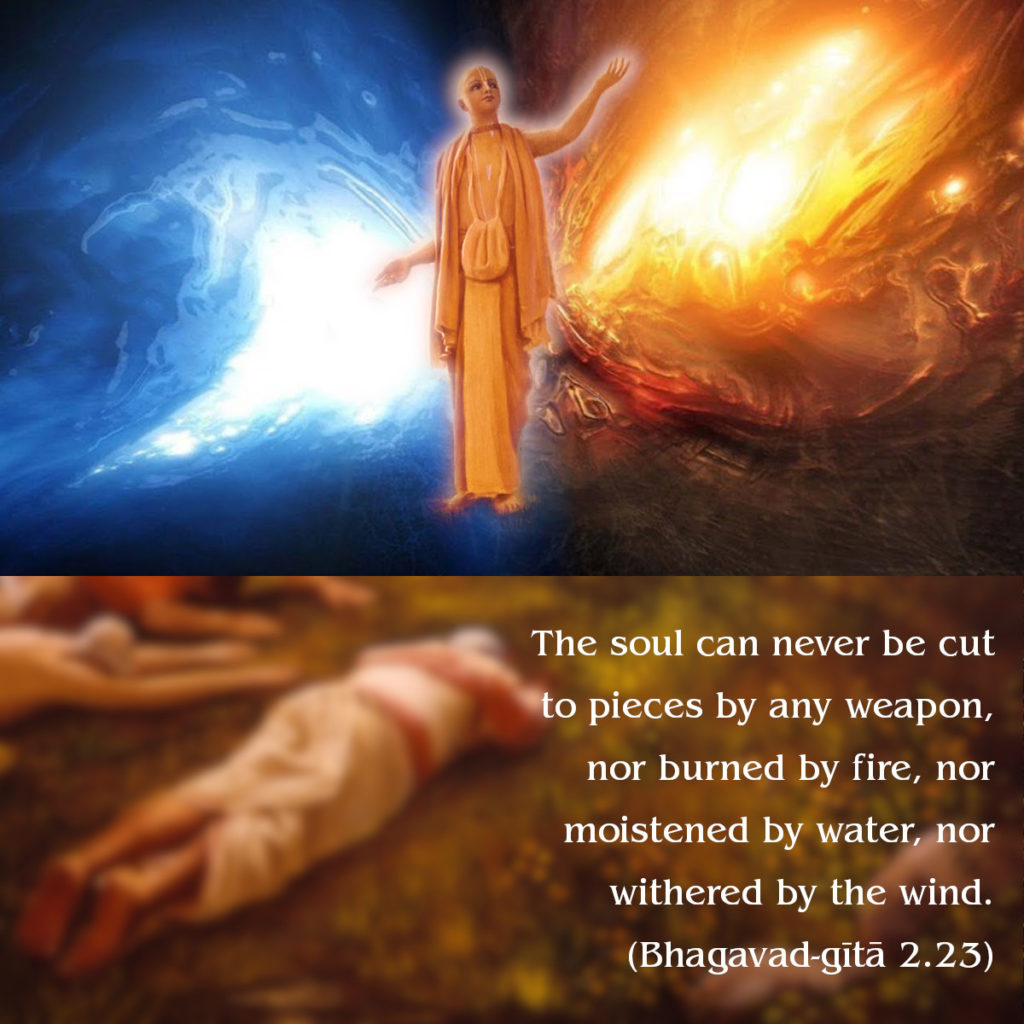
नैनं छिन्दन्ति शस्त्राणि नैनं दहति पावक: |
न चैनं क्लेदयन्त्यापो न शोषयति मारुत: || 23||
nainaṁ chhindanti śhastrāṇi nainaṁ dahati pāvakaḥ
na chainaṁ kledayantyāpo na śhoṣhayati mārutaḥ
na—not; enam—this soul; chhindanti—shred; śhastrāṇi—weapons; na—nor; enam—this soul; dahati—burns; pāvakaḥ—fire; na—not; cha—and; enam—this soul; kledayanti—moisten; āpaḥ—water; na—nor; śhoṣhayati—dry; mārutaḥ—wind
Translation:
Weapons cannot cut, fire cannot burn, water cannot wet, wind cannot dry up this Atma.
Commentary:
The Jiva is the combination of three factors, body, mind, and Atma. One is subtler than the other. The five material elements can affect the body only because the body is composed of the five elements. They cannot affect the mind, the subtle body, because the subtle body is finer than the gross body. We see that gross matter can break up. or destroy only a gross object. The sword can cut through a plant or human body, but it cannot cut the air or the ether. Finer and finer objects are not touched or affected by gross things, Atma, being the subtlest element nothing can touch or affect it in any way.
From the spiritual point of view, both the gross and subtle bodies are just false creations caused by ignorance (avidya), like the snake in the rope. So the superimposed mind and body do not in any way interfere with or change Atma, which remains always the underlying substratum, like the rope on which the illusion of the snake is superimposed. The creations of the body and mind are like the water in a mirage. They appear to exist, but they have no existence in reality. What exists is Atma and Atma alone. Thus if the seeker contemplates the eternal and immortal Self, he acquires boundless courage and firmness.
ALEXANDER AND THE SAGE
A notable incident happened during the Greek king Alexander’s invasion of Bharat. In the 4th century BC, there lived an enlightened sage in the forests of Takshasila. Alexander got to learn about the resplendent sage and desired to meet him. To his astonishment, though, the sage politely refused his invitation. Alexander then sent one of his helmsmen with lots of gold and other expensive gifts to lure the sage to come and see him. When the sage refused to accept the gifts as well, the king was infuriated and also confused. This was the first time anyone had dared to disobey his command. Then, instead of the sage coming to see him, Alexander decided to go himself to punish the sage.
Arriving at the abode of the sage along with his army, he saw the blissful sage sitting meditatively. Alexander got furious and asked him, “Why did you refuse my invitation and gifts?” To this, the sage calmly replied, “I refuse your hospitality as you acquire your wealth through unrighteous means, and it is smeared with the blood of innocents.” This truthful and point-blank response shook Alexander. He shouted in a fit of anger, “Do you know who I am?” The sage retorted, “Do you know who you are?” The subtle import of that question was lost on Alexander.
This was too much for Alexander, so he pulled his sword out and threatened the sage, “Are you not scared that I could kill you this very moment?” Hearing this, the grand old sage laughed at Alexander’s ignorance, then chanted this śloka from the Gita—nainaṃ chindanti śastrāṇi—and continued, “I am that Atman which no weapon can touch, no fire can burn, no water can wet. Nothing can happen to me. There is no place where I do not exist. I am all-pervading; your country, this country, the entire space is just a picture on me. And yet, I see nothing in me. I am Brahman. I am established in that state of Nirvāṇa, where there is neither creation nor sustenance nor dissolution.” Saying this, the sage became silent. The foolish conqueror stood there dumbfounded. (Source: Srimad Bhagavad Gita – Elixir of Eternal Wisdom | Vol 1)