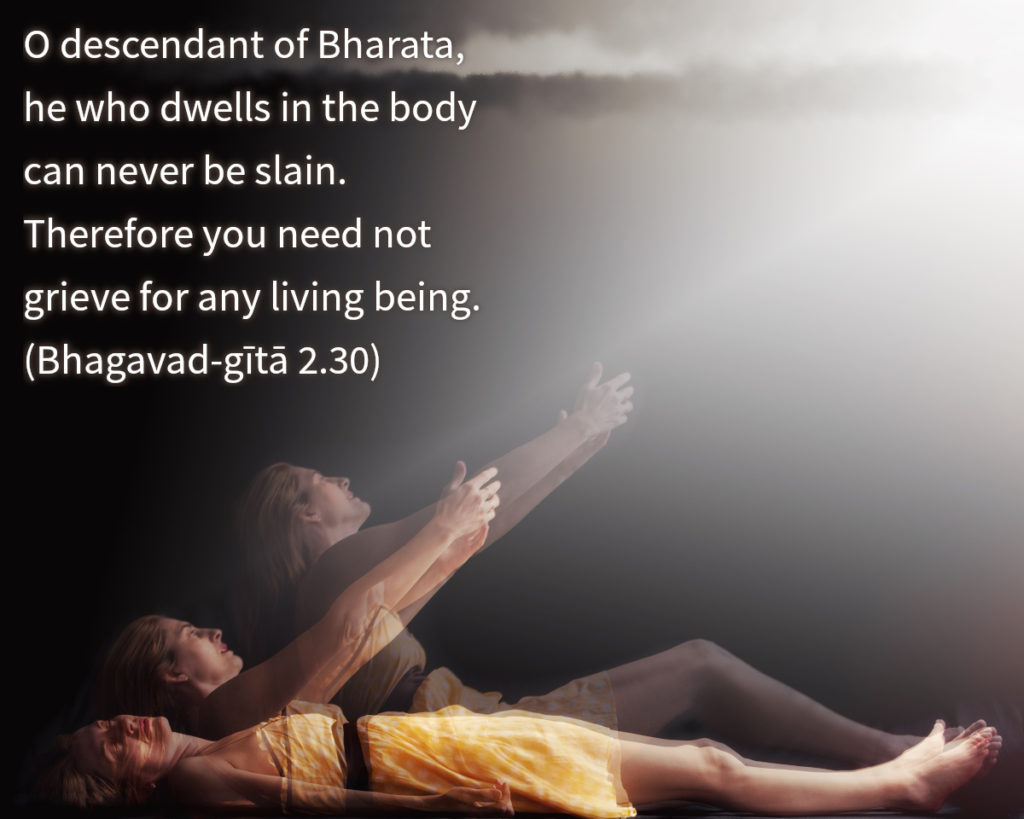
देही नित्यमवध्योऽयं देहे सर्वस्य भारत |
तस्मात्सर्वाणि भूतानि न त्वं शोचितुमर्हसि || 30||
dehī nityam avadhyo ’yaṁ dehe sarvasya bhārata
tasmāt sarvāṇi bhūtāni na tvaṁ śhochitum arhasi
dehī—the soul that dwells within the body; nityam—always; avadhyaḥ—immortal; ayam—this soul; dehe—in the body; sarvasya—of everyone; bhārata—descendant of Bharat, Arjun; tasmāt—therefore; sarvāṇi—for all; bhūtāni—living entities; na—not; tvam—you; śhochitum—mourn; arhasi—should
Translation:
O Arjuna! The Self existing in the body of all beings is never slain. So it is not right for you to grieve for any creature.
Commentary:
Though the body is slain, the indwelling Atma is not slain. This is true in the case of all creatures. It follows that Atma dwells in the body, as a witness, unaffected by the modifications of the body.
Always :- The immortality of Atma applies to all time, past, present and future.
The body may belong to any man, beast, or plant or any thing in the universe. The indwelling Atma is the same everywhere. When the body suffers and dies, the ignorant man thinks that he is suffering and dying, and so weeps and wails for the destruction of the body. The Lord here states categorically that the real man is no other than Atma, and so whatever might happen to the body, he is not at all affected by it, even as the sky is not affected by the passage of clouds over it. So where is the cause for sorrow ? Sorrow comes only by the false identification of the Self with the body. To think that you are the body is the very source, the very cause of all sorrow and suffering. It is immediately removed when you come to know that you are Atma. So the seeker should constantly contemplate and realise his oneness with the immortal and ever-blessed Self.
Bharata: Arjuna is addressed as `Bharata’ (i.e.) ‘Lover of Light.’ It is in the light of the Self that all things shine, all things are seen and known. Whatever light is in the world, all that belongs to Atma, and not to insentient matter. He who loves this light is ‘Bharata’.
THE REMARKABLE STORY OF VIKTOR FRANKL
Swami Ranganathananda mentions this incident in his commentary on the Gita:
The Jewish scientists in Hitler’s Nazi prison were subjected to tremendous pressure—all sorts of persecution, torture, and suffering. Many died in that kind of treatment. Among the very few who survived was Victor Frankl. He has authored a beautiful book about his life in the concentration camp. He says that he survived it by adopting the attitude of a witness, by constantly affirming to himself that he is not the body. Otherwise, he would have broken down, but he somehow detached himself from the body. He began to think of himself as a witness to what was going on as the Self. He adopted the attitude of moving away from the world, and that gave him the power to endure. Thus he could stand all the torture inflicted on him, and his mind remained undisturbed, and he survived. (Source: Srimad Bhagavad Gita – Elixir of Eternal Wisdom | Vol 1)
SOCRATES — “CATCH ME, THE REAL ME”
In the dialogues of Plato is described the incident of Socrates facing death. He faced it with absolute courage and peace. He had a calm, peaceful and fearless mind because of his deep knowledge that he was not the body but the Immortal Self.
Plato describes this event in detail. Socrates was about to drink the poison, and all his young disciples were sitting around him, emotionally upset. The only calm person there was Socrates himself, who chided them, “I asked the women to go away as they were crying a lot, and it was not giving me the peace I needed at the time of death. But you young men also are crying!” Then, an aged person named Crito (an old friend of Socrates) turned to him and asked, “Socrates! How shall we bury you?”
The man was not dead yet! He was going to take the poison in a few minutes. His death was going to happen only after that. But here, this disciple asks Socrates, ‘How shall we bury you!’
The Master greeted this question with a gentle smile and said, “Crito! Before asking this question, you must first catch me—the real me.”
See the language? It is pure Vedanta; every word of it. “You must first catch me—the real me. “Be of good cheer, Crito. You refer to this body? As to the body, do with it what you do with other people.” This was Socrates’ answer. The Atman cannot be destroyed, burnt, moistened, dried, or buried.
Here, it is evident that this particular knowledge of the immortality of the Self, the Atman, gives absolute peace of mind, composure and courage. It infuses immense peace to the people around them as well. This is not mere theory; it is experience. (Source: Srimad Bhagavad Gita – Elixir of Eternal Wisdom | Vol 1)