यदृच्छया चोपपन्नं स्वर्गद्वारमपावृतम् |
सुखिन: क्षत्रिया: पार्थ लभन्ते युद्धमीदृशम् || 32||
yadṛichchhayā chopapannaṁ swarga-dvāram apāvṛitam
sukhinaḥ kṣhatriyāḥ pārtha labhante yuddham īdṛiśham
yadṛichchhayā—unsought; cha—and; upapannam—come; swarga—celestial abodes; dvāram—door; apāvṛitam—wide open; sukhinaḥ—happy; kṣhatriyāḥ—warriors; pārtha—Arjun, the son of Pritha; labhante—obtain; yuddham—war; īdṛiśham—such
Translation:
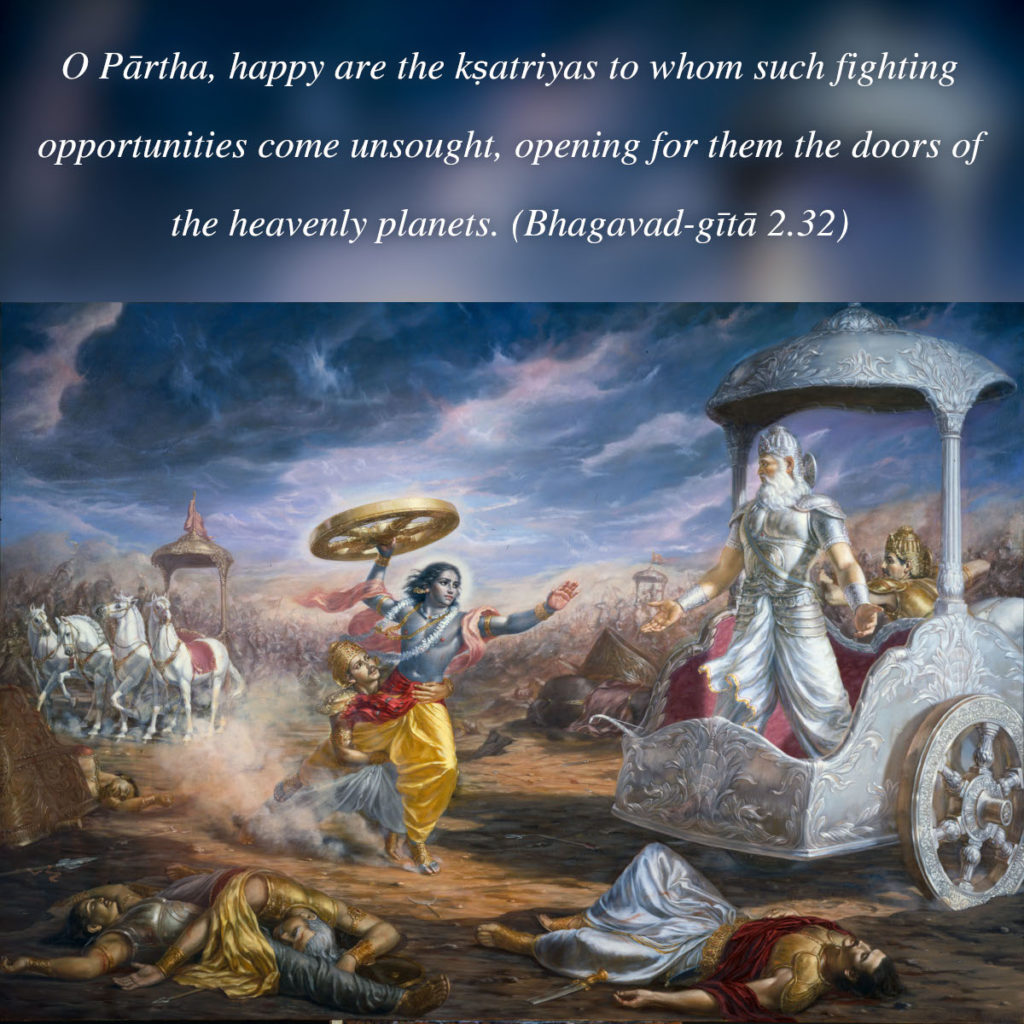
Happy indeed are the kshatriyas, O Pārtha, to whom comes such a war, offering itself unsought, opening the gate to heaven.
Commentary:
Arjuna is here addressed as Partha, the son of Pritha (Kunti). This reminds us of the message that the mother sent to her son on the eve of the battle through Lord Krishna.
“O Krishna! Tell Arjuna and the battle-minded Bhima that the time has come to justify why a Kshatriya mother desires to have sons.”
War against external enemies is the duty prescribed for the Kshatriya. But the internal conflict with bad instincts and impulses, like lust, greed, and hate, is taking place in the heart of every human being. The Kshatriya who fights a righteous war gains a kingdom or Heaven. The man who defeats the external enemies attains Moksha, liberation (‘Moksha dvaram apavrutam’). The true warrior is always eager to undertake a righteous war. The spiritual seeker is always ready and alert to fight ignorance in whatever form it may raise its head.
The righteous war is not a religious war against the followers of other religions. The righteous war may be waged even against our own evil-doer kith and kin (Rig Veda 6.75.19). Life is a continuous battle between the forces of evil and goodness. A valiant person must fight with the spirit of a warrior—with a will and determination for victory—and without any compromise with the forces of evil and difficulties. God helps the valiant who adhere to morality. Dharma (righteousness) protects those who protect Dharma (morality, justice, and righteousness).
It is better to die for a right cause and acquire the grace of sacrifice than to die an ordinary but compulsory death. The gates of heaven open wide for those who stand up to vindicate justice and righteousness (Dharma). Not to oppose an evil is to indirectly support it. Very similar ideas are expressed in other scriptures of the world. There is no sin in killing an aggressor. Whosoever helps and supports an aggressor is also an aggressor. Thus, all those who supported Kauravas were basically aggressors and deserved to be eliminated.
DIE IN THE CAUSE OF OTHERS
We know of many who participated in India’s freedom movement and were also drawn to spiritual life. Many became selfless in that effort. Swami Vivekananda once said, “Let the best of the society renounce their lives for the good of many—bahujana-hitāya bahujanasukhāya ca. All of you come. Let us build a bridge through which many will cross this ocean of sorrow. Yes, this is setu-bandhana. This is the Divine Mother’s work. Rarely comes the opportunity to participate in such a colossal mission. Whoever participates gets liberated by Divine Will…” The following statement of Swamiji will sweep anyone off their feet! “I love you all so much; my love for you is so deep that I would like to see you die in the cause of others.” Yes, effacing the ego is sādhanā. Even a squirrel got liberated by participating in the mission of constructing the grand bridge for Lord Rama. This is the secret. (Source: Srimad Bhagavad Gita – Elixir of Eternal Wisdom | Vol 1)
BHAGAVAN SRI RAMANA ON GANDHIJI’S WORK
During the Indian freedom movement, a tremendous energy-current ran through society. Once, a few freedom fighters visited Bhagavan Ramana Maharshi and posed these questions, “Will India get liberated? Will Gandhi’s movement be successful?” Maharshi replied, “Gandhi himself has not thought about it. He has surrendered to the Higher Power. So too, if you surrender to the Higher Power, you will not be concerned about the result.” This is the clue. The choice is ours. When a divine mission opens up in front of us, let us throw away our inhibitions and carry our piece of rock or pebble to build the mighty bridge of salvation for many now and future generations. (Source: Srimad Bhagavad Gita – Elixir of Eternal Wisdom | Vol 1)