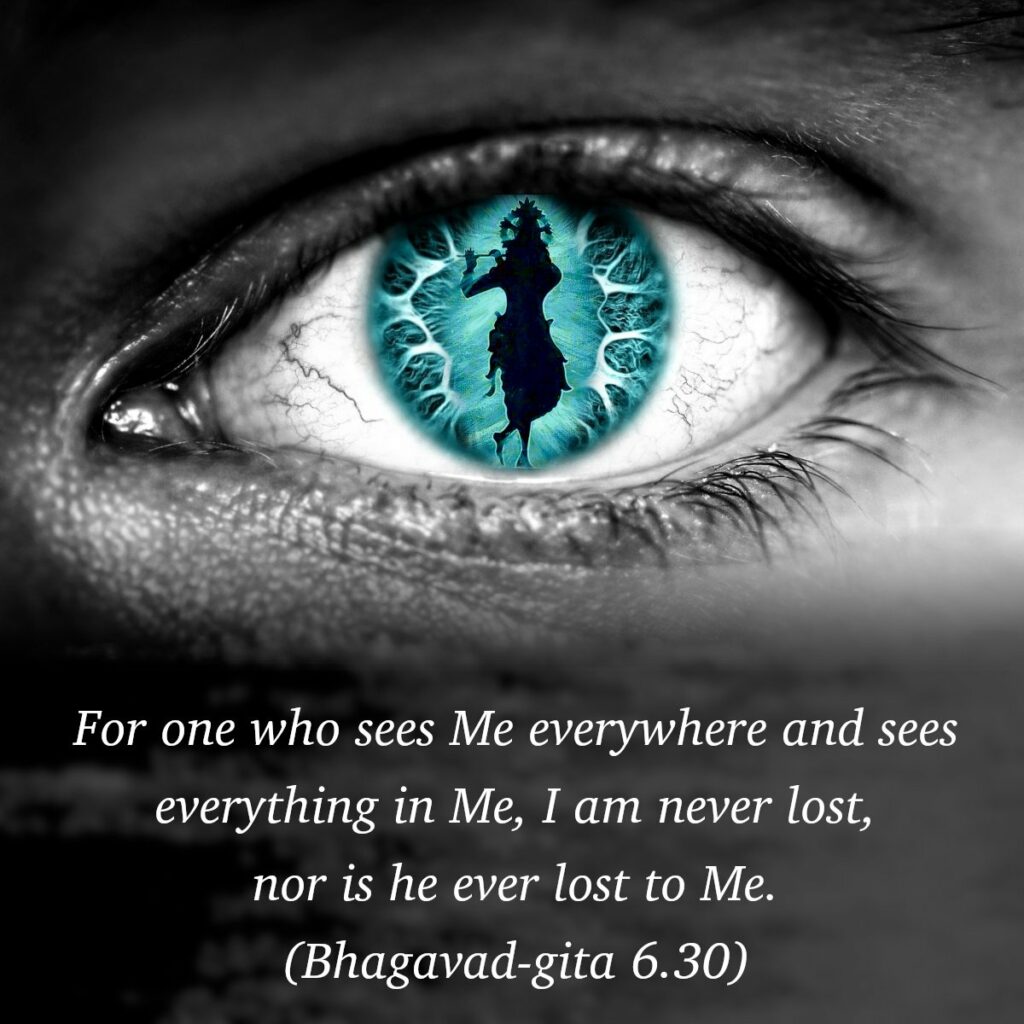
यो मां पश्यति सर्वत्र सर्वं च मयि पश्यति |
तस्याहं न प्रणश्यामि स च मे न प्रणश्यति || 30||
yo māṁ paśhyati sarvatra sarvaṁ cha mayi paśhyati
tasyāhaṁ na praṇaśhyāmi sa cha me na praṇaśhyati
yaḥ—who; mām—me; paśhyati—see; sarvatra—everywhere; sarvam—everything; cha—and; mayi—in me; paśhyati—see; tasya—for him; aham—I; na—not; praṇaśhyāmi—lost; saḥ—that person; cha—and; me—to me; na—nor; praṇaśhyati—lost
Translation:
He who sees Me in all beings and all beings in me never becomes lost to me, nor do I become lost to him.
Commentary:
Lord Krishna is Paramatma in all, and so the Yogi of universal vision sees the Lord everywhere and everything in the Lord. When the individual self has become one with Atma, the individual and the supreme Self live together. How can one be lost to the other? Here the word ‘pasyati‘ does not mean seeing with the physical eye. Seeing is experiencing the Self everywhere.
From the point of view of the devotee, the Lord is Paramatma. It is explained here how the Lord’s grace works on the devotee. He who sees the Lord everywhere receives the fulness of his grace. The Lord is ever alive to the devotee, and the devotee is ever alive to the Lord. No doubt all are children of the Lord. But the devotee has given up his child’s play with material things and yearns to live with the Lord. So the Lord has him ever under his loving eye and watchful care. Of what avail is it to spend a whole life-time seeking for the favour of some petty worldly person when the Lord Himself is ever near the individual, ready to confer the highest blessings of life? Why not approach Him? Through Jnana, equal vision and purity the Lord’s grace could be obtained in full. Having once obtained it, never is it lost again. To see the Lord in all and the Lord in all things is the aim of Yogi. This is Sarvatmadrishti.
—–
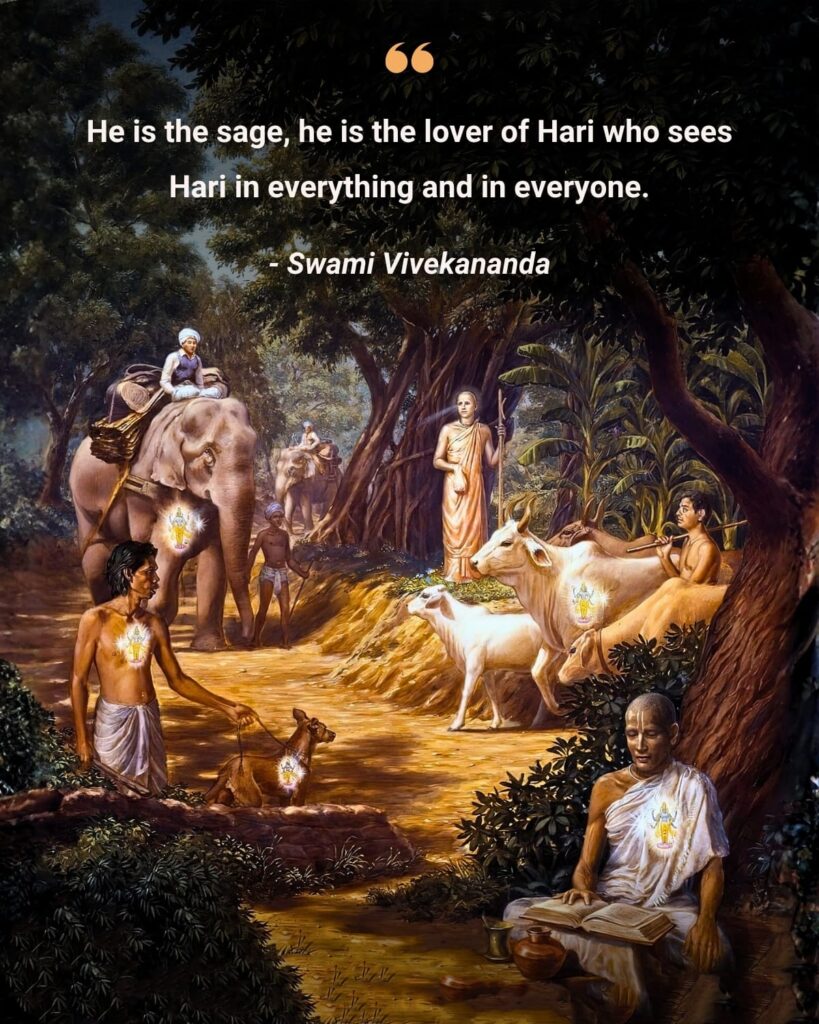
Swami Vivekananda Says —
‘‘People are afraid that when they attain to it, when they realise that there is but One, the fountains of love will be dried up.… People never stop to think that those who bestowed the least thought on their own individualities have been the greatest workers in the world. Then alone a man loves when he finds that the object of his love is not any low, little, mortal thing. Then alone a man loves when he finds that the object of his love is not a clod of earth, but is the veritable God Himself. The wife will love the husband the more when she thinks that the husband is God Himself. The husband will love the wife the more when he knows that the wife is God Himself. That mother will love the children more who thinks that the children are God Himself. That man will love his greatest enemy who knows that that very enemy is God Himself. That man will love a holy man who knows that the holy man is God Himself, and that very man will also love the unholiest of men because he knows the background of that unholiest of men is even He, the Lord. Such a man becomes a world-mover for whom his little self is dead and God stands in its place. The whole universe will become transfigured to him.… Instead of being a prison-house, where we every day struggle and fight and compete for a morsel of bread, this universe will then be to us a playground. Beautiful will be this universe then! Such a man alone has the right to stand up and say, ‘How beautiful is this world!’ He alone has the right to say that it is all good. This will be the great good to the world resulting from such realisation, that instead of this world going on with all its friction and clashing, if all mankind today realise only a bit of that great truth, the aspect of the whole world will be changed, and in place of fighting and quarrelling, there would be a reign of peace.
‘‘If one-millionth part of the men and women who live in this world simply sit down and for a few minutes say, ‘You are all God, O ye men, and O ye animals, and living beings, you are all the manifestations of the one living Deity!’ the whole world will be changed in half an hour. Instead of throwing tremendous bombshells of hatred into every corner, instead of projecting currents of jealousy and of evil thought, in every country people will think that it is all He.’’[Source]
Sri Ramakrishna Says —
MASTER (to Manomohan): “I see Rama in all things. You are all sitting here, but I see only Rama in every one of you. I see that it is God Himself who has become everything — the universe and its living beings.” (Source: Gospel of Sri Ramakrishna)
—
“Once a wicked man beat into unconsciousness a monk who lived in a monastery. On regaining consciousness he was asked by his friends, ‘Who is feeding you milk?’ The monk said, ‘He who beat me is now feeding me.’” (Source: Gospel of Sri Ramakrishna)
—–
“But for my part I accept everything: Turiya and also the three states of waking, dream, and deep sleep. I accept all three states. I accept all — Brahman and also maya, the universe, and its living beings. If I accepted less I should not get the full weight.”
A DEVOTEE: “The full weight? How is that?” (All laugh.)
MASTER: “Brahman is qualified by the universe and its living beings. At the beginning, while following the method of ‘Not this, not this’, one has to eliminate the universe and its living beings. But as long as ‘I-consciousness’ remains, one cannot but feel that it is God Himself who has become everything. He alone has become the twenty-four cosmic principles.
“When a man speaks of the essential part of the bel-fruit, he means its flesh only, and not the seeds and shell. But if he wants to speak of the total weight of the fruit, it will not do for him to weigh only the flesh. He must accept the whole thing: seeds and shell and flesh. Seeds and shell and flesh belong to one and the same fruit.
“The Nitya and the Lila belong to the same Reality. Therefore I accept everything, the Relative as well as the Absolute. I don’t explain away the world as maya. Were I to do that I should get short weight.”
MAHIMACHARAN: “It is a good synthesis: from the Absolute to the Relative, and from the Relative to the Absolute.”
MASTER: “The jnanis regard everything as illusory, like a dream; but the bhaktas accept all the states. The milk flows only in dribblets from the jnani. (All laugh.) There are some cows that pick and choose their fodder; hence their milk flows only in dribblets. But cows that don’t discriminate so much, and eat whatever they get, give milk in torrents. A superior devotee of God accepts both the Absolute and the Relative; therefore he is able to enjoy the Divine even when his mind comes down from the Absolute. Such a devotee is like the cows that give milk in torrents.” (All laugh.)
MAHIMA: “But the milk of a cow that eats without discrimination smells a little.” (Laughter.)
MASTER (with a smile): “That’s true, no doubt. Therefore that milk should be boiled. One should boil such milk over the fire a little while; there will be no smell whatever if you boil the milk over the fire of Knowledge. (All laugh) (Source: Gospel of Sri Ramakrishna)
—
ISHAN (to the doctor): “Our faith is shallow on account of our pride. It is said in the Ramayana that a crow named Bhushandi did not at first accept Rama as an Incarnation of God. Once it incurred Rama’s displeasure. It travelled through the different worlds — the lunar, solar, and so forth — and through Mount Kailas, to escape Rama’s wrath. But it found that it could not escape. Then it surrendered itself to Him and took refuge at His feet. Rama took the crow in His hand and swallowed it. Thereupon the crow found that it was seated in its own nest in a tree. After its pride had thus been crushed, the bird came to realise that though Rama looked like any other man, yet He contained in His stomach the entire universe — sky, moon, sun, stars, oceans, rivers, men, animals, and trees.”
MASTER (to the doctor): “It is very difficult to understand that God can be a finite human being and at the same time the all-pervading Soul of the universe. The Absolute and the Relative are His two aspects. How can we say emphatically with our small intelligence that God cannot assume a human form? Can we ever understand all these ideas with our little intellect? Can a one-seer pot hold four seers of milk?
“Therefore one should trust in the words of holy men and great souls, those who have realised God. They constantly think of God, as a lawyer of his lawsuits. Do you believe the story of the crow Bhushandi?” (Source: Gospel of Sri Ramakrishna)
—
The musician sang a song about the monastic life of Chaitanya. Now and then she improvised lines: “He will not look upon a woman; for that is against the sannyasi’s duty.” “Eager to take away men’s sorrows, he will not look upon a woman.” “For the Lord’s birth as Sri Chaitanya otherwise would be in vain.”
The Master stood up, as he heard about Chaitanya’s renunciation, and went into samadhi. The devotees put garlands of flowers around his neck. Bhavanath and Rakhal supported his body lest he should fall on the ground. Vijay, Kedar, Ram, M., Latu, and the other devotees stood around him in a circle, recalling one of the scenes of Chaitanya’s kirtan.
The Master gradually came down to the sense plane. He was talking to Krishna, now and then uttering the word “Krishna”. He could not say it very distinctly because of the intensity of his spiritual emotion. He said: “Krishna! Krishna! Krishna! Krishna Satchidananda! Nowadays I do not see Your form. Now I see You both inside me and outside. I see that it is You who have become the universe, all living beings, the twenty-four cosmic principles, and everything else. You alone have become mind, intelligence, everything. It is said in the “Hymn of Salutation to the Guru’: ‘I bow down to the Guru by whose grace I have realised Him who pervades the indivisible universe of the animate and the inanimate.’
“You alone are the Indivisible. Again, it is You who pervade the universe of the animate and the inanimate. You are verily the manifold universe; again, You alone are its basis. O Krishna! You are my life. O Krishna! You are my mind. O Krishna! You are my intelligence. O Krishna! You are my soul. O Govinda! You are my life-breath. You are my life itself.” (Source: Gospel of Sri Ramakrishna)
In his early days with Sri Ramakrishna, the young Sharat asked a blessing that he might see God in every being. The Master blessed him, saying, “Yes, you will attain it.” The following incident indicates how that blessing was fulfilled towards the end of his life: One of the devotees who was nurtured by Swami Saradananda’s loving care one day remarked, “Swami, why do you love us so much?” Swami Saradananda did not say anything. After a few days, when that devotee came to Udbodhan, the swami said: “A few days ago I went to Belur Math and prostrated before Sri Ramakrishna. The Master appeared before me and said, ‘You love all because you find me in all.’ That is the answer I would give you today.”
(Source: God Lived with Them)
When Namadev approached his guru Vishoba Khechar, he found him sleeping with his feet resting on the Shivalingam! Namadev was appalled. The first thing he found in his guru was a terrible mistake! When he shifted the guru’s feet away from the lingam, and tried to lay it down, another lingam appeared beneath the feet! This continued until there was no space empty of the Lord! Namadev realised that everything was in the form of Shiva—the temple, the guru, and even himself. Experiencing the omnipresence of God, Namadev embraced his guru’s feet!
—
One day, Sant Namdev was at his humble home preparing a meal. He had just finished cooking a stack of dry rotis (Indian flatbreads). Suddenly, a hungry, stray dog dashed into the house, grabbed the dry rotis in its mouth, and bolted outside.
Instead of reacting with anger, picking up a stick, or trying to punish the dog—which would be a normal human reaction—Namdev grabbed a bowl of ghee (clarified butter) and started running after the animal.
As he chased the dog down the streets, Namdev wasn’t shouting in anger. Instead, he was crying out with deep affection, “O Lord! Please stop! Do not eat the dry rotis, they will scratch your throat and give you a stomach ache. Please, let me smear some ghee on them! It will taste much better.”
To the ordinary onlookers in the village, Namdev looked completely insane—a grown man chasing a street dog with a bowl of butter, calling it God. But Namdev was entirely oblivious to the crowd. He did not see a filthy stray; he only saw Lord Vitthala who had come to him hungry. As his devotion deepened, he reached a spiritual state where he stopped seeing the physical differences in the world and only saw his beloved Lord everywhere.
The story of Pavhari Baba and the thief is a beautiful and famous anecdote in Indian spiritual history that perfectly illustrates extreme non-attachment, compassion, and the philosophy of seeing the Divine (God) in every living being.
Pavhari Baba was a highly revered saint and yogi who lived a very austere life in an underground cave in Ghazipur, Uttar Pradesh. He owned almost nothing, subsisting on very little, and spent most of his time in deep meditation. One night, while Pavhari Baba was sleeping, a thief sneaked into his humble ashram. The thief looked around and began gathering the few meager belongings the saint possessed—mostly just a few blankets and some simple cooking vessels. As the thief was tying the items into a bundle, Pavhari Baba suddenly woke up. Startled and terrified of being caught, the thief dropped the bundle of stolen goods and ran out into the night as fast as he could.
Instead of shouting for help or being relieved that his belongings were safe, Pavhari Baba reacted in a completely unexpected way. He picked up the heavy bundle of dropped goods, placed it on his own shoulders, and sprinted out into the darkness to chase after the thief. Because the Baba lived a disciplined and healthy yogic life, he was remarkably fast and soon caught up with the exhausted thief. The terrified thief fell to his knees, expecting to be beaten or dragged to the police. Instead, Pavhari Baba gently set the bundle down in front of the trembling man, folded his hands in deep reverence, and began to weep. He addressed the thief as “Narayana” (a name for the Supreme Lord) and apologized to him.
Baba said, “O Lord! Please forgive me for startling you. You came to my humble home, and I frightened you away. These things belong to you. Please, take them. I am sorry for the trouble you had to go through to get them.”
The thief was absolutely stunned. He had expected anger and violence, but instead, he was met with absolute, unconditional love and a man who literally saw him as a manifestation of God. This profound encounter completely shattered the thief’s heart. Overwhelmed by Pavhari Baba’s purity and compassion, he refused to take the bundle. Instead, he fell at the saint’s feet, weeping bitterly in repentance. The thief abandoned his life of crime that very night. He decided to renounce the world, stayed with Pavhari Baba, and eventually became a monk and a devoted disciple, dedicating the rest of his life to spiritual practice.
The Meaning: Swami Vivekananda, who was deeply influenced by Pavhari Baba and often spoke of him, used this story to explain the essence of true Vedanta—not just talking about the presence of God in all beings, but actually living it, to the point where even a thief stealing your possessions is treated with the utmost love and respect.
Ramcharitmanas (Lanka Kand)
“Siyaramamaya saba jaga jani, karahu pranama jori juga pani.”
“Know the entire world to be pervaded by Sita and Rama; bow to it with folded hands.”—–
Seeing God in everything is the culmination of Vedantic experience. When Nag Mahashay was asked why he remained with his hands folded reverently so much of the time, he replied, “I perceive God in every being and in everything.” (Source: They Lived with God)
Until one reaches the highest state of Realisation and abides in it constantly, glimpses of it come and go. But once the mind enters the infinite and limitless realm, there is no more suffering of coming and going—‘pōkku-varavu’ as Bhagavan Ramana Maharshi says. Ever splendorous, his Realisation will never dim again. The Śruti (Chandogya Upanishad 8.4.2) says, “Once the dawn has arrived, and the splendorous sun of Realisation has risen, never will it set again.” (Source: Srimad Bhagavad Gita – Elixir of Eternal Wisdom)
KĀKKASSERI BHATTATIRI — THE JĪVANMUKTA
There was a sage by the name of Kākkasseri Bhattatiri in Kerala. Though he hailed from a religious Brahmin family, he moved about without performing any Vedic rituals, nor did he do any spiritual practices. Often, he would be seen sitting by the river, quiet and still. Disapproving this behaviour, some orthodox ritualistic Brahmins once asked him, “Why are you not performing your nitya-karma (daily rituals such as sandhyā-vandana), which a Brahmin is supposed to do at sunrise and sunset?” The sage replied,* “In the horizon of my heart, the splendorous sun of Consciousness shines forth always! Neither does it rise nor does it set. How then can I perform these rituals of dawn and dusk!” That is the state of a jīvanmukta, the one who has realised the Self. (Source: Srimad Bhagavad Gita – Elixir of Eternal Wisdom | Vol 1)
Once, Kausalyā Devī, having bathed her son Rāma, laid him in his cradle to sleep. She then went to her prayer room where she worshipped the lord of her heart (iṣṭa deva) and made the customary food offering. Thereafter, she went to check something in the kitchen and, on returning to the prayer room, what did she see? The food that she had offered to the deity was being relished by the little Rāma. Taken aback, she wondered how Rāma could be there eating the food when, just a while ago, she had placed him in the cradle. On checking the cradle, she found the little one fast asleep in it. Again, returning to her prayer room she saw Rāma happily eating the food offering. It was as though the Lord was trying to convey to her that the One to whom she was offering worship was none other than Himself! She had offered Him food and so He was accepting it. Kausalyā did not understand and was, thus, astounded. So Śrī Rama smiled and gave her a glimpse of His cosmic form (viśva darśan) just as in His avatāra as Śrī Kṛṣṇa He had given Yaśodā the same vision in His open mouth. In a flash, Kausalyā saw, at one and the same time, prakṛti or nature in its unmanifest form, the play of māyā, jīvas buffeted here and there because of ignorance and, how, those who gained Knowledge attained liberation. (Source: Discourses on Ramcharitmanas by Swami Tejomayananda)
One day, after eating His fill of butter, Bhagavān ate mud. He loved rolling in the dust of Vraja, but on this day, He ate it as well. All His little gopa friends ran to Yashodā Mā to tell her.
A frantic Yashodā-jī ran to her child. Holding both His hands tightly in hers, she scolded Him and addressed Him in a formal manner, as a parent reprimands a child using the child’s full name. Chastising her little Krishna, Mother Yashodā demanded an explanation. She said, “Tell me, why did You eat mud?”
Bhagavān pleaded innocence and replied, “I did not eat mud, Mother.”
His mother said, “But all Your friends are saying You did. And not only they, but even Your brother, Balarāma, says so!”
Bhagavān coolly replied, “They are all liars. Which mud did I eat?”
Yashodā Mā chided him, “So they all are liars, is it? And You are the only one telling the truth?”
Bhagavān replied, “If you think I am lying, look in My mouth and see for yourself.” After all, what greater means of knowledge is there for most people? Most people say, “Seeing is believing.” Most people are more willing to believe something seen versus something heard.
Yashodā Maiyā said, “Very well, if that is the case, then open Your mouth and show me!” So, Bhagavān opened His mouth. And lo! When she looked into it, she saw space, the five elements, the directions, the sun, the moon, planets, stars, galaxies, the five subtle elements, all of Vraja, all living beings—including their karmas, attributes, and even their samsaras. She saw the entire cosmos. She even saw herself standing and rebuking Krishna! The last time she had seen the entire cosmos in her son’s mouth, she had shut her eyes, but this time, she did not. Instead, she began contemplating.
She thought, “Is this a dream? Or is this the Lord’s maya? Has my mind become deluded? Or does my child have some yogic power?” When she began pondering like this, Bhagavān decided to put a stop to it. Typically, when people contemplate on maya, they become completely confounded. However, the Lord knew that if Mother Yashodā kept deliberating like this, she would soon realize His true nature. And once this happened, how could His childhood pranks and plays continue? His mother would simply start worshipping Him.
Shukadeva-jī said, “This is why Bhagavān cast His maya over her, so that she would see and love Him only as her son.” (Source: Discourses on Srimad Bhagavata by Swami Tejomayananda)
Related Articles:
- Its hands and feet are everywhere; Its eyes, heads, and faces are everywhere; Its ears are everywhere; Its existence envelops all. (BG 13.14)
- He who sees the Supreme Lord abiding alike in all beings, and not perishing when they perish— verily he alone sees. (BG 13.28)
- The sage harmonised in yoga sees the Self in all beings, and all beings in the Self; he sees the same everywhere. (BG 6.29)
- The Yogi who worships Me abiding in all beings and who is established in unity abides in me in whatever manner he is acting. (BG 6.31)
- The wise man beholds all beings in the Self and the Self in all beings; for that reason he does not hate anyone. (Isha Upanishad, Verse 6)
- O Arjuna! Having obtained this knowledge, you will not thus be deluded again and by this Knowledge, you will see all beings in your Self and also in Me. (BG 4.35)
- Seeing the Atman in all beings, and all beings in the Atman, one attains the highest Brahman – not by any other means. (Kaivalya Upanishad, Verse 10)
- See God in All
- He said: It is not for the sake of the husband, my dear, that he is loved, but for one’s own sake that he is loved. It is not for the sake of the wife, my dear, that she is loved, but for one’s own sake that she is loved. It is not for the sake of the sons, my dear, that they are loved, but for one’s own sake that they are loved. It is not for the sake of wealth, my dear, that it is loved, but for one’s own sake that it is loved. It is not for the sake of the Brāhmaṇa, my dear, that he is loved, but for one’s own sake that he is loved. It is not for the sake of the Kṣatriya, my dear, that he is loved, but for one’s own sake that he is loved. It is not for the sake of the worlds, my dear, that they are loved, but for one’s own sake that they are loved. It is not for the sake of the gods, my dear, that they are loved, but for one’s own sake that they are loved. It is not for the sake of the beings, my -dear, that they are loved, but for one’s own sake that they are loved. It is not for the sake of all, my dear, that all is loved, but for one’s own sake that it is loved. The Self, my dear Maitreyī, should be realised—should be heard of, reflected on and meditated upon. By the realisation of the Self, my dear, through hearing, reflection and meditation, all this is known. (Brihadaranyaka Upanishad 2.4.5)
Question: What is the effect of union with Atma?
Answer: The Yogi sees the Lord in all things, and lives ever with the Lord.
Bhagavad Gita: Chapter 6 🔻 (47 Verses)