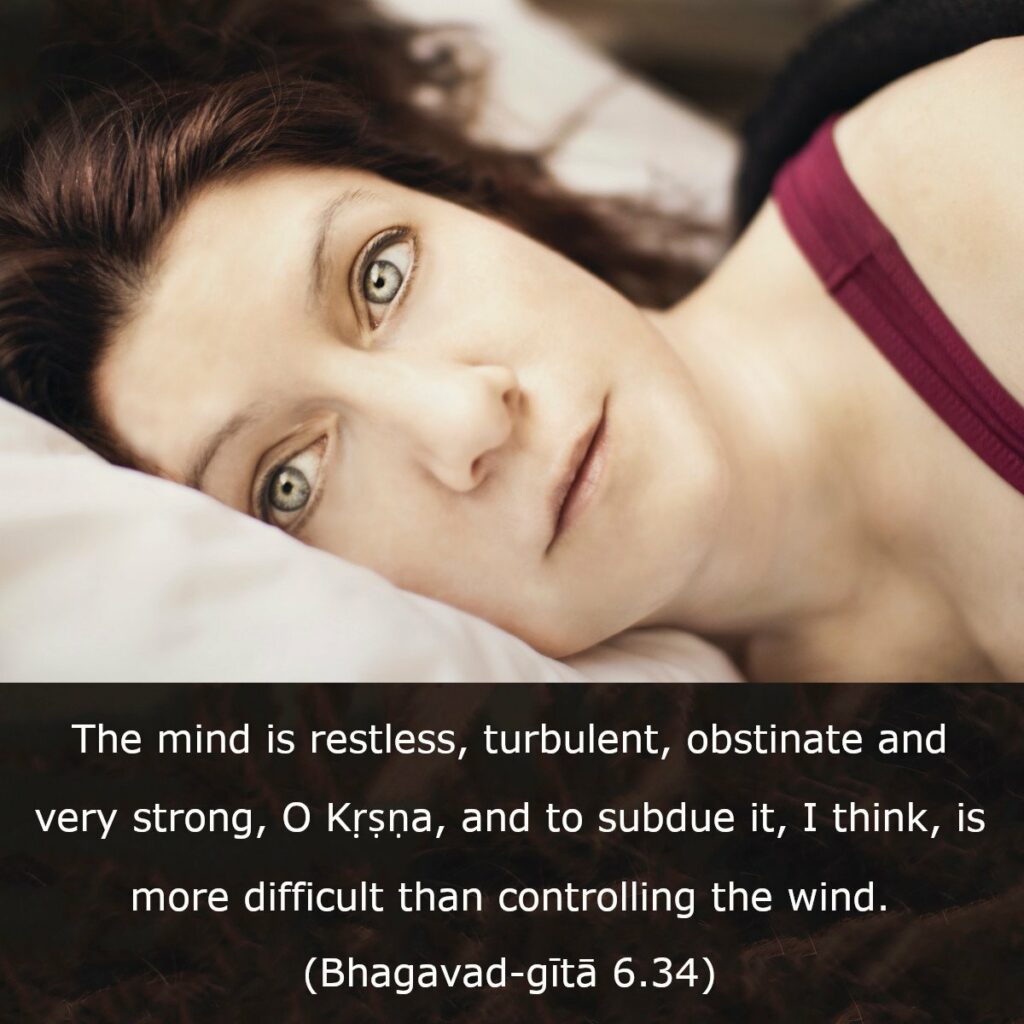
चञ्चलं हि मन: कृष्ण प्रमाथि बलवद्दृढम् |
तस्याहं निग्रहं मन्ये वायोरिव सुदुष्करम् || 34||
chañchalaṁ hi manaḥ kṛiṣhṇa pramāthi balavad dṛiḍham
tasyāhaṁ nigrahaṁ manye vāyor iva su-duṣhkaram
chañchalam—restless; hi—certainly; manaḥ—mind; kṛiṣhṇa—Shree Krishna; pramāthi—turbulent; bala-vat—strong; dṛiḍham—obstinate; tasya—its; aham—I; nigraham—control; manye—think; vāyoḥ—of the wind; iva—like; su-duṣhkaram—difficult to perform
Translation:
The mind is very restless, turbulent, strong, and obstinate, O Krishna. It appears to me that it is more difficult to control than the wind.
Commentary:
Yoga (Union with Atma) is possible only when the mind is steady. But the mind is most infirm and unsteady. The body and senses are harassed continuously by its restlessness. Peace is practically impossible when the heart is churned by the mind like the milky ocean by the Mandara mountain. Having fed and strengthened itself on worldly things for several births, it has acquired great power and defies all attempts to bring it under control. The nature of the mind is described here by four attributes. It is restless, turbulent, strong and unyielding. Every man knows the vagaries of the mind. The elders compare it to a monkey, drunk and stung by a scorpion. Those who practice meditation know how the mind rebels and defies discipline. Arjuna compares it to the wind.
It is strong and cannot be held or directed as one wishes. ‘Sudushkaram’ is the word used by Arjuna, meaning that it is very difficult to control the mind.
HOW TO CONTROL THE MIND
Someone once asked Bhagavan Ramana Maharshi how to control the mind. Maharshi said, “If you know the Self, there will be no mind for you to control.” This is the straight path.
मानसं तु किं मार्गणे कृते।
नैव मानसं मार्ग आर्जवात्॥ Upa.Sa. 17
‘When you try to seek the mind, you find that the mind does not exist.’ You just know the truth that it does not exist. That is all that is required. This is the most direct way. The mind is actually a sign of not knowing the Self. The moment the rope is seen, the snake disappears. So too, the moment the Self is known, there is no more mind or body; only the Self exists. This is the ultimate way to be free of the illusory prison of the mind. This inner dawning happens in a mature soul with deep guru-bhakti when he listens to the teachings of Vedanta and does manana and nididhyāsana. (Source: Srimad Bhagavad Gita – Elixir of Eternal Wisdom | Vol 1)
Question: What is the nature of the mind?
Answer: It is restless, turbulent, strong, and obstinate.
Bhagavad Gita: Chapter 6 🔻 (47 Verses)