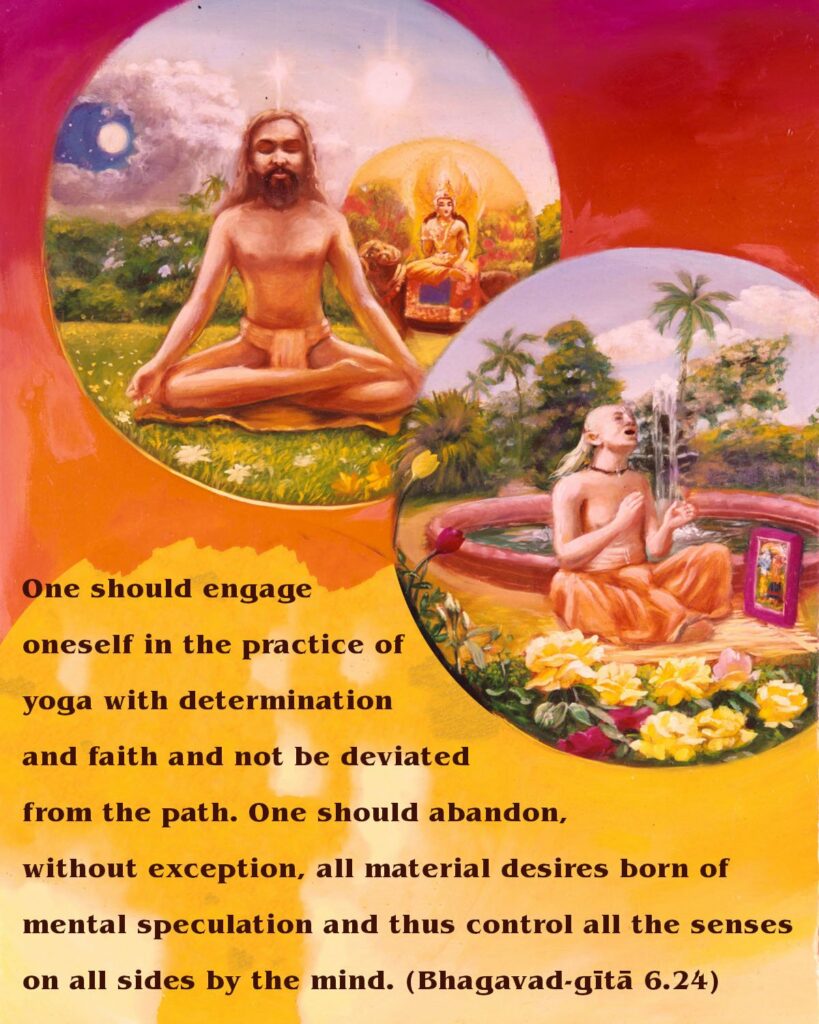
सङ्कल्पप्रभवान्कामांस्त्यक्त्वा सर्वानशेषत: |
मनसैवेन्द्रियग्रामं विनियम्य समन्तत: || 24||
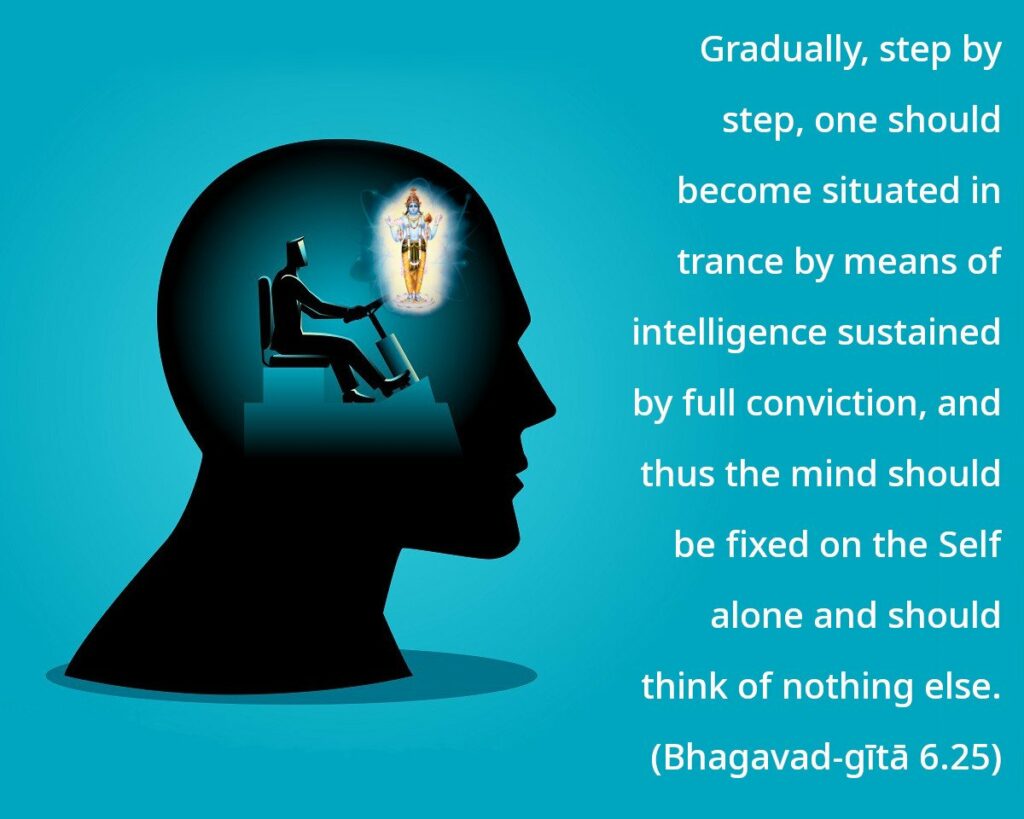
शनै: शनैरुपरमेद्बुद्ध्या धृतिगृहीतया |
आत्मसंस्थं मन: कृत्वा न किञ्चिदपि चिन्तयेत् || 25||
saṅkalpa-prabhavān kāmāns tyaktvā sarvān aśheṣhataḥ
manasaivendriya-grāmaṁ viniyamya samantataḥ
śhanaiḥ śhanair uparamed buddhyā dhṛiti-gṛihītayā
ātma-sansthaṁ manaḥ kṛitvā na kiñchid api chintayet
saṅkalpa—a resolve; prabhavān—born of; kāmān—desires; tyaktvā—having abandoned; sarvān—all; aśheṣhataḥ—completely; manasā—through the mind; eva—certainly; indriya-grāmam—the group of senses; viniyamya—restraining; samantataḥ—from all sides; śhanaiḥ—gradually; śhanaiḥ—gradually; uparamet—attain peace; buddhyā—by intellect; dhṛiti-gṛihītayā—achieved through determination of resolve that is in accordance with scriptures; ātma-sanstham—fixed in God; manaḥ—mind; kṛitvā—having made; na—not; kiñchit—anything; api—even; chintayet—should think of
Translation:
Having abandoned all desires born of the ego-centric will, having restrained the group of senses with mind from all sides, one should attain quietude slowly and slowly by the intellect held firmly. And then, fixing the mind in Atma, he should not think of anything else at all.
Commentary:
In the early part of this Discourse, the external aspects of meditation, like the place, the seat, and the posture, have been explained. Now, the Lord explains the internal process of Dhyana Yoga. In these two verses, Bhagavan gives perfect guidelines on withdrawing the mind and making it abide in the Self.
All the desires should be given up completely. What is the source of these desires? They are born of the ego-centric will (sankalpa). So desires are described as born from Sankalpa (samkalpa prabhavah). When there is no sankalpa (thought) there is no desire. By discrimination and dispassion, it is possible to root out Sankalpa. All desires without reservation should be given up completely. We have to note that whenever the Lord speaks of desires, he invariably refers to ‘all’ of them, because he knows that one desire leads to another, and that to a third, and they would extend to infinity if they are allowed to breed. So, the instruction is that all desires should be abandoned completely. When there are no desires, the mind is calm and collected and it can be made to rest in the Self. So for Dhyana Yoga abandoning g all desires is essential.
The whole group of senses should be restrained from all sides. Even here, the Lord insists on total restraint of all the senses, not partial control of all the senses or complete control of some of the senses. The words ‘indriyagramam’ and ‘samantatah’ show that in Dhyana Yoga total control of every one of the senses is essential. The mind is the instrument of control. The senses are like wild horses, and the mind is the strong rein to check their turbulent behaviour. If the mind is pure and godly, what can the senses do? They are automatically brought under control. If the mind is impure on account of past samskaras, then they draw the mind away from the spiritual path. So it is said ‘be controlled by purity of mind acquired through discrimination and dispassion’.
The aspirant should attain quietude by the intellect held firmly. This stillness or quietude is the effect of shutting out the external world by perfect sense-control. Intellect is higher than the mind (Manastu para buddhih). But the intellect will be powerless to assert itself if it does not function with firmness, courage, and determination. The rebellious mind will overpower the intellect and make it dance to its tune. If the mind is like a tiger, the intellect should be like the lion. Then only the mind yields to the immovable determining will of the intellect and turns inside to see the Self.
The process of sense-control and mind-control should be carried on slowly and slowly (sanaih-sanaih). Force should be avoided. The mind should be turned inwards by long slow steady practice. It should be persuaded and induced to get back to back its source, from the objective world where it has wandered about for many many lives without check or control or guidance. On account of past momentum, the mind runs out in spite of one’s best effort to stop it. One may hold it by violence, but it cannot be for long. Again when the control is relaxed, it runs in its old grooves. By violent repression, the inner personality may be damaged. So persuasion is the only way. Let the mind be told that what it is running after is after all a mirage, that if it turns inwards it would find a nobler and higher treasure, and that its external attachments have brought only pain and suffering. Thus thinking discriminating and reasoning the mind will gradually change its former attitude. As it finds rest and peace within, it would be induced to rest in the Self longer and longer. The practice should be carried on day after day, and only then the mind come to rest. Slow and steady wins the race.
The teaching of the Gita contains the essence of all sastras and the aim of all kinds of Sadhana. The mind should be fixed in Atma, and nothing else should be thought of. As the mind contemplates Atma, it is more and more absorbed in it, till finally it is dissolved like a bit of salt in the sea.
Dhyana in its highest stage is oneness with the object of meditation. So there is nothing other than Atma in that state. If the mind deviates from its aim even for a second, by the intrusion of some thought, Dhyana is interrupted. That is why the Lord declares that nothing other than Atma should be allowed to crop up in the mind during meditation.
This exhortation of the Gita should be remembered and thought of by all the seekers- “Establish the mind in Atma and do not think of anything else,” May this be practically realised by all earnest seekers on the spiritual path.
—–
—–
Sri Ramakrishna Says —
“The Naked One (Totapuri) mentioned that there were seven hundred Naga monks in their monastery. The beginners were taught to meditate while sitting on thick cushions, for a hard seat would be uncomfortable and the pain would divert their minds from God to the body. As they progressed in meditation, they were given less and less comfortable seats, and finally only an animal skin or the bare ground sufficed. In food and other matters also the same gradation was observed. In dress, for instance, they were trained by degrees to go without clothes. People from their very birth are fettered with the eightfold ties of shame, hatred, fear, pride of caste, good conduct, honour, and so on, so these monks were taught to renounce them one by one. After they were well-grounded in meditation, they were asked to roam from one holy place to another, first in the company of other monks and subsequently alone. Such was the method of training among the Nagas.” (Source: Sri Ramakrishna and His Divine Play)
(Similar to Sri Ramakrishna’s Saying “Sandhya merges in Gayatri and Gayatri merges in OM” & Swami Vivekananda Says that religion has three components Rituals, Mythology and Philosophy — It’s like going from Gross to the subtlest)
A PITHY UPADEŚA
Thayumanavar, the illustrious sage of Tamil Nadu, served his Guru for twelve years. In the twelfth year, the Guru announced that he was leaving the place but instructed his disciple to stay there. Holding onto the feet of the Guru, he pleaded, “Please, Master! Impart some teaching to me before you leave.” The Master said, “Be still,” and left. But that was all that was required. Those simple words—‘Be still’—were the disciple’s royal road to Realisation. He remained still, free of thoughts. (Source: Srimad Bhagavad Gita – Elixir of Eternal Wisdom | Vol 1)
Swami Sarvapriyananda Says —
Practice the smallest and start with the easiest.
Often, when we feel inspired after listening to a discourse, reading something uplifting, or observing others, we set very high goals for ourselves. The idea of waking up at 3.30 AM like sages feels powerful. But inspiration alone is not enough to sustain drastic change. The mind resists sudden, extreme shifts in routine.
The key mistake is trying to take a leap that is too big. When someone suddenly decides to wake up at 3.30 AM despite being used to waking much later, it may work for a day or two due to motivation. But very soon, the body and mind rebel. The result is not just failure, but a kind of inner discouragement. The mind then starts forming a negative belief: “I am not capable of this.” This is dangerous, because repeated failures weaken confidence and create self-doubt.
Instead of forcing a drastic change gradual progress is suggested. If someone wakes up at 8.30 AM, the first step is not 3.30 AM — it is 8.15 AM. This small, almost effortless shift builds a sense of success. After some days, another small step follows. Over time, these small changes accumulate into a significant transformation. This approach respects the natural rhythm of the mind and body.
There is also an important lesson here about consistency over intensity. Big, dramatic efforts often fail because they are unsustainable. But small, steady efforts create lasting habits. When the mind sees that something is achievable, it cooperates instead of resisting. Gradually, confidence builds, discipline strengthens, and what once seemed impossible becomes natural.
At a deeper level, this teaching reflects a universal principle i.e. real growth is incremental. Whether it is spiritual practice, studying, physical fitness, or emotional development, lasting change rarely comes from sudden leaps. It comes from patience, and steady effort. By starting small and staying consistent, one not only achieves the goal but also transforms the inner mindset.
Related Articles:
- In Him are woven heaven, earth and the space between and the mind with all the sense-organs. Know that non-dual Atman alone and give up all other talk. He is the bridge to Immortality. (Mundaka Upanishad 2.2.5)
Question: What are the conditions to be adopted by one practising Dhyana Yoga?
Answer: He should give up all desires completely. He should restrain the senses and the mind from all sides. He should turn the mind inwards by the control of the determined intellect and fix it in the Self. He should not think of anything other than Atma.
Question: From whence do desires arise?
Answer: Desires arise from the ego-centric will.
Question: What is the type of intellect needed for controlling the mind?
Answer: The intellect should be firm and undespondent.
Question: How should Dhyana be performed?
Answer: Dhyana on the Self should be done slowly and slowly.
Bhagavad Gita: Chapter 6 🔻 (47 Verses)