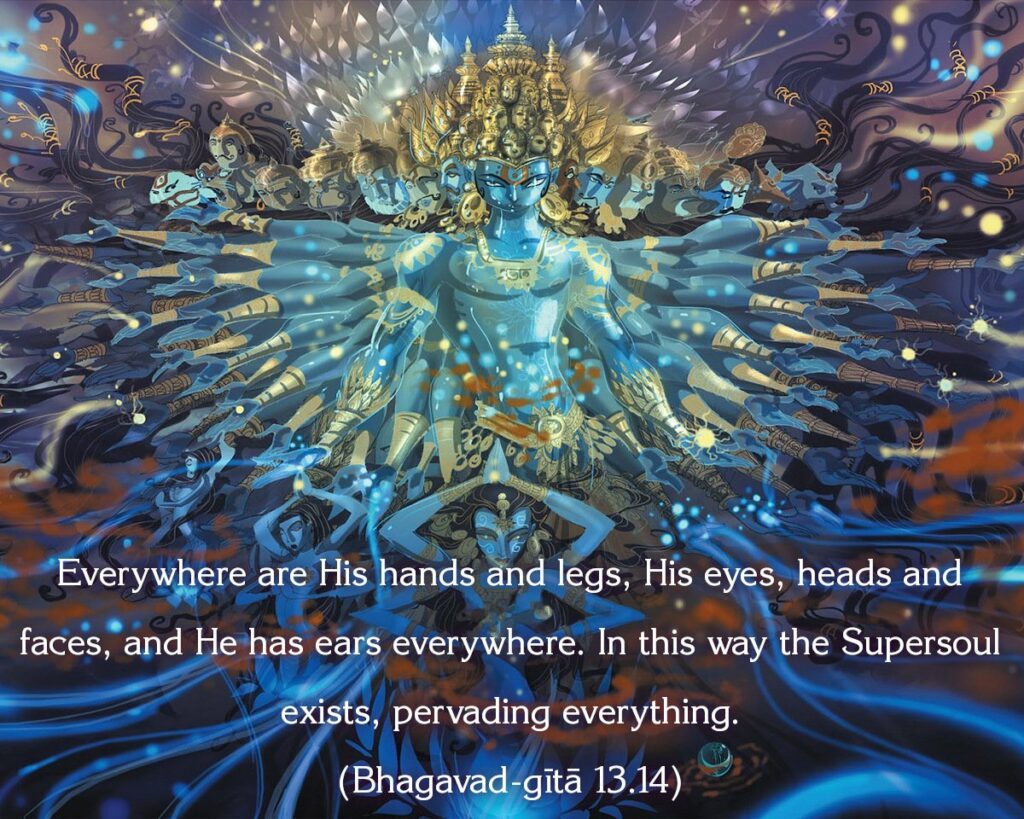
सर्वत: पाणिपादं तत्सर्वतोऽक्षिशिरोमुखम् |
सर्वत: श्रुतिमल्लोके सर्वमावृत्य तिष्ठति || 14||
sarvataḥ pāṇi-pādaṁ tat sarvato ’kṣhi-śhiro-mukham
sarvataḥ śhrutimal loke sarvam āvṛitya tiṣhṭhati
sarvataḥ—everywhere; pāṇi—hands; pādam—feet; tat—that; sarvataḥ—everywhere; akṣhi—eyes; śhiraḥ—heads; mukham—faces; sarvataḥ—everywhere; śhruti-mat—having ears; loke—in the universe; sarvam—everything; āvṛitya—pervades; tiṣhṭhati—exists
Translation:
Its hands and feet are everywhere; Its eyes, heads, and faces are everywhere; Its ears are everywhere; Its existence envelops all.
Commentary:
Brahman is described as having eyes, ears hands, feet, etc., everywhere, and as pervading the entire Universe. All that men do is witnessed directly by Paramatma and so it is man’s duty to follow Dharma in his life and conduct. Every thought generated in the mind is known to Paramatma, and so whatever thought of by man should be pure and good.
Where is God? The answer is He is everywhere. This verse states the ‘saguna’ aspect of Brahman, the all-pervasive cosmic intelligence, the basis and foundation by which the whole of the manifested universe is sustained.
sarvam avritya tishtati: Brahman pervades all the Universe. What pervades all should be more than the Universe that is pervaded. The Universe which is Drisya is just a fragment of Brahman.
Swami Vivekananda Says —
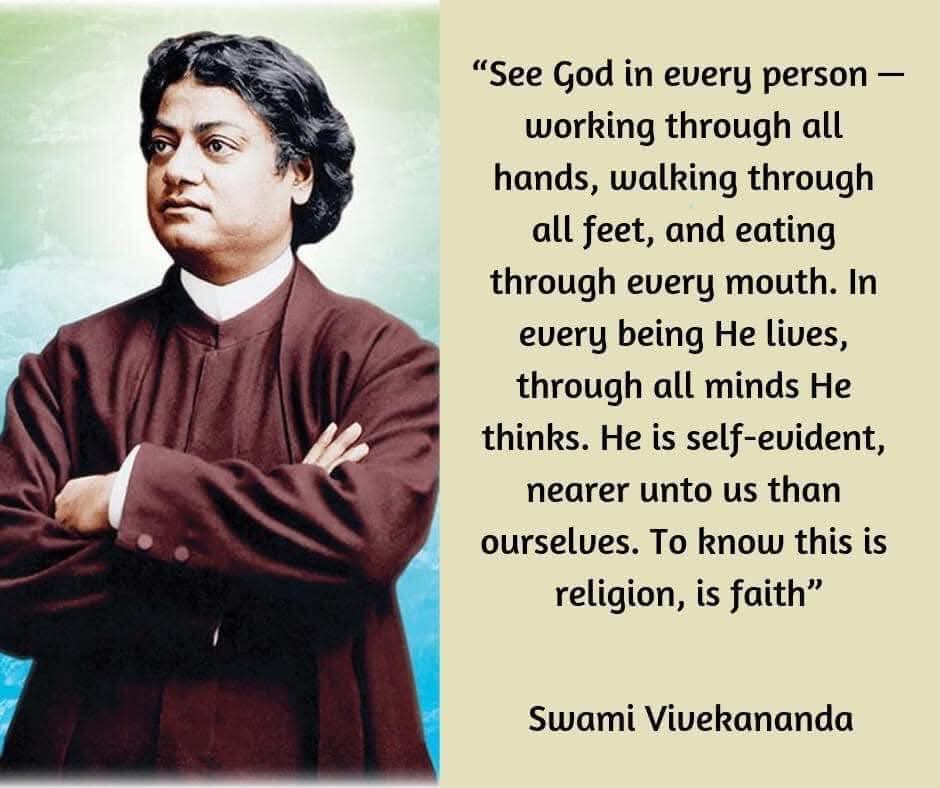
For the whole world is one; you are rated a very insignificant part of it, and therefore it is right for you that you should serve your millions of brothers rather than aggrandize this little self. “With hands and feet everywhere, with eyes, heads, and mouths everywhere, with ears everywhere in the universe, That exists pervading all.”[Source]
So give up being a slave. For the next fifty years this alone shall be our keynote — this, our great Mother India. Let all other vain gods disappear for the time from our minds. This is the only god that is awake, our own race — “everywhere his hands, everywhere his feet, everywhere his ears, he covers everything.” All other gods are sleeping. What vain gods shall we go after and yet cannot worship the god that we see all round us, the Virat? When we have worshipped this, we shall be able to worship all the other gods.[Source]
We must learn to feel ourselves as much in the sun, in the stars, as here. Spirit is beyond all time and space; every eye seeing is my eye; every mouth praising the Lord is my mouth; every sinner is I. We are confined nowhere, we are not body. The universe is our body. We are just the pure crystal reflecting all, but itself ever the same. We are magicians waving magic wands and creating scenes before us at will, but we have to go behind appearances and know the Self. This world is like water in a kettle, beginning to boil; first a bubble comes, then another, then many until all is in ebullition and passes away in steam. The great teachers are like the bubbles as they begin — here one, there one; but in the end every creature has to be a bubble and escape. Creation, ever new, will bring new water and go through the process all over again. Buddha and Christ are the two greatest “bubbles” the world has known. They were great souls who having realised freedom helped others to escape.[Source]
‘‘People are afraid that when they attain to it, when they realise that there is but One, the fountains of love will be dried up.… People never stop to think that those who bestowed the least thought on their own individualities have been the greatest workers in the world. Then alone a man loves when he finds that the object of his love is not any low, little, mortal thing. Then alone a man loves when he finds that the object of his love is not a clod of earth, but is the veritable God Himself. The wife will love the husband the more when she thinks that the husband is God Himself. The husband will love the wife the more when he knows that the wife is God Himself. That mother will love the children more who thinks that the children are God Himself. That man will love his greatest enemy who knows that that very enemy is God Himself. That man will love a holy man who knows that the holy man is God Himself, and that very man will also love the unholiest of men because he knows the background of that unholiest of men is even He, the Lord. Such a man becomes a world-mover for whom his little self is dead and God stands in its place. The whole universe will become transfigured to him.… Instead of being a prison-house, where we every day struggle and fight and compete for a morsel of bread, this universe will then be to us a playground. Beautiful will be this universe then! Such a man alone has the right to stand up and say, ‘How beautiful is this world!’ He alone has the right to say that it is all good. This will be the great good to the world resulting from such realisation, that instead of this world going on with all its friction and clashing, if all mankind today realise only a bit of that great truth, the aspect of the whole world will be changed, and in place of fighting and quarrelling, there would be a reign of peace.
‘‘If one-millionth part of the men and women who live in this world simply sit down and for a few minutes say, ‘You are all God, O ye men, and O ye animals, and living beings, you are all the manifestations of the one living Deity!’ the whole world will be changed in half an hour. Instead of throwing tremendous bombshells of hatred into every corner, instead of projecting currents of jealousy and of evil thought, in every country people will think that it is all He.’’[Source]
“Do you know what I see? I see Him as all. Men and other creatures appear to me only as hollow forms, moving their heads and hands and feet, but within is the Lord Himself.” – Sri Ramakrishna
From Purusha Suktam and Narayana Suktam
सहस्रशीर्षा पुरुषः सहस्राक्षः सहस्रपात् ।
स भूमिं विश्वतो वृत्वात्यतिष्ठद्दशाङुलम् ॥
Sahasra-Shiirssaa Purussah Sahasra-Akssah Sahasra-Paat |
Sa Bhuumim Vishvato Vrtva-Atya[i]-Tisstthad-Dasha-Angulam ||The Purusha has thousand heads,
He has thousand eyes,
He has thousand feet,
He is spread all over the universe,
And is beyond the count with ten fingers.
(Source: Purusha Suktam)Veda Purusha is said to have ‘Thousand’ heads, ‘Thousand’ eyes etc. Here Thousand doesn’t mean just 1000. Thousand(Sahasra) implies almost infinite but technically speaking we cannot use the word ‘Infinite’ because the number of living beings in the creation is not infinite. There must be a certain number. But human language is not sufficient even to name the figure. For some ‘Mystical’ reason, the Rishis used the words ‘Sata‘(100) and ‘Sahasra‘(1000) not only for the respective figures but also to denote “uncountable” in number. Scriptures say that God has uncountable names and all names are his names. But still we use ‘Satanama‘ and ‘sahasranamas‘ while worshiping God. The words ‘Sata and ‘Sahasra‘ are not meant for restricting it to 100 or 1000 but to convey the ‘Wholeness’.
This verse explains the unity of all living beings. Even though, the external world appears with several living entities, the underlying principle(i.e., Lord Rudra) in all the beings is only one. The Self or Atman or Purusha is same in all. All hands, all legs, all heads of all living entities are hands/legs/heads of One Purusha.
—–
Sahasra seersham devam viswaksham viswa sambhuvam.
Viswam narayanam devam aksharam paramam padam.
I meditate on god Narayana,
Who has thousands of heads,
Who sees everywhere,
Who does good to all the world,
Who is the world,
Who is indestructible,
And who is the greatest destination.
(Source: Narayana Suktam)
Related Articles:
- The sage harmonised in yoga sees the Self in all beings, and all beings in the Self; he sees the same everywhere. (BG 6.29)
- He who sees Me in all beings and all beings in me never becomes lost to me, nor do I become lost to him. (BG 6.30)
- The Yogi who worships Me abiding in all beings and who is established in unity abides in me in whatever manner he is acting. (BG 6.31)
- He who sees the Supreme Lord abiding alike in all beings, and not perishing when they perish— verily he alone sees. (BG 13.28)
- O Arjuna! Having obtained this knowledge, you will not thus be deluded again and by this Knowledge, you will see all beings in your Self and also in Me. (BG 4.35)
- The wise man beholds all beings in the Self and the Self in all beings; for that reason he does not hate anyone. (Isha Upanishad, Verse 6)
- Seeing the Atman in all beings, and all beings in the Atman, one attains the highest Brahman – not by any other means. (Kaivalya Upanishad, Verse 10)
- See God in All
Bhagavad Gita: Chapter 13 🔻 (35 Verses)