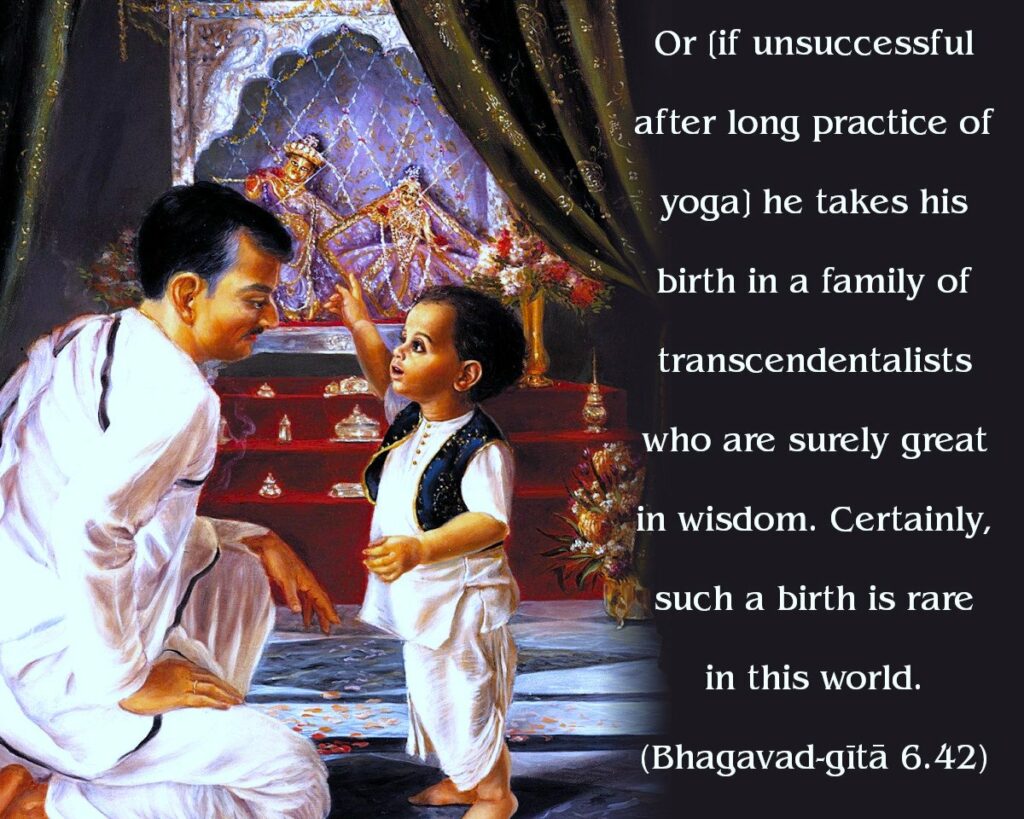
अथवा योगिनामेव कुले भवति धीमताम् |
एतद्धि दुर्लभतरं लोके जन्म यदीदृशम् || 42||
atha vā yoginām eva kule bhavati dhīmatām
etad dhi durlabhataraṁ loke janma yad īdṛiśham
atha vā—else; yoginām—of those endowed with divine wisdom; eva—certainly; kule—in the family; bhavati—take birth; dhī-matām—of the wise; etat—this; hi—certainly; durlabha-taram—very rare; loke—in this world; janma—birth; yat—which; īdṛiśham—like this
Translation:
Or he is born into a family of yogis rich in wisdom. Verily, such a birth is hard to gain in this world.
Commentary:
The verse refers to aspirants who have reached higher levels of yoga. They are superior to the common yogabhrashta. And hence, they are born in the family of wise yogis. Such a birth, says the Lord is very difficult to attain because they are men of knowledge having reached the Atmic state, and being born as children of the wise provides the best opportunity for self-realisation. We find that mighty spiritual men were born to parents who had done a great ‘tapas‘. The atmosphere in such homes is saturated with divine fragrance. They breathe the atmosphere and feel the very presence of God. What more does the aspirant require to complete his yoga and attain perfection?
People wish to be born in the lineage of kings, princes, and millionaires. Of what avail is it except to get further entangled in the meshes of Maya, and suffer the inevitable penalties of earthly life? The wise man desires to be born in the line of yogis so that he could attain perfection in the shortest possible time. The Lord declares here that birth in the family of yogis is very difficult to attain (Durlabhataram).
FAMILY-LIFE AFTER SANNYĀSA
The Vārkari-Vitthala-sampradāya in Maharashtra has a remarkable history behind it. The great movement happened through Jnaneswara. He was born to Vitthal Pant, a highly evolved soul. Vitthal Pant got married to a pious soul. Soon after, driven by tremendous vairāgya, he renounced home without telling his wife. He went to Kasi and took sannyāsa from Swami Ramananda. In due course, the Master learned that Vitthal Pant had left his wife without her permission. Intuiting that his destiny was to live a family life, the Guru ordered him to go back home to his wife and resume the life of a householder.
Vitthal Pant came back to Alandi in Maharashtra and re-joined his wife. This was against the scriptures since a sannyāsin who has renounced everything and everyone in this world is not allowed to take up family life once again. This was unpalatable for the traditional orthodox society, and they ostracised Vitthal Pant. Vitthal Pant and his family had to suffer much humiliation due to this. Four children were born to this yogi who had re-entered family life. The first son was Nivrttinath—which meant renunciation; the second son was Jnaneswara—the Lord of Jñāna, the third was Sopanadev—the spiritual ladder; and the fourth, a daughter, was Mukta—the free soul. (The children’s names indicate the spiritual states of their father.) All four children were jīvanmuktas. This happened by Divine Will in order to prepare a field for these four great souls to take birth. This is an example of yogī-kula. (Source: Srimad Bhagavad Gita – Elixir of Eternal Wisdom | Vol 1)
Question: What is the future of the yogi of high caliber?
Answer: He is born into a family of the yogis. The idea is that even from childhood he practices yoga and attains perfection more easily and more quickly than others.
Question: What is the best birth for an individual?
Answer: Birth in the family of Jnanis and Yogis is the best.
Bhagavad Gita: Chapter 6 🔻 (47 Verses)