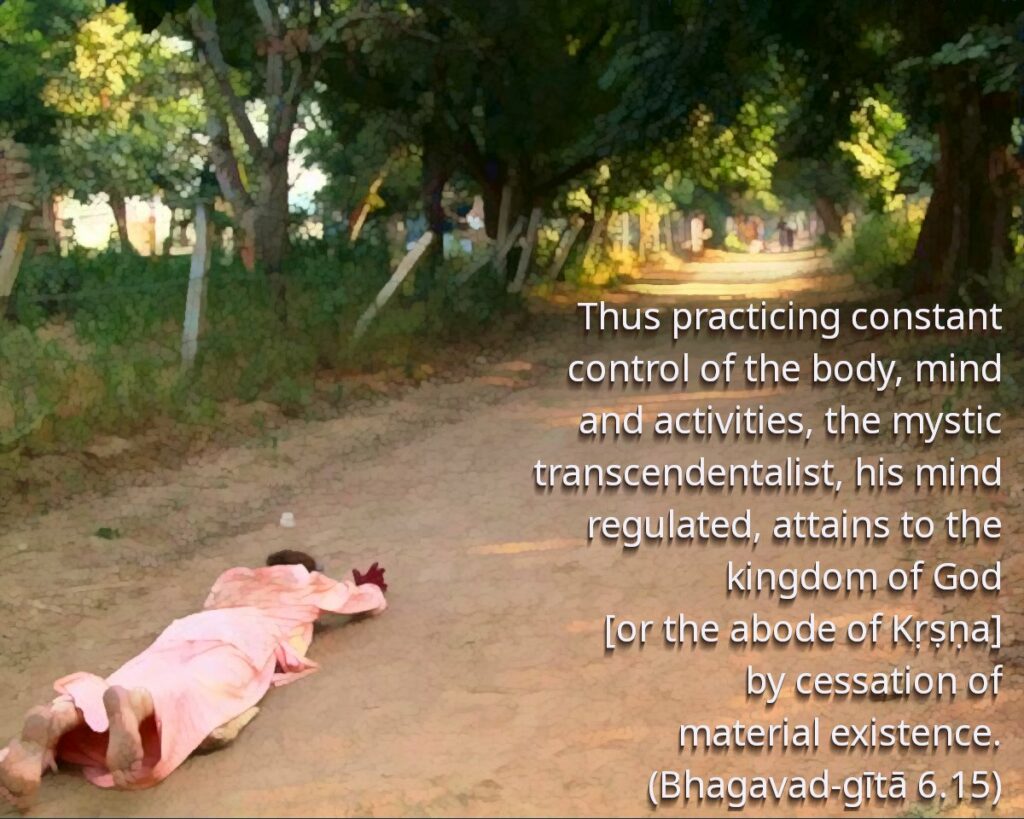
युञ्जन्नेवं सदात्मानं योगी नियतमानस: |
शान्तिं निर्वाणपरमां मत्संस्थामधिगच्छति || 15||
yuñjann evaṁ sadātmānaṁ yogī niyata-mānasaḥ
śhāntiṁ nirvāṇa-paramāṁ mat-sansthām adhigachchhati
yuñjan—keeping the mind absorbed in God; evam—thus; sadā—constantly; ātmānam—the mind; yogī—a yogi; niyata-mānasaḥ—one with a disciplined mind; śhāntim—peace; nirvāṇa—liberation from the material bondage; paramām—supreme; mat-sansthām—abides in me; adhigachchhati—attains
Translation:
Thus the self-controlled Yogi holding the mind in meditation on the Self, attains peace abiding in me which culminates in the highest bliss of liberation.
Commentary:
Dhyana yoga leads to supreme peace and liberation. It is the peace of the Self, of the very nature of the Lord. It is not like the passing delights and pleasures of worldly life. The wise men seek the highest everlasting peace only. Self-control and continuous practice of meditation is necessary to attain such peace and bliss. So the seeker should carry on the sadhana, by constant discrimination by the rejection of the unreal, and by fixing the mind on the eternal Self. That is the price to pay for attaining the highest bliss of liberation.
—–
SWAMI TAPOVAN AND RAMANA BHAGAVAN
Swami Tapovan Maharaj, who is considered a mighty jīvanmukta, lived in Uttarkashi for many years. During his younger days as a seeker, he went to see Bhagavan Ramana Maharshi, who was then residing in Virupaksha cave in Arunachala. This brahmachari was a highly evolved soul. He had already listened to Vedanta and was in a state of deep contemplation—manana and nididhyāsana. Though the Maharshi did not speak, the mind of the brahmachari entered a state of deep peace in the presence of Maharshi. He stayed there for a few hours and then took leave. In his nididhyāsana in the presence of Maharshi, a great insight came to him that the real nature of the Self is Peace—“śāntoyam ātmā,” as stated by the Upanishads. A deep confirmation happened within him that Peace is Brahman; Peace is Samādhi; Peace is Liberation; Peace is Nirvāṇa. He walked out of Virupaksha cave that day, established in that Peace. (Source: Srimad Bhagavad Gita – Elixir of Eternal Wisdom | Vol 1)
Question: What is the fruit of Dhyana yoga?
Answer: Supreme peace and bliss.
Question: What is its nature?
Answer: It is liberation, Moksha, which is the very nature of the Self, the supreme Lord.
Question: What should the sadhaka do to attain this peace?
Answer: He should control the mind and hold it in meditation on the Self.
Bhagavad Gita: Chapter 6 🔻 (47 Verses)