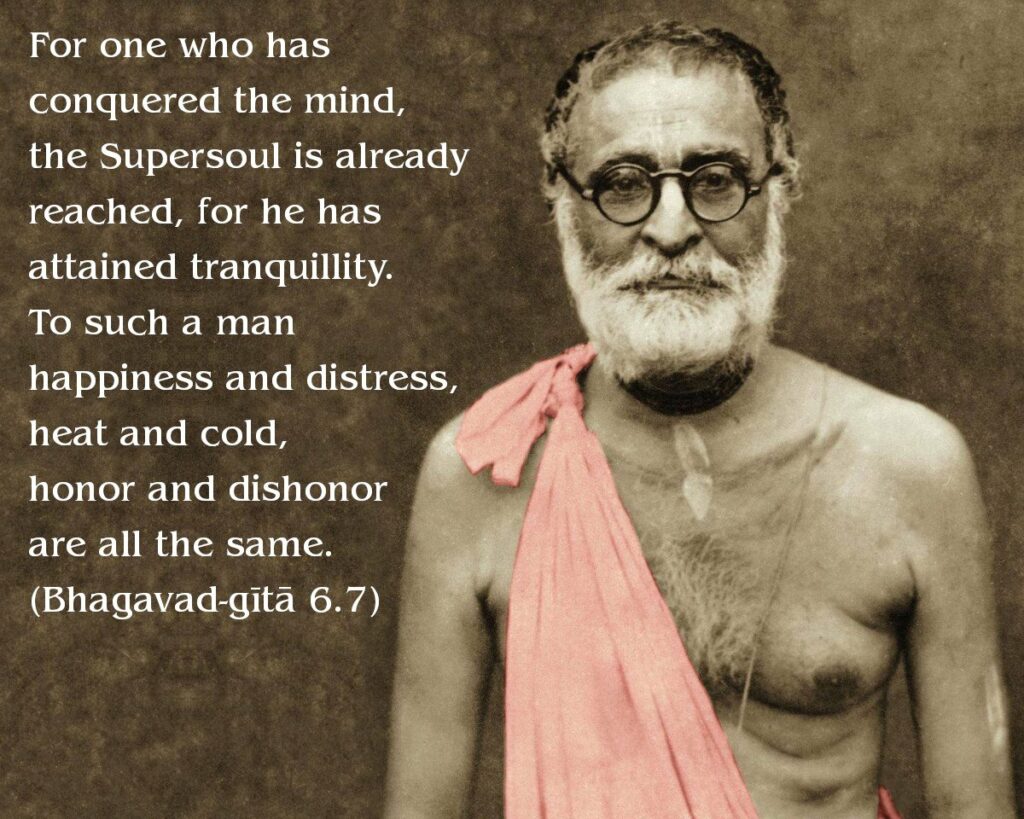
जितात्मन: प्रशान्तस्य परमात्मा समाहित: |
शीतोष्णसुखदु:खेषु तथा मानापमानयो: || 7||
jitātmanaḥ praśhāntasya paramātmā samāhitaḥ
śhītoṣhṇa-sukha-duḥkheṣhu tathā mānāpamānayoḥ
jita-ātmanaḥ—one who has conquered one’s mind; praśhāntasya—of the peaceful; parama-ātmā—God; samāhitaḥ—steadfast; śhīta—in cold; uṣhṇa—heat; sukha—happiness; duḥkheṣhu—in distress; tathā—also; māna—in honor; apamānayoḥ—and dishonor
Translation:
The man who has subdued the mind and is full of peace experiences the Supreme Self under all conditions in heat and cold, pleasure and pain, honour and dishonour. (The mind of such a man experiences the Self under all conditions).
Commentary:
The ill-regulated mind of the common man is upset by the pains of opposites, heat and cold, pleasure and pain, honour and disgrace. Proud in the hour of praise, sullen in the hour of shame, elated in the hour of pleasure, depressed in the hour of pain, the mind goes through a constant wheel of different moods and passions. Every moment of life causes a peculiar change in mind. The ignorant man lives and dies under the sway of the turbulent and disturbed mind. He is never peaceful. Peace is the result of a restful state of mind. When the mind is in a state of restless ecstasy, there can be no taste of peace at all. But the mind of the sage is different. It is always in a state of balance, whatever changes may be happening outside, and rests in the infinite peace of Atma. As little waves and ripples of wind cannot shake a huge mountain, the pairs of opposites cannot move the man who has subdued the mind. He is always established in the Self and enjoys the bliss of Self. So by constant practice, the seeker has to keep the mind in a condition of immovable stability.
—–
A UNIQUE WAY TO TRANSCEND SUFFERING
On a hot summer’s day, Jagadeesa Sastri, a scholarly devotee of Bhagavan Ramana Maharshi, was walking with the Sage on the hill. They were trapped between two shelters about two kilometres apart up the hill. Both of them were walking barefoot. The Sage walked along unaffected, but Jagadeesa Sastri could not endure the scorching heat; he felt he was being put in a cauldron. He prayed to his sat-guru, “O Bhagavan! How can I come out of this situation?” Maharshi said, “Meditate that the heat you are experiencing, the Sun, your body, everything is one. Every experience arises in the Self and subsides in the Self. Even when you are undergoing this suffering, it is nothing but the experience of the Self.” The Sage then asked him, “You are feeling the heat; do you think the Sun will feel the heat? Know that you are the Sun. Do not identify with this body.” Saying this, the Sage whispered, ‘sūryo’ham—I am the Sun’. This worked like a mystic mantra. The scholarly devotee absorbed the state of the Sage into his being. The meditation, ‘I am the Sun’—was set into a current. From that day on, he became free of the affliction of heat. (Source: Srimad Bhagavad Gita – Elixir of Eternal Wisdom | Vol 1)
Question: Who is it that remains unmoved by the pairs of opposites?
Answer: The sage who has conquered the mind is not affected by the pairs of opposites. His mind rests peacefully in the Seif.
Bhagavad Gita: Chapter 6 🔻 (47 Verses)