सखेति मत्वा प्रसभं यदुक्तं
हे कृष्ण हे यादव हे सखेति |
अजानता महिमानं तवेदं
मया प्रमादात्प्रणयेन वापि || 41||
यच्चावहासार्थमसत्कृतोऽसि
विहारशय्यासनभोजनेषु |
एकोऽथवाप्यच्युत तत्समक्षं
तत्क्षामये त्वामहमप्रमेयम् || 42||
sakheti matvā prasabhaṁ yad uktaṁ
he kṛiṣhṇa he yādava he sakheti
ajānatā mahimānaṁ tavedaṁ
mayā pramādāt praṇayena vāpi
yach chāvahāsārtham asat-kṛito ’si
vihāra-śhayyāsana-bhojaneṣhu
eko ’tha vāpy achyuta tat-samakṣhaṁ
tat kṣhāmaye tvām aham aprameyam
sakhā—friend; iti—as; matvā—thinking; prasabham—presumptuously; yat—whatever; uktam—addressed; he kṛiṣhṇa—O Shree Krishna; he yādava—O Shree Krishna, who was born in the Yadu clan; he sakhe—O my dear friend; iti—thus; ajānatā—in ignorance; mahimānam—majesty; tava—your; idam—this; mayā—by me; pramādāt—out of negligence; praṇayena—out of affection; vā api—or else; yat—whatever; cha—also; avahāsa-artham—humorously; asat-kṛitaḥ—disrespectfully; asi—you were; vihāra—while at play; śhayyā—while resting; āsana—while sitting; bhojaneṣhu—while eating; ekaḥ—(when) alone; athavā—or; api—even; achyuta—Krishna, the infallible one; tat-samakṣham—before others; tat—all that; kṣhāmaye—beg for forgiveness; tvām—from you; aham—I; aprameyam—immeasurable
Translation:
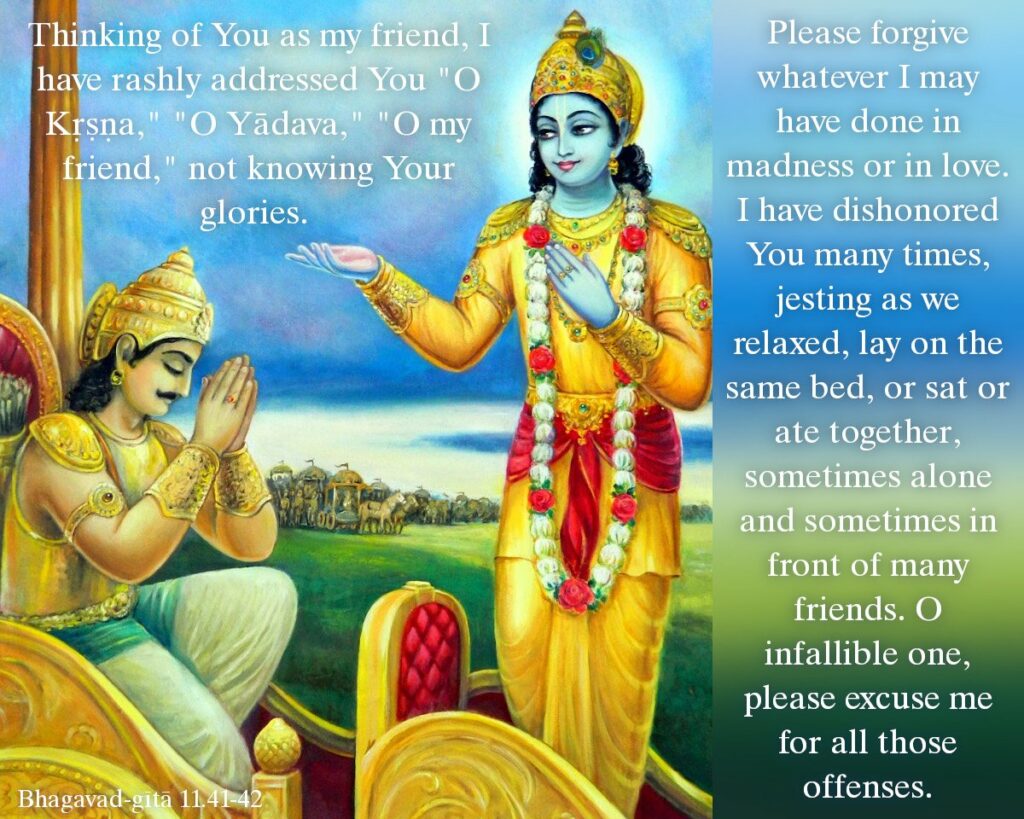
Whatever I have rashly said from inadvertence or love, addressing Thee as “O Krishna,” “O Yādava,” or “O Friend,” regarding Thee merely as a friend, unaware of Thy greatness; and in whatever other ways I may have shown disrespect to Thee while playing or resting, while sitting or eating, while alone, Ο Eternal Lord, or in the presence of others— all that I implore Thee, Ο Immeasurable, to forgive.
Commentary:
ARJUNA’S CLOSENESS WITH SRI KRISHNA
In the Udyoga parva of the Mahabharata, there is a scene in which Sanjaya comes to visit the Pandavas as a messenger from the Kaurava camp. As he enters Arjuna’s room, what he sees shocks him—Arjuna is lying down with his legs resting on the lap of Sri Krishna! What could have been more illustrative of the intimacy that existed between them? As soon as Sanjaya sees this, he returns and tells Dhritarashtra, “O King! Your son has no hope of winning the war. He is finished!” Now, looking back at such behaviour, Arjuna is in tears! This is why he says, śayyā—while lying down.
Arjuna says, “How many times have I simply called you Krishna, Yadava! Please forgive my ignorance. I have been very casual with You, O Bhagavan, sometimes in jest, while at play, while reposing, simply sitting or at mealtimes. I could have been spiritually blessed by Your presence on those innumerable occasions, but I just wasted them. I have behaved without due respect to You, O Lord, thinking of You casually as my friend. It was sheer ignorance! Please forgive me.” (Source: Srimad Bhagavad Gita – Elixir of Eternal Wisdom | Vol 1)
Bhagavad Gita: Chapter 11 🔻 (55 Verses)
| 01 | 02 | 03 | 04 | 05 | 06 | 07 | 08 | 09 | 10 |
| 11 | 12 | 13 | 14 | 15 | 16 | 17 | 18 | 19 | 20 |
| 21 | 22 | 23 | 24 | 25 | 26 | 27 | 28 | 29 | 30 |
| 31 | 32 | 33 | 34 | 35 | 36 | 37 | 38 | 39 | 40 |
| 41 | 42 | 43 | 44 | 45 | 46 | 47 | 48 | 49 | 50 |
| 51 | 52 | 53 | 54 | 55 |