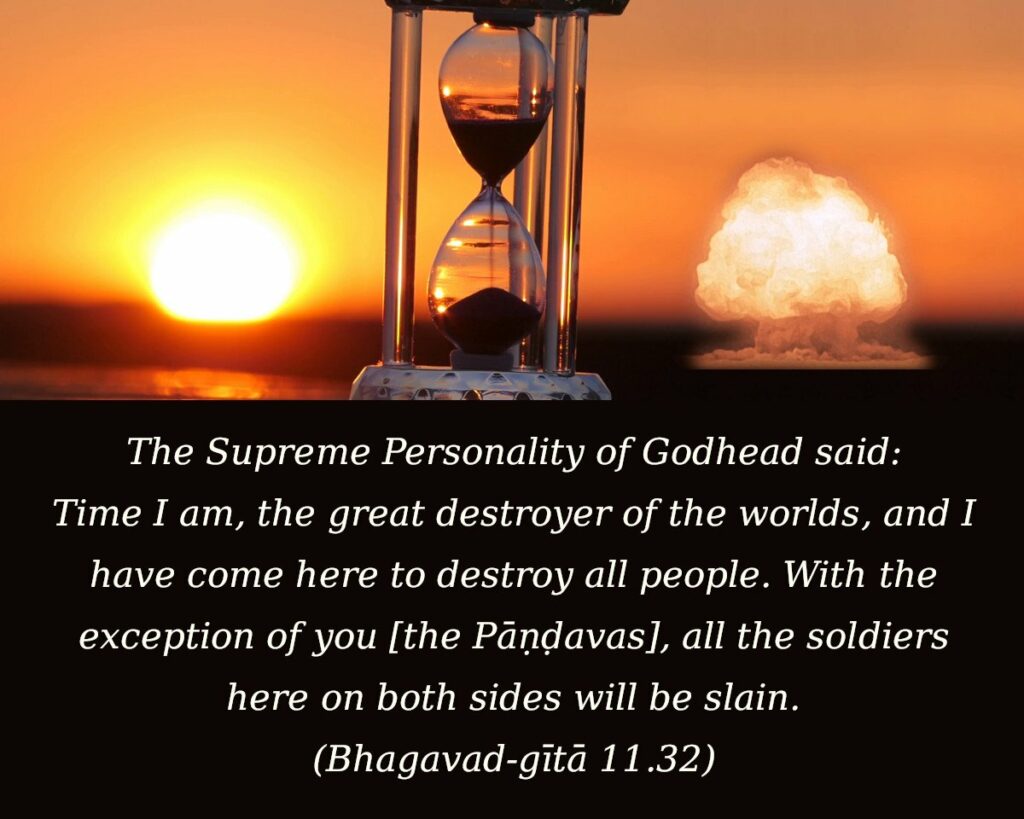
श्रीभगवानुवाच |
कालोऽस्मि लोकक्षयकृत्प्रवृद्धो
लोकान्समाहर्तुमिह प्रवृत्त: |
ऋतेऽपि त्वां न भविष्यन्ति सर्वे
येऽवस्थिता: प्रत्यनीकेषु योधा: || 32||
śhrī-bhagavān uvācha
kālo ’smi loka-kṣhaya-kṛit pravṛiddho
lokān samāhartum iha pravṛittaḥ
ṛite ’pi tvāṁ na bhaviṣhyanti sarve
ye ’vasthitāḥ pratyanīkeṣhu yodhāḥ
śhrī-bhagavān uvācha—the Supreme Lord said; kālaḥ—time; asmi—I am; loka-kṣhaya-kṛit—the source of destruction of the worlds; pravṛiddhaḥ—mighty; lokān—the worlds; samāhartum—annihilation; iha—this world; pravṛittaḥ—participation; ṛite—without; api—even; tvām—you; na bhaviṣhyanti—shall cease to exist; sarve—all; ye—who; avasthitāḥ—arrayed; prati-anīkeṣhu—in the opposing army; yodhāḥ—the warriors
Translation:
The Lord said: I am mighty, world-destroying Time, now engaged here in slaying these men. Even without you, all these warriors standing arrayed in the opposing armies shall not live.
Commentary:
—–
In late 1909, Advaitananda, an all-renouncing sannyasin of the Master, made himself ready to depart from this world. He had suffered from stomach trouble off and on, and towards the end he had a fever. Dr. Matilal Mukhopadhyay of Ghusuri, Howrah, was his physician and all the monks served their old brother with loving care. One day the swami stood in front of Sri Ramakrishna’s picture and prayed, “Master, please release me from this pain.” The Master soon answered the prayer of his old disciple. Swami Premananda later said: “Before his death Gopal-da saw the Master carrying a mace on his shoulder. He then asked, ‘Master, why are you carrying the mace on your shoulder?’ The Master replied: ‘I am Gadadhar [literally, “Upholder of the Mace,” an epithet of Lord Vishnu. Gadadhar was also Sri Ramakrishna’s childhood name]. In this age I shall rebuild after destroying everything.’” Truly, Sri Ramakrishna was born in this modern time to destroy doubt and delusion from the minds of the people. (Source: God Lived with Them)
RAMANA MAHARSHI ON REBIRTH
This verse sprang into many a mind when the first atomic bomb exploded in Japan. It was like a revelation to the whole world as to how a single minute atom could unleash so much destruction. The power of kāla was revealed there. kāla means time and also the god of death. In fact, both are one and the same. When the Timeless happens within time, it is called birth, which is the beginning of death as well. Death begins right from the moment of birth. The moment we start identifying with the body, death has started, and the moment we give up the body-identity, death is no more. When someone asked about rebirth to Bhagavan Sri Ramana Maharshi, the Sage said, “Even now, if you know yourself, you will understand that you have no body. Then why discuss taking another body?” (Source: Srimad Bhagavad Gita – Elixir of Eternal Wisdom | Vol 1)
RAMA’S RESPONSE TO BHARATA
In the Ramayana, when Bharata prays to Rama to return and to sit on the throne, Rama retorts, “What avails this throne or this dynasty! Many are the dynasties that have been wiped off the face of this earth. Unnumbered palaces have crumbled down, leaving no trace. Uncountable are the great ones who are no more to be found. They are all gone. You and I are just travellers meeting on the way like two twigs being taken along in the flow of a river. When there comes a sudden surge of water in between, we get separated, and no more do we meet. This is life.” This is the perfect understanding of kāla. We often see in our own lives that we meet many people and think that they are our closest and most intimate ones, yet suddenly, we get separated, and after that, perhaps, we may never meet them again in this lifetime. (Source: Srimad Bhagavad Gita – Elixir of Eternal Wisdom | Vol 1)
Bhagavad Gita: Chapter 11 🔻 (55 Verses)
| 01 | 02 | 03 | 04 | 05 | 06 | 07 | 08 | 09 | 10 |
| 11 | 12 | 13 | 14 | 15 | 16 | 17 | 18 | 19 | 20 |
| 21 | 22 | 23 | 24 | 25 | 26 | 27 | 28 | 29 | 30 |
| 31 | 32 | 33 | 34 | 35 | 36 | 37 | 38 | 39 | 40 |
| 41 | 42 | 43 | 44 | 45 | 46 | 47 | 48 | 49 | 50 |
| 51 | 52 | 53 | 54 | 55 |