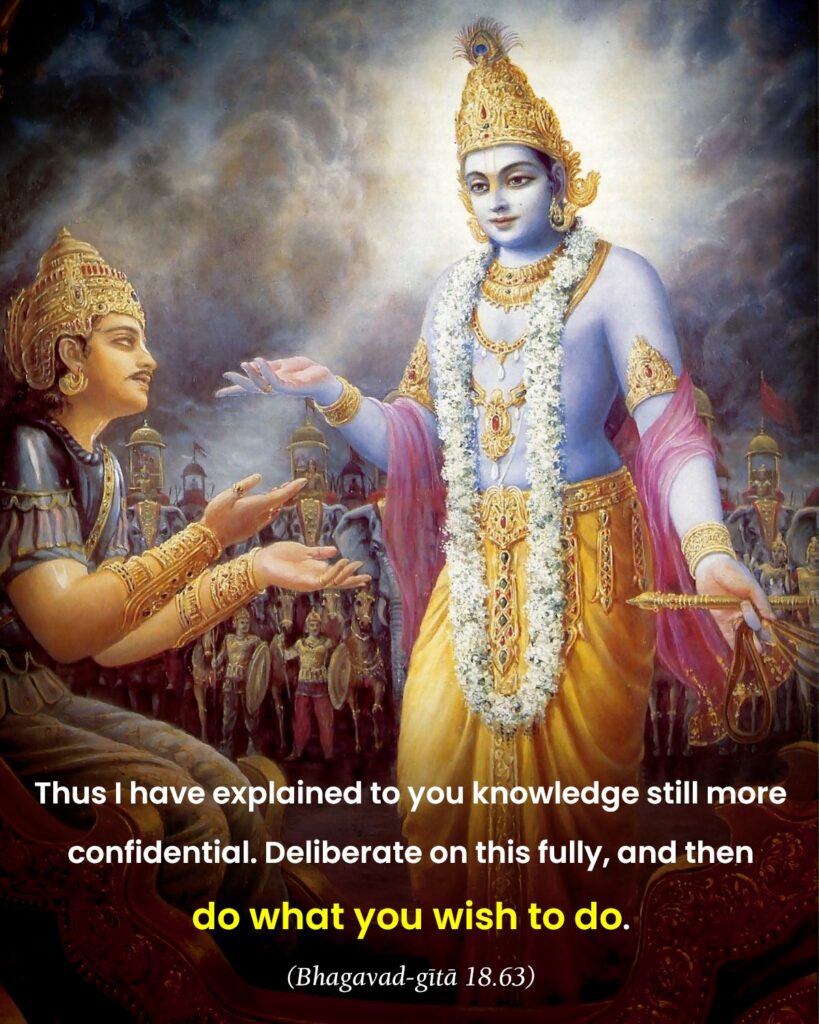
इति ते ज्ञानमाख्यातं गुह्याद्गुह्यतरं मया |
विमृश्यैतदशेषेण यथेच्छसि तथा कुरु || 63||
iti te jñānam ākhyātaṁ guhyād guhyataraṁ mayā
vimṛiśhyaitad aśheṣheṇa yathechchhasi tathā kuru
iti—thus; te—to you; jñānam—knowledge; ākhyātam—explained; guhyāt—than secret knowledge; guhya-taram—still more secret knowledge; mayā—by me; vimṛiśhya—pondering; etat—on this; aśheṣheṇa—completely; yathā—as; ichchhasi—you wish; tathā—so; kuru—do
Translation:
Thus, I have explained to you this knowledge that is more secret than all secrets. Ponder over it deeply, and then do as you wish.
Commentary:
The Lord describes the Gita-Sastra as the most secret of all knowledge. The teachings of this wisdom should be communicated only to such disciples who are qualified to receive it. Arjuna was qualified to receive it by virtue of his great devotion to Krishna, and the virtuous qualities (Daivisampat) that he possessed. Lord Krishna has thereby done a great service to mankind. Even for learning any worldly skill or art, a great deal of preparation is necessary for the student. When that is so, what amount of internal and external preparation is necessary for receiving this highest wisdom, one can easily understand. So the Lord declares that he has taught the most secret wisdom to Arjuna, just because he is fit to receive it, and finds it most necessary in the circumstances in which he is placed.
Vimrisyaita daseshena: Fully reflecting over it. It is the practice of all great teachers to give all that the disciple wants by way of teaching and instruction, and finally leave it to the disciple to decide what he should do, and how he should act. Only the narrow-minded teacher insists on the disciple to accept what he says without doubt or question. On the other hand, the great teachers give complete freedom of thought and reflection to the disciples. Man has to make a free choice of his course of action according to his own nature. The disciple should Know and feel the truth of what was taught to him. Then only he derives the full benefit of the master’s teaching. We see in this context how broad-minded the Lord was when he left the freedom of choice to Arjuna himself. Arjuna was one of the greatest devotees of Krishna. Krishna’s word was law unto him. If Lord Krishna wanted Arjuna to fight in the form of a command, Arjuna would have immediately acted up without any hesitation. But the Lord takes a different view. After giving the full message of wisdom, the Lord asks Arjuna to reflect over it, think well and deeply, and come to a voluntary decision. Such a decision would ultimately benefit him much more than a mere verbal command from the teacher. The final decision is left entirely to the individual.
Yadhecchasi tadha Kuru: Act as you wish. The Lord simply explained the position to Arjuna. That is all. He has nothing more to say. The disciple is free to take it or leave it. Here is a great example of Nishkama-karma. Having taught the Gita Sastra, the Lord leaves it without a thought of the fruit of his action. Although the main objective of the Lord is to make Arjuna fight the battle, He remains unconcerned about the result of his message. The Lord seems to say “you may fight or you may not. That is your decision, not mine. I have taught you the essence of all the Vedas, and it is your duty in the present situation, to take it or leave it. I am unconcerned”. Such is the way how great teachers act in respect of their disciples. Their message is delivered in a simple and powerful way. They pass on, leaving it to the people to think about it, draw their own conclusions and come to their own decision. This is an example of Nishkama-karma with which the scripture comes to a close.
Jnanam akhyyatam: Although in the Gita Sastra, the Lord has dealt with Karma, Bhakti, Dhyana, etc., they are all implied in the simple word wisdom (Jnana). The various paths culminate in Jnana. They are all intended to purify the mind gradually, and the mind so purified by the practice of Karma and Bhakti etc., acquires Jnana by which man attains the highest goal of Moksha. Karma and Bhakti are stepping stones to Jnana. Jnana is the peak point of realisation.
Swami Vivekananda Says —
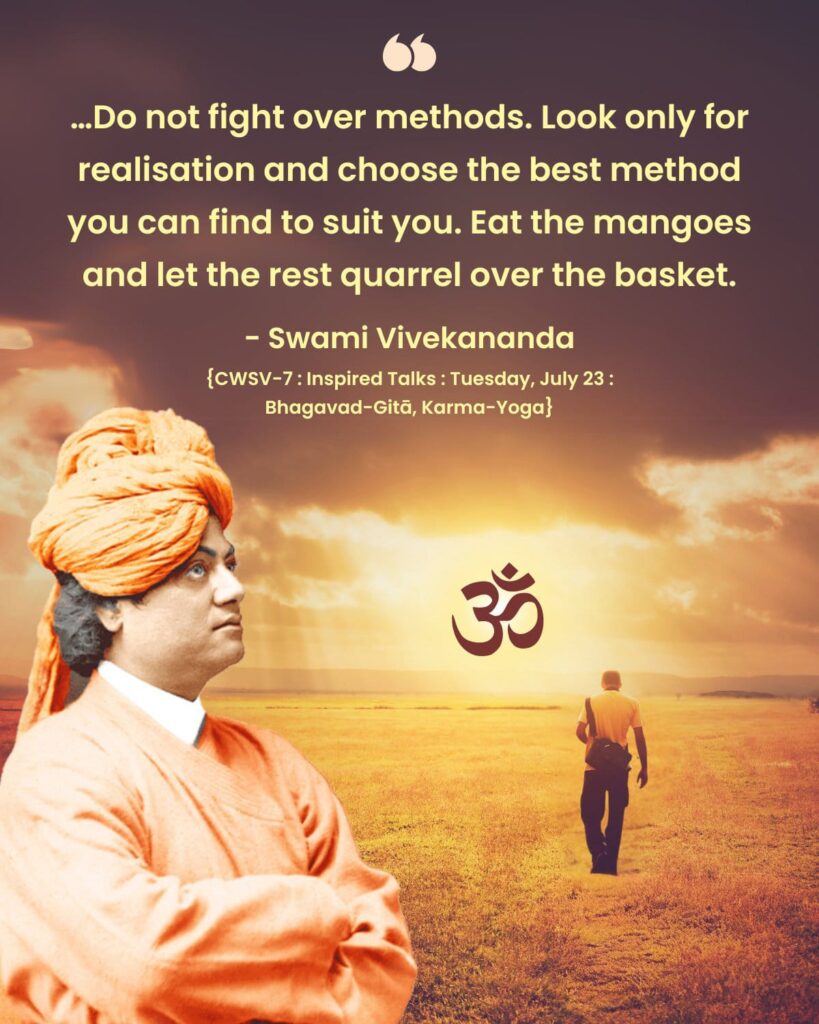
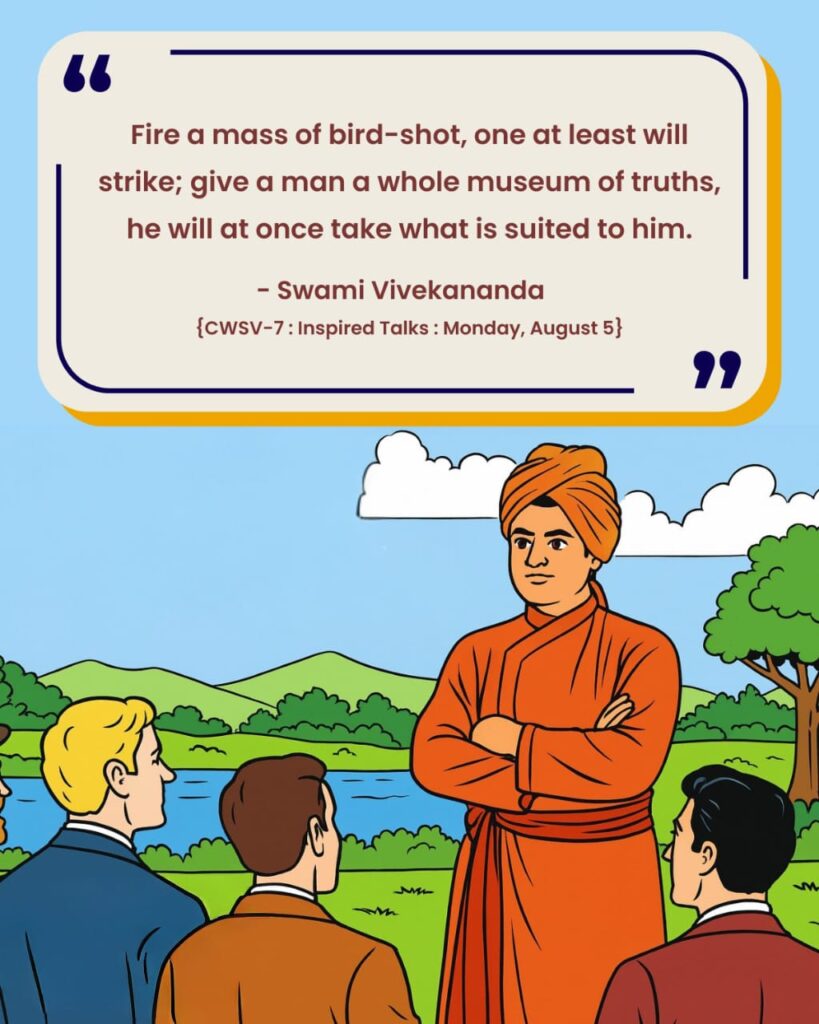
My idea is to bring to the door of the meanest, the poorest, the noble ideas that the human race has developed both in and out of India, and let them think for themselves.[Source]
Liberty is the first condition of growth. It is wrong, a thousand times wrong, if any of you dares to say, “I will work out the salvation of this woman or child.” I am asked again and again, what I think of the widow problem and what I think of the woman question. Let me answer once for all — am I a widow that you ask me that nonsense? Am I a woman that you ask me that question again and again? Who are you to solve women’s problems? Are you the Lord God that you should rule over every widow and every woman? Hands off! They will solve their own problems.[Source]
Have faith in man first, and then having faith in him, believe that if there are defects in him, if he makes mistakes, if he embraces the crudest and the vilest doctrines, believe that it is not from his real nature that they come, but from the want of higher ideals. If a man goes towards what is false, it is because he cannot get what is true. Therefore the only method of correcting what is false is by supplying him with what is true. Do this, and let him compare. You give him the truth, and there your work is done. Let him compare it in his own mind with what he has already in him; and, mark my words, if you have really given him the truth, the false must vanish, light must dispel darkness, and truth will bring the good out. This is the way if you want to reform the country spiritually; this is the way, and not fighting, not even telling people that what they are doing is bad.[Source]
Our true nature is good, it is free, the pure being that can never be or do wrong. When we read God with our eyes and minds, we call Him this or that; but in reality there is but One, all variations are our interpretations of that One. We become nothing; we regain our true Self. Buddha’s summary of misery as the outcome of “ignorance and caste” (inequality) has been adopted by the Vedantists, because it is the best ever made. It manifests the wonderful insight of this greatest among men. Let us then be brave and sincere: whatever path we follow with devotion, must take us to freedom. Once lay hold of one link of the chain and the whole must come after it by degrees. Water the root of the tree and the whole tree is watered. It is of little advantage to waste time to water each leaf. In other words, seek the Lord and getting Him we get all. Churches, doctrines, forms — these are merely the hedges to protect the tender plant of religion; but later on they must all be broken down, that the little plant may become a tree. So the various religious sects, Bibles, Vedas, and scriptures are just “tubs” for the little plant; but it has to get out of the tub and fill the world.[Source]
Sri Ramakrishna Says —
MASTER (smiling):“I keep men’s own ideals intact. I ask a Vaishnava to hold to his Vaishnava attitude and a Sakta to his. But this also I say to them: “Never feel that your path alone is right and that the paths of others are wrong and full of errors.’ Hindus, Mussalmans, and Christians are going to the same destination by different paths. A man can realise God by following his own path if his prayer is sincere.
“Vijay’s mother-in-law said to me, ‘Why don’t you tell Balaram that it is unnecessary to worship God with form; that it will be enough if he prays to the formless Satchidananda?’ I replied, ‘Why should I say such a thing, and why should he listen to me even if I should say it?’”
M: “That is true, sir. There are different paths to suit time, place, and the fitness of the candidate. Whatever path a man may follow, he will ultimately reach God if he is pure of heart and has sincere longing. That is what you say.” (Source: Gospel of Sri Ramakrishna)
Disciple: “- instructs his disciples not to practise Japa without taking bath etc. Are such observances compulsory ?”
Swami Saradananda: “The Master came to make religion easy. People were being crushed under the weight of rules and regulations. To repeat the Lord’s name and to worship Him no special time and place are necessary. In whatever condition one may be, one can take His name. The Master never used to give too much importance to these external observances. As to means, adopt whichever suits you best. If you like God with form, that will also lead you to the goal. If you like God without form, well and good; stick to it and you will progress. If you doubt His very existence, then better put the question to Him thus: I do not know whether Thou existeth or not, whether Thou art formless or with form. Do Thou make known to me Thy real nature. As to changing of clothes, taking bath, and other external observances, if you can observe them, well and good; if not, go on calling on Him without paying much attention to all these. The Master once sang a song to me and told me, ‘Assimilate any one of these ideas and you will reach the goal.’ The song runs as follows :
‘O Lord, Thou art my everything, the sole support of my life, the quintessence of reality. There is none else besides Thee in this world whom I can call as my own.
“Thou art happiness, peace, help, wealth, knowledge, intellect, and strength; Thou art the dwelling house and the pleasure garden; Thou art the friend and relative.
“Thou art this present life, the sole refuge; Thou art the life hereafter and the heaven; Thou art the injunction of the scriptures, the Guru full of blessings, and the store of infinite bliss.
‘Thou art the way and the goal; Thou art the creator and preserver and the worshipped; Thou art the father that punishest Thy child, the loving mother and the storehouse of infinite bliss art Thou.” (Source: Spiritual Talks by the First Disciples of Sri Ramakrishna)
Swami Turiyananda: “(To the Sannyasins present) That you people did not enter the world was due to the good impressions of past lives. You have finished all that already, so where was the need for you to enter the world again? It is because you understood everything that you gave up. You have forsooth been born with this privilege. Don’t you see that the world is mad after sense-enjoyment? People run into debt to get married. And before the debt is cleared, perhaps, they die! Whenever anybody spoke to Shri Ramakrishna about giving up the world, he would say, ‘If you are sincere you will find the circumstances gradually becoming favourable.’ He never said, ‘Leave everything and come away.’ ‘If you are sincere that is what he used to say, because he knew the contents of everyone’s mind. (Source: Spiritual Talks by the First Disciples of Sri Ramakrishna)
Swami Turiyananda: “How wonderfully Shri Ramakrishna taught each man so as to remove his particular wants! He used to illustrate it saying, ‘A mother has made various curries out of a fish. She doesn’t give all her boys the same thing. She gives to each what would exactly suit his stomach.’ The Master followed this in practice also.
“Swami Yogananda once heard reproaches against Shri Ramakrishna. He pocketed the affront and reported the matter to the Master. Hearing this Master said, “They abused me and you kept quiet!’ And he rebuked the Swami.
“Again, some time after this event, one day Swami Niranjanananda was coming to Dakshineswar by boat. A number of people in it were criticizing Shri Ramakrishna. The Swami was exceptionally strong. He at once came out of the cabin and placing his legs across began to roll the boat saying, ‘You are abusing Shri Ramakrishna. I shall now sink this boat. I would like to see who dares to oppose me.’ They were all frightened, and besought him to stop. When Shri Ramakrishna heard this he said, ‘You fool, if they abused me, what was that to you? Let everybody say what he likes, what matters it to you?’
“You see the fun! The teaching was different, according to the recipient’s need. Where can you find a teacher like him?” (Source: Spiritual Talks by the First Disciples of Sri Ramakrishna)
DEVOTION FOR SALE
One day, the saint Kabir walked around in the streets, calling out like a vendor, “If anyone wants parā-bhakti, supreme devotion, here I am ready to give it.” Many came and asked what the price was. Kabir replied, “You must just hand over your head. I will cut off your head, and you shall have parā-bhakti.” Hearing this, all ran away, except one who was a mature devotee. He said, “Here I am. Cut off my head or do whatever you want.”
Kabir hugged him and said, “Your head is already gone in surrender.” Then Kabir whispered in his ear, “Dear one, only Rama exists. You do not exist. Now onwards, you will recognise that there is no ‘you’ in you; you will find only Rama everywhere, whether in the waking state or the dream state—jāgrati svapni rāma.” This is the symbolic meaning of losing the head because it is the head that stands in the way and obstructs the non-dual experience by segregating and naming things. The differentiation of ‘I’, ‘you’ and ‘he’ is all brought about by the head. Good, bad, pleasure, pain—all such segregation happens because of the intellect. Experience is one; experience is whole; experience is divine. There is no experiencer thereof; there exists only the Lord—the one non-dual—kevala-anubhava-svarūpa. This is the truth, and this is being revealed here. Hence Bhagavan says, “This is guhyād-guhyataram—this is the greatest secret which cannot be bought by anything human.” (Source: Srimad Bhagavad Gita – Elixir of Eternal Wisdom | Vol 3) (Related Article: Are You Ready?)
THE INFALLIBLE KNOWLEDGE
Some days after the Mahabharata war, while Arjuna and Krishna were taking a stroll, Arjuna said, “Krishna, You taught me something precious in Kurukshetra, but I do not remember it now. Though the experience, the flavour of it, is there within me, I do not remember the teaching. Please tell me the Bhagavad Gita once again.” Krishna laughed and said, “That Arjuna who asked, thirsting for the sacred waters of the Gita, is no more here. Hence, that Krishna who taught the Gita also cannot come forth now.” Tears filled Arjuna’s eyes, and he beseeched, “Lord, what will happen to me? I do not seem to remember it.”
Bhagavan said,(Anu Gita 1.11) “That which I have already given to you is enough for you to realise Brahman, O Arjuna. I have given you the Gita once; it is infallible. I have transmitted the very Experience. Now you are Me, and I am you. My light alone is there in you. sattvamekam dvidhā sthitam—one being appears in two forms. Arjuna, you do not exist.”
It is impossible for a disciple who has come in contact with a true Enlightened Being to retain the ego. Then what doubt can be there about Arjuna who is the divine partner of the Lord? There is no question of the ego sprouting and living in him again; it is impossible. It is gone, and only the teaching remains. The teaching is transmitted from heart to heart. The Bhagavata says, “tene brahma hṛdā (SB1.1.1)—Brahman is transmitted from heart to heart.” (Source: Srimad Bhagavad Gita – Elixir of Eternal Wisdom | Vol 3)
Śrī Rāma tells Śabarī that He will explain to her the nine kinds of devotion (navadhā bhakti). He advises her to listen carefully and grasp what He says. This teaching given to Śabarī is, in fact, directed at all of us. As far as Śabarī is concerned, it is a boon conferred on her, the boon of devotion. Śrī Rāma says that if anyone’s heart is filled with even one of these nine kinds of devotion, that person becomes very dear to Him. As for Śabarī, He says, she is fully endowed with all nine.
Related Articles:
- Better to Marry Than to Burn – Sri Ramakrishna
- Let Him Who Likes Do So
- You have the right to work only, and not to the fruits of work. Let not the fruit of action be your motive, nor let your attachment be to inaction. (BG 2.47)
- One’s own duty, ill-performed and without merit, is better than the duty of another well-discharged. Better is death in discharging one’s own duty. Another’s duty is fraught with fear. (BG 3.35)
- Better is one’s own duty though destitute of merits or incomplete than the duty of another well performed; the man who performs action ordained by his own nature does not incur sin. (BG 18.47)
Question: How is the Gita Sastra described?
Answer: As the most secret of all secrets.
Question: Having delivered the message of wisdom, what should be the attitude of the teacher?
Answer: He should leave it to the disciple to reflect over it deeply, and act according to his own wish.
Bhagavad Gita: Chapter 18 🔻 (78 Verses)
| 01 | 02 | 03 | 04 | 05 | 06 | 07 | 08 | 09 | 10 |
| 11 | 12 | 13 | 14 | 15 | 16 | 17 | 18 | 19 | 20 |
| 21 | 22 | 23 | 24 | 25 | 26 | 27 | 28 | 29 | 30 |
| 31 | 32 | 33 | 34 | 35 | 36 | 37 | 38 | 39 | 40 |
| 41 | 42 | 43 | 44 | 45 | 46 | 47 | 48 | 49 | 50 |
| 51 | 52 | 53 | 54 | 55 | 56 | 57 | 58 | 59 | 60 |
| 61 | 62 | 63 | 64 | 65 | 66 | 67 | 68 | 69 | 70 |
| 71 | 72 | 73 | 74 | 75 | 76 | 77 | 78 |