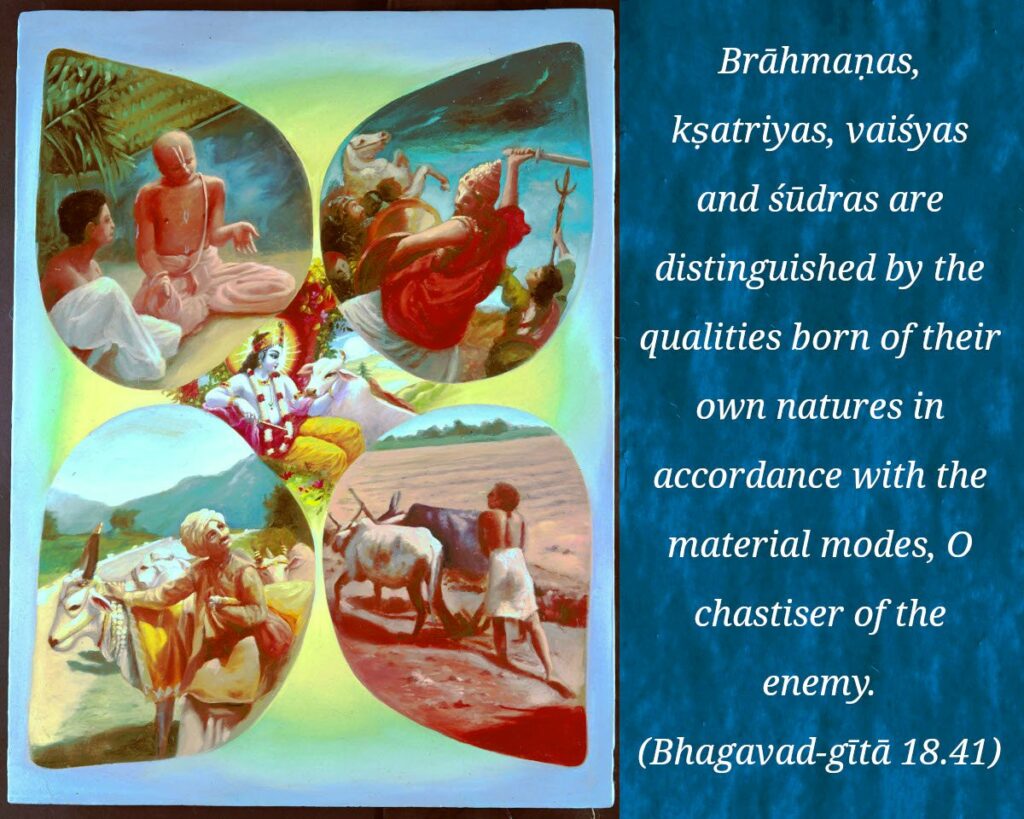
ब्राह्मणक्षत्रियविशां शूद्राणां च परन्तप |
कर्माणि प्रविभक्तानि स्वभावप्रभवैर्गुणै: || 41||
brāhmaṇa-kṣhatriya-viśhāṁ śhūdrāṇāṁ cha parantapa
karmāṇi pravibhaktāni svabhāva-prabhavair guṇaiḥ
brāhmaṇa—of the priestly class; kṣhatriya—the warrior and administrative class; viśhām—the mercantile and farming class; śhūdrāṇām—of the worker class; cha—and; parantapa—Arjun, subduer of the enemies; karmāṇi—duties; pravibhaktāni—distributed; svabhāva-prabhavaiḥ-guṇaiḥ—work based on one’s nature and guṇas
Translation:
O Arjuna! works for the different castes (Brahmins, Kshatriyas, Vaisyas and Sudras) are variously determined according to their nature born of Prakriti.
Commentary:
In the Fourth Discourse (13th verse), the Lord already declared that the differentiation of the castes is determined by the difference in the nature of men (chaturvarnyam maya sriahtam gunakarma vibhagasah). Here again, the Lord states that the difference among the castes is due to qualities differently exhibited according to their nature. So, the accident of birth is not the real criterion to fix the special gradation of the caste system. It shows that caste is no bar for anyone who aspires for Self-realisation. Though the birth is apparently in the lower castes, man can ascend to great spiritual heights by the purity of his character and conducts. The Gita thus throws open the gates of Brahmajnana to all people who are qualified for it by virtue of their inherent predispositions and acquired merit. The accident of birth is of very little significance.
HASTAMALAKA
When journeying through the country, Sankaracharya reached a village in Karnataka where he came across a boy who appeared dumb and dull-witted. But the great teacher recognised that the boy was, in fact, a brahmanishṭha, a Realised Soul. With affection, Acharya asked him, “Who are you? What is your real nature? Do you remember who you are?”
The boy majestically sang a few verses, declaring joyfully, “I am not a human being. I am not a deva. I am not a yaksha. I am not a brāhmaṇa. I am not a kshatriya. I am not a vaiśya. I am not a śūdra. Neither am I a celibate, a householder, an austere forest-dweller aspirant, or a monk. I am the ever-pure, never-bound Awareness. I am the body-less Reality. I am the Atman.”
Acharya embraced him and said, “You are Hastāmalaka! Just like a person hides a gooseberry in his palm, you have hidden infinite Realisation in your heart.”
Only when we know this Truth will we understand the real purport of the classifications of brāhmaṇa, kshatriya, vaiśya and śūdra. One must not enter into unnecessary controversies about differences in castes and such. It is not fitting for sādhakas to get into such unfruitful discussions. These classifications have been prescribed in the śāstras by our compassionate sages. They did not prescribe the caste system with an intention to segregate or divide human beings. On the contrary, its purpose is to give a system by which we can all live comfortably, serving and loving each other. Unfortunately, it is human nature to corrupt every system. The ego corrupts; attachment and aversion corrupt. That is how this age-old system of varṇas also got corrupted. The flaws that we see in the caste system of today are not the flaws of the śāstras but of the human mind. (Source: Srimad Bhagavad Gita – Elixir of Eternal Wisdom | Vol 3)
Question: How are the four castes formed?
Answer: By their qualities.
Question: How are the duties of each determined?
Answer: By the tendencies with which people are born.
Question: Is the caste determined by birth?
Answer: No, It is determined by their nature.
Bhagavad Gita: Chapter 18 🔻 (78 Verses)
| 01 | 02 | 03 | 04 | 05 | 06 | 07 | 08 | 09 | 10 |
| 11 | 12 | 13 | 14 | 15 | 16 | 17 | 18 | 19 | 20 |
| 21 | 22 | 23 | 24 | 25 | 26 | 27 | 28 | 29 | 30 |
| 31 | 32 | 33 | 34 | 35 | 36 | 37 | 38 | 39 | 40 |
| 41 | 42 | 43 | 44 | 45 | 46 | 47 | 48 | 49 | 50 |
| 51 | 52 | 53 | 54 | 55 | 56 | 57 | 58 | 59 | 60 |
| 61 | 62 | 63 | 64 | 65 | 66 | 67 | 68 | 69 | 70 |
| 71 | 72 | 73 | 74 | 75 | 76 | 77 | 78 |