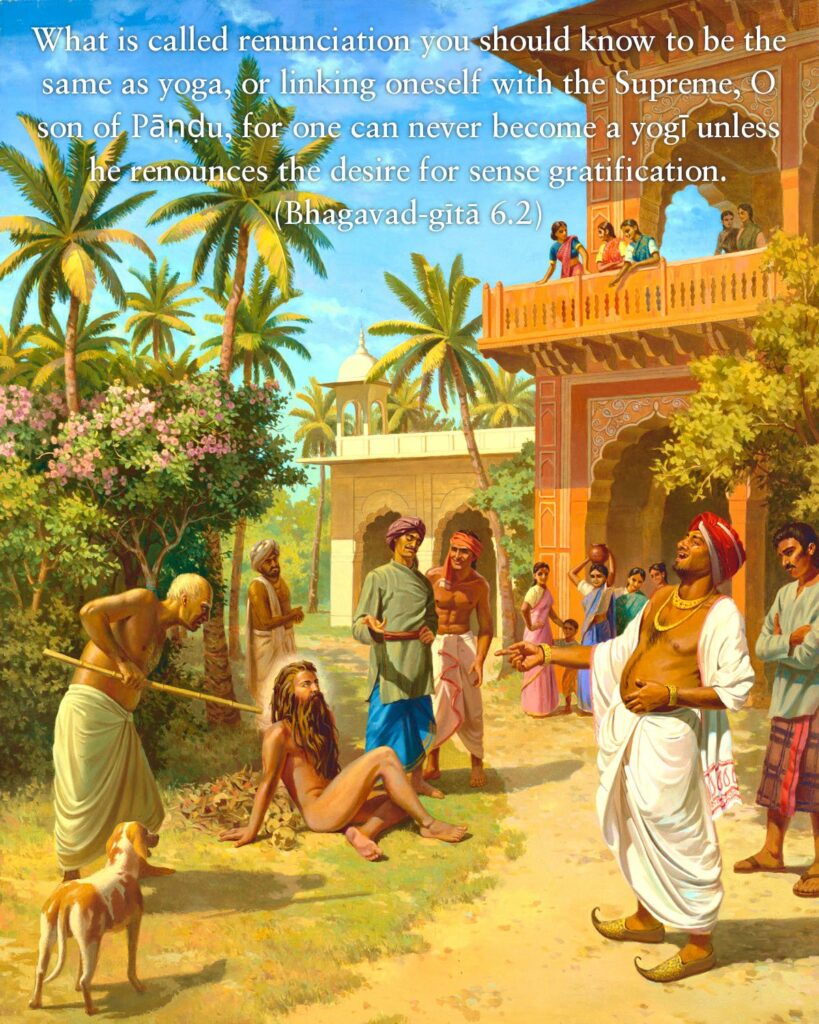
यं संन्यासमिति प्राहुर्योगं तं विद्धि पाण्डव |
न ह्यसंन्यस्तसङ्कल्पो योगी भवति कश्चन || 2||
yaṁ sannyāsam iti prāhur yogaṁ taṁ viddhi pāṇḍava
na hyasannyasta-saṅkalpo yogī bhavati kaśhchana
yam—what; sanyāsam—renunciation; iti—thus; prāhuḥ—they say; yogam—yog; tam—that; viddhi—know; pāṇḍava—Arjun, the son of Pandu; na—not; hi—certainly; asannyasta—without giving up; saṅkalpaḥ—desire; yogī—a yogi; bhavati—becomes; kaśhchana—anyone
Translation:
O Arjuna! That which is called sannyasa, know that to be yoga also; no one who has not given up desire can ever become a yogi.
Commentary:
By sharp discrimination between the Self and non-Self, the Jnanayogi rejects anatma (non-self) and establishes himself in the Supreme Reality. The Karma yogi acts without any feeling of doership, without desire, without the sense of ‘I’ and ‘Mine’, and surrenders his work with its fruits to God. So acting he lives in the Supreme Reality. The Jnana yogi follows the path of introspection into himself by eliminating the senses the mind and the external world. The Bhakti yogi has no relish for anything in the world, and he contemplates the Lord repeating His name, singing His glories, and thus lives in bliss and blessedness. In this way whatever path man may follow – Jnana, Karma, Bhakti, Dhyana – the inner principle is the same (i.e.) the rejection of insentient material things. Besides this, life in the Divine is implicit in all these yogas. That is why the Lord teaches that sannyasa and yoga are the same in their goal and aim. No one who has not renounced desire, the ego-centric initiative (samkalpa) for possessing material things, can ever become a yogi. Without the renunciation of desire, to live an idle and aimless life is neither sannyasa nor yoga.
—–
Disciple: Mother, everybody says that one who approaches the Kalpatant (wish-fulfilling tree) has to ask for something. But I wonder, for what should children ask their Mother? A mother gives to every child according to its need. As Sri Ramakrishna used to say, “ A mother serves different dishes to suit the stomachs of her different children.” Now please tell me which is the correct attitude.
Mother (Sri Sarada Devi): How much intelligence does a man possess? He is likely to ask for something other than what he really needs. He may even end up creating a monkey in place of Siva. It is wise to take refuge in Him. He will always give you whatever is necessary. However, one should pray for devotion and desirelessness; for such a prayer does no harm.
Disciple: The Master said, “Those who come here will be in their last embodiment.” Again, Swamiji said, “ None can have liberation without complete renunciation.” What, then, will be the fate of householders?
Mother: Yes, what the Master said is true; and what Swamiji said is equally true. But householders need not renounce externally. They will automatically acquire internal renunciation. However, some need formal Sannyasa. Why should you be afraid? Surrender yourself to Him and live. And know that the Master is always behind you. (Source: The Gospel Of The Holy Mother)
RENOUNCE THE RENOUNCER
This verse is very striking. Sannyāsa is yoga, and yoga is sannyāsa. Sannyāsa means renunciation. What should one renounce? Bhagavan says, “Renounce all desires, concepts and ideas; renounce all the image-making in the mind; renounce all goals, and renounce becoming.” All these put together, come under one word—saṅkalpa. One who has renounced all saṅkalpa—the saṅkalpa-sannyāsi—is a real sannyāsin. Someone asked Sri Ramana Maharshi, “Should I not renounce all my possessions?” The Sage replied, “The possessor too.” What a powerful upadeśa this is—renounce the renouncer! When the ego is given up, everything is given up. Maharshi has declared several times that sannyāsa means giving up the ego. Devoid of the ego, even a householder is a sannyāsin. Though one might sport a shaved head and ochre robes, as long as the ego and desires remain, he is not a sannyāsi, but only a saṃsāri. (Source: Srimad Bhagavad Gita – Elixir of Eternal Wisdom | Vol 1)
SRI RAMAKRISHNA’S INITIATION
Sri Ramakrishna Paramahamsa lived and dressed like an ordinary brahmin priest outwardly. Before giving mahāvākya upadeśa to Ramakrishna, Totapuri Baba gave him sannyāsa dīksha, because as per tradition, mahāvākya upadeśa is to be given only to a sannyāsi. Hence Sri Ramakrishna took sannyāsa in the Puri-sampradāya. He told Totapuri that he would continue to wear the usual clothes of a brahmin and live like an ordinary family man in order to avoid hurting his mother’s feelings. Totapuri said, “arey! You are a Jñāni, a Realised Person. You can even live with your wife since nothing can bind you now. You are like the mudfish which lives in the mud, but no dirt sticks to it. Go and live as normally as possible.” Such freedom is there in Jñāna. Traditional sannyāsa has many rules but they become redundant in the case of a Jñāni.
The yoga that we have discussed so far is karma-yoga. Even from that standpoint, a karma-yogi, who has absolutely no desire for the fruit of action, is a sannyāsin because his mind is free. Sannyāsa is innate in karma-yoga because without renouncing the desire for the fruit—phala-kāmana—karma cannot be transformed into yoga. Thus, in a karma-yogi, inner renunciation is natural. (Source: Srimad Bhagavad Gita – Elixir of Eternal Wisdom | Vol 1)
Question: Are sannyasa and yoga different?
Answer: No. What is called sannyasa is the same as yoga.
Question: When does a man become a yogi?
Answer: Only when he gives up desire and attachment does he become a Yogi.
Bhagavad Gita: Chapter 6 🔻 (47 Verses)