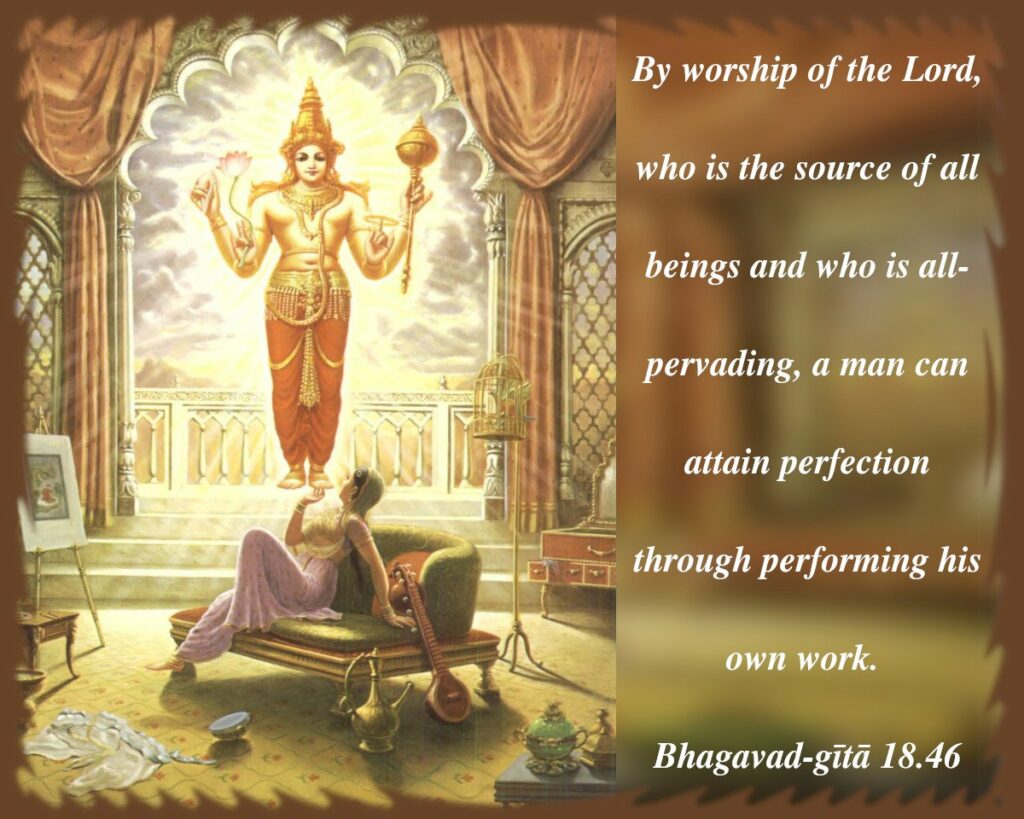
यत: प्रवृत्तिर्भूतानां येन सर्वमिदं ततम् |
स्वकर्मणा तमभ्यर्च्य सिद्धिं विन्दति मानव: || 46||
yataḥ pravṛittir bhūtānāṁ yena sarvam idaṁ tatam
sva-karmaṇā tam abhyarchya siddhiṁ vindati mānavaḥ
yataḥ—from whom; pravṛittiḥ—have come into being; bhūtānām—of all living entities; yena—by whom; sarvam—all; idam—this; tatam—pervaded; sva-karmaṇā—by one’s natural occupation; tam—him; abhyarchya—by worshipping; siddhim—perfection; vindati—attains; mānavaḥ—a person
Translation:
By performing one’s natural occupation, one worships the Creator from whom all living entities have come into being, and by whom the whole universe is pervaded. By such performance of work, a person easily attains perfection.
Commentary:
Yatah pravrittir bhutanam: It is clear that Paramatma is the origin and source of all beings. All beings come from Him and return to Him. Paramatma is the vital Intelligence Principle without which insentient Prakriti can do nothing. Therefore the worship of Paramatma is the highest duty of man in whom Paramatma is manifesting in the highest degree.
Yena saravam idam tatam: All this is pervaded by the Lord. This declaration is made thrice in the Gita. Paramatma is present everywhere, like cream in milk. He is not seen with the external eye, but to the eye of knowledge, He is visible. He is ‘Sarvasakshi’, the Seer of everything because He is present in the innermost core of every being. So realising, man should be pure in thought and deed and should be devoted to Him who is the origin and source of his very being.
Svakarmana tam abhyarcha: The performance of one’s own duty is itself the worship of the Lord. This is the excellence of Kamayoga. The tiller in the field, the worker in the factory, the judge in the court, the minister in the cabinet, the trader, the cobbler, in fact, every man who is engaged in some form of work or other, can transform and sublimate that work into the worship of the Lord by offering it to Him-the action and its fruits altogether. Thus every step that he takes, every breath that he breathes, every action that he does becomes worship of the Lord. Such worship automatically purifies the mind, because the mind is agitated only when man becomes attached to his work for selfish ends and by selfish motives. He who can maintain the attitude of detachment and surrender remains restful and lives in peace. Such peace leads to the vision of Paramatma. Of all the methods mentioned to purify the mind, this is the best and most easy to practice. As man is engaged in some form of work, the ideal is to perform it as worship of the Lord, free from fear and anxiety, free from binding egotism and binding selfishness.
Thus Karma becomes the means to Moksha. Karma binds only when the performer desires to obtain this or that fruit either in this world or in other worlds. Man knows in his heart of hearts that he is attached to work by contemplating the pleasure of enjoying the rewards. This should be given up by the true seeker whose will is set on the realisation of ultimate perfection. The Lord declares that man attains perfection by following the principle of detached performance of one’s own duty.
This verse explains the combination of Karma, Bhakti, and Jnana.
- Performance of action (Karma)
- Worship of the Lord through action (Bhakti)
- Purification of the mind which brings about self-realisation (Jnana)
Swami Vivekananda Says —
Do not say we are weak; we can do anything and everything. What can we not do? Everything can be done by us; we all have the same glorious soul, let us believe in it. Have faith, as Nachiketâ. At the time of his father’s sacrifice, faith came unto Nachiketa; ay, I wish that faith would come to each of you; and every one of you would stand up a giant, a world-mover with a gigantic intellect — an infinite God in every respect. That is what I want you to become. This is the strength that you get from the Upanishads, this is the faith that you get from there.
Ay, but it was only for the Sannyâsin! Rahasya (esoteric)! The Upanishads were in the hands of the Sannyasin; he went into the forest! Shankara was a little kind and said even Grihasthas (householders) may study the Upanishads, it will do them good; it will not hurt them. But still the idea is that the Upanishads talked only of the forest life of the recluse. As I told you the other day, the only commentary, the authoritative commentary on the Vedas, has been made once and for all by Him who inspired the Vedas — by Krishna in the Gita. It is there for every one in every occupation of life. These conceptions of the Vedanta must come out, must remain not only in the forest, not only in the cave, but they must come out to work at the bar and the bench, in the pulpit, and in the cottage of the poor man, with the fishermen that are catching fish, and with the students that are studying. They call to every man, woman, and child whatever be their occupation, wherever they may be. And what is there to fear! How can the fishermen and all these carry out the ideals of the Upanishads? The way has been shown. It is infinite; religion is infinite, none can go beyond it; and whatever you do sincerely is good for you. Even the least thing well done brings marvellous results; therefore let every one do what little he can. If the fisherman thinks that he is the Spirit, he will be a better fisherman; if the student thinks he is the Spirit, he will be a better student. If the lawyer thinks that he is the Spirit, he will be a better lawyer, and so on, and the result will be that the castes will remain for ever. It is in the nature of society to form itself into groups; and what will go will be these privileges. Caste is a natural order; I can perform one duty in social life, and you another; you can govern a country, and I can mend a pair of old shoes, but that is no reason why you are greater than I, for can you mend my shoes? Can I govern the country? I am clever in mending shoes, you are clever in reading Vedas, but that is no reason why you should trample on my head. Why if one commits murder should he be praised, and if another steals an apple why should he be hanged? This will have to go. Caste is good. That is the only natural way of solving life. Men must form themselves into groups, and you cannot get rid of that. Wherever you go, there will be caste. But that does not mean that there should be these privileges. They should be knocked on the head. If you teach Vedanta to the fisherman, he will say, I am as good a man as you; I am a fisherman, you are a philosopher, but I have the same God in me as you have in you. And that is what we want, no privilege for any one, equal chances for all; let every one be taught that the divine is within, and every one will work out his own salvation.[Source]
The only way to rise is by doing the duty next to us, and thus gathering strength go on until we reach the highest state. A young Sannyâsin went to a forest; there he meditated, worshipped, and practiced Yoga for a long time. After years of hard work and practice, he was one day sitting under a tree, when some dry leaves fell upon his head. He looked up and saw a crow and a crane fighting on the top of the tree, which made him very angry. He said, “What! Dare you throw these dry leaves upon my head!” As with these words he angrily glanced at them, a flash of fire went out of his head — such was the Yogi’s power — and burnt the birds to ashes. He was very glad, almost overjoyed at this development of power — he could burn the crow and the crane by a look. After a time he had to go to the town to beg his bread. He went, stood at a door, and said, “Mother, give me food.” A voice came from inside the house, “Wait a little, my son.” The young man thought, “You wretched woman, how dare you make me wait! You do not know my power yet.” While he was thinking thus the voice came again: “Boy, don’t be thinking too much of yourself. Here is neither crow nor crane.” He was astonished; still he had to wait. At last the woman came, and he fell at her feet and said, “Mother, how did you know that?” She said, “My boy, I do not know your Yoga or your practices. I am a common everyday woman. I made you wait because my husband is ill, and I was nursing him. All my life I have struggled to do my duty. When I was unmarried, I did my duty to my parents; now that I am married, I do my duty to my husband; that is all the Yoga I practice. But by doing my duty I have become illumined; thus I could read your thoughts and know what you had done in the forest. If you want to know something higher than this, go to the market of such and such a town where you will find a Vyâdha (The lowest class of people in India who used to live as hunters and butchers.) who will tell you something that you will be very glad to learn.” The Sannyasin thought, “Why should I go to that town and to a Vyadha?” But after what he had seen, his mind opened a little, so he went. When he came near the town, he found the market and there saw, at a distance, a big fat Vyadha cutting meat with big knives, talking and bargaining with different people. The young man said, “Lord help me! Is this the man from whom I am going to learn? He is the incarnation of a demon, if he is anything.” In the meantime this man looked up and said, “O Swami, did that lady send you here? Take a seat until I have done my business.” The Sannyasin thought, “What comes to me here?” He took his seat; the man went on with his work, and after he had finished he took his money and said to the Sannyasin, “Come sir, come to my home.” On reaching home the Vyadha gave him a seat, saying, “Wait here,” and went into the house. He then washed his old father and mother, fed them, and did all he could to please them, after which he came to the Sannyasin and said, “Now, sir, you have come here to see me; what can I do for you?” The Sannyasin asked him a few questions about soul and about God, and the Vyadha gave him a lecture which forms a part of the Mahâbhârata, called the Vyâdha-Gitâ. It contains one of the highest flights of the Vedanta. When the Vyadha finished his teaching, the Sannyasin felt astonished. He said, “Why are you in that body? With such knowledge as yours why are you in a Vyadha’s body, and doing such filthy, ugly work?” “My son,” replied the Vyadha, “no duty is ugly, no duty is impure. My birth placed me in these circumstances and environments. In my boyhood I learnt the trade; I am unattached, and I try to do my duty well. I try to do my duty as a householder, and I try to do all I can to make my father and mother happy. I neither know your Yoga, nor have I become a Sannyasin, nor did I go out of the world into a forest; nevertheless, all that you have heard and seen has come to me through the unattached doing of the duty which belongs to my position.”
There is a sage in India, a great Yogi, one of the most wonderful men I have ever seen in my life. He is a peculiar man, he will not teach any one; if you ask him a question he will not answer. It is too much for him to take up the position of a teacher, he will not do it. If you ask a question, and wait for some days, in the course of conversation he will bring up the subject, and wonderful light will he throw on it. He told me once the secret of work, “Let the end and the means be joined into one.” When you are doing any work, do not think of anything beyond. Do it as worship, as the highest worship, and devote your whole life to it for the time being. Thus, in the story, the Vyadha and the woman did their duty with cheerfulness and whole-heartedness; and the result was that they became illuminated, clearly showing that the right performance of the duties of any station in life, without attachment to results, leads us to the highest realisation of the perfection of the soul. [Source]
The householder is the basis, the prop, of the whole society. He is the principal earner. The poor, the weak, the children and the women who do not work — all live upon the householder; so there must be certain duties that he has to perform, and these duties must make him feel strong to perform them, and not make him think that he is doing things beneath his ideal. Therefore, if he has done something weak, or has made some mistake, he must not say so in public; and if he is engaged in some enterprise and knows he is sure to fail in it, he must not speak of it. Such self-exposure is not only uncalled for, but also unnerves the man and makes him unfit for the performance of his legitimate duties in life. At the same time, he must struggle hard to acquire these things — firstly, knowledge, and secondly, wealth. It is his duty, and if he does not do his duty, he is nobody. A householder who does not struggle to get wealth is immoral. If he is lazy and content to lead an idle life, he is immoral, because upon him depend hundreds. If he gets riches, hundreds of others will be thereby supported.
If there were not in this city hundreds who had striven to become rich, and who had acquired wealth, where would all this civilization, and these alms-houses and great houses be?
Going after wealth in such a case is not bad, because that wealth is for distribution. The householder is the centre of life and society. It is a worship for him to acquire and spend wealth nobly, for the householder who struggles to become rich by good means and for good purposes is doing practically the same thing for the attainment of salvation as the anchorite does in his cell when he is praying; for in them we see only the different aspects of the same virtue of self-surrender and self-sacrifice prompted by the feeling of devotion to God and to all that is His. [Source]
Here are two Sanskrit words. The one is Pravritti, which means revolving towards, and the other is Nivritti, which means revolving away. The “revolving towards” is what we call the world, the “I and mine”; it includes all those things which are always enriching that “me” by wealth and money and power, and name and fame, and which are of a grasping nature, always tending to accumulate everything in one centre, that centre being “myself”. That is the Pravritti, the natural tendency of every human being; taking everything from everywhere and heaping it around one centre, that centre being man’s own sweet self. When this tendency begins to break, when it is Nivritti or “going away from,” then begin morality and religion. Both Pravritti and Nivritti are of the nature of work: the former is evil work, and the latter is good work. This Nivritti is the fundamental basis of all morality and all religion, and the very perfection of it is entire self-abnegation, readiness to sacrifice mind and body and everything for another being. When a man has reached that state, he has attained to the perfection of Karma-Yoga. This is the highest result of good works. Although a man has not studied a single system of philosophy, although he does not believe in any God, and never has believed, although he has not prayed even once in his whole life, if the simple power of good actions has brought him to that state where he is ready to give up his life and all else for others, he has arrived at the same point to which the religious man will come through his prayers and the philosopher through his knowledge; and so you may find that the philosopher, the worker, and the devotee, all meet at one point, that one point being self-abnegation. However much their systems of philosophy and religion may differ, all mankind stand in reverence and awe before the man who is ready to sacrifice himself for others. Here, it is not at all any question of creed, or doctrine — even men who are very much opposed to all religious ideas, when they see one of these acts of complete self-sacrifice, feel that they must revere it. Have you not seen even a most bigoted Christian, when he reads Edwin Arnold’s Light of Asia, stand in reverence of Buddha, who Preached no God, preached nothing but self-sacrifice? The only thing is that the bigot does not know that his own end and aim in life is exactly the same as that of those from whom he differs. The worshipper, by keeping constantly before him the idea of God and a surrounding of good, comes to the same point at last and says, “Thy will be done,” and keeps nothing to himself. That is self-abnegation. The philosopher, with his knowledge, sees that the seeming self is a delusion and easily gives it up. It is self-abnegation. So Karma, Bhakti, and Jnana all meet here; and this is what was meant by all the great preachers of ancient times, when they taught that God is not the world. There is one thing which is the world and another which is God; and this distinction is very true. What they mean by world is selfishness. Unselfishness is God. One may live on a throne, in a golden palace, and be perfectly unselfish; and then he is in God. Another may live in a hut and wear rags, and have nothing in the world; yet, if he is selfish, he is intensely merged in the world. [Source]
—
Sister Nivedita in Her Introduction to ‘Complete Works of Swami Vivekananda’ Says —
Like the Krishna of the Gitâ, like Buddha, like Shankarâchârya, like every great teacher that Indian thought has known, Swami Vivekananda’s sentences are laden with quotations from the Vedas and Upanishads. He stands merely as the Revealer, the Interpreter to India of the treasures that she herself possesses in herself. The truths he preaches would have been as true, had he never been born. Nay more, they would have been equally authentic. The difference would have lain in their difficulty of access, in their want of modern clearness and incisiveness of statement, and in their loss of mutual coherence and unity. Had he not lived, texts that today will carry the bread of life to thousands might have remained the obscure disputes of scholars. He taught with authority, and not as one of the Pandits. For he himself had plunged to the depths of the realisation which he preached, and he came back like Ramanuja only to tell its secrets to the pariah, the outcast, and the foreigner.
And yet this statement that his teaching holds nothing new is not absolutely true. It must never be forgotten that it was the Swami Vivekananda who, while proclaiming the sovereignty of the Advaita Philosophy, as including that experience in which all is one, without a second, also added to Hinduism the doctrine that Dvaita, Vishishtâdvaita, and Advaita are but three phases or stages in a single development, of which the last-named constitutes the goal. This is part and parcel of the still greater and more simple doctrine that the many and the One are the same Reality, perceived by the mind at different times and in different attitudes; or as Sri Ramakrishna expressed the same thing, “God is both with form and without form. And He is that which includes both form and formlessness.”
It is this which adds its crowning significance to our Master’s life, for here he becomes the meeting-point, not only of East and West, but also of past and future. If the many and the One be indeed the same Reality, then it is not all modes of worship alone, but equally all modes of work, all modes of struggle, all modes of creation, which are paths of realisation. No distinction, henceforth, between sacred and secular. To labour is to pray. To conquer is to renounce. Life is itself religion. To have and to hold is as stern a trust as to quit and to avoid.
This is the realisation which makes Vivekananda the great preacher of Karma, not as divorced from, but as expressing Jnâna and Bhakti. To him, the workshop, the study, the farmyard, and the field are as true and fit scenes for the meeting of God with man as the cell of the monk or the door of the temple. To him, there is no difference between service of man and worship of God, between manliness and faith, between true righteousness and spirituality. All his words, from one point of view, read as a commentary upon this central conviction. “Art, science, and religion”, he said once, “are but three different ways of expressing a single truth. But in order to understand this we must have the theory of Advaita.” [Source]
WEAVING AS A WORSHIP
Kabir, a renowned saint of Kasi, was a weaver by profession. Even in his old age, Kabir continued his work as a weaver. Many rich and powerful people used to gather around him to hear him speak and sing ecstatically. They were drawn to him by the divine atmosphere around him. All of them, including the kings and the zamindars, who were his devotees, pleaded with him, “Why do you toil like this? Must you weave day after day? At this old age, you make clothes and walk all the way to the market to sell them. We feel ashamed that our Guru has to do all this! We are here to look after you and serve you. Just be here and sing your divine songs, and we shall listen and be blessed.”
Kabir laughed and said, “What else am I to do? This is the only work that this body can do. This is how I can worship Rama, who comes in so many forms. This is my pūja. Do you think I am weaving? Do you think I am toiling, working? No! It is not so. In fact, I stopped working long ago. Weaving is my worship. What is being woven here is not cloth but a divine fabric of which every thread is Rama. Wherever I look, I see only Him—jita dekhūṃ tita tūm—wherever I look, it is Rama. Kabir disappeared long back at the feet of Master Ramananda. In me, ‘I’ am not; only Rama is.” (Source: Srimad Bhagavad Gita – Elixir of Eternal Wisdom | Vol 3)
Question: What is the source of all beings?
Answer: Paramatma.
Question: By whom is this universe pervaded?
Answer: By Paramatma.
Question: How can the Jiva attain perfection?
Answer: If a man performs his prescribed duties in the spirit of the worship of the Lord, surrendering the fruits to him, he gets purification of mind and when the mind is purified, he attains Bahmajnana.
Bhagavad Gita: Chapter 18 🔻 (78 Verses)
| 01 | 02 | 03 | 04 | 05 | 06 | 07 | 08 | 09 | 10 |
| 11 | 12 | 13 | 14 | 15 | 16 | 17 | 18 | 19 | 20 |
| 21 | 22 | 23 | 24 | 25 | 26 | 27 | 28 | 29 | 30 |
| 31 | 32 | 33 | 34 | 35 | 36 | 37 | 38 | 39 | 40 |
| 41 | 42 | 43 | 44 | 45 | 46 | 47 | 48 | 49 | 50 |
| 51 | 52 | 53 | 54 | 55 | 56 | 57 | 58 | 59 | 60 |
| 61 | 62 | 63 | 64 | 65 | 66 | 67 | 68 | 69 | 70 |
| 71 | 72 | 73 | 74 | 75 | 76 | 77 | 78 |