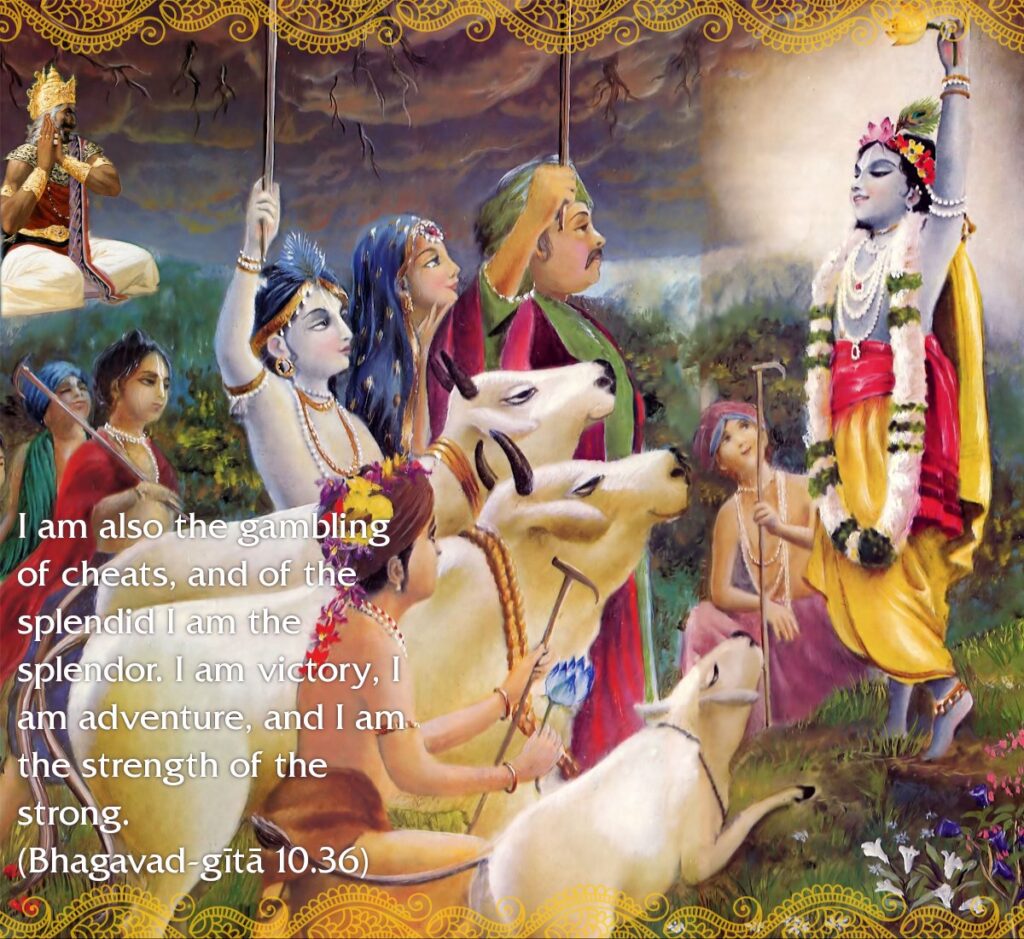
द्यूतं छलयतामस्मि तेजस्तेजस्विनामहम् |
जयोऽस्मि व्यवसायोऽस्मि सत्त्वं सत्त्ववतामहम् || 36||
dyūtaṁ chhalayatām asmi tejas tejasvinām aham
jayo ’smi vyavasāyo ’smi sattvaṁ sattvavatām aham
dyūtam—gambling; chhalayatām—of all cheats; asmi—I am; tejaḥ—the splendor; tejasvinām—of the splendid; aham—I; jayaḥ—victory; asmi—I am; vyavasāyaḥ—firm resolve; asmi—I am; sattvam—virtue; sattva-vatām—of the virtuous; aham—I
Translation:
I am the gambling of cheats; I am the vigour of the strong. I am victory; I am effort; I am the quality of sattva in the good.
Commentary:
Dyutam: This word should be carefully understood. It is definitely not a licence given to gamblers to carry on their fraudulent business. It is only an affirmation of the existence (astitvam) of the Lord in essence in every one of the activities, good and bad, carried on in the world. Good people carry on good work, and the bad bad work, and they reap the consequences accordingly. But the Lord is present in essence in all.
The Lord is victory. The Lord is determination. The aspirant has to realise the universality of the Lord by seeing Him everywhere, in all qualities and actions. His manifestation is to be realised in the splendid, good and eminent things. His existence (astitvam) is to be realised in all things.
“tejastejasvināmaham—I am the splendour of the splendid.” Tejas means spiritual energy which manifests as effulgence, splendour. Mahatmas, who, by the power of tapas, have transmuted all their energy as divine energy, carry a great presence in them. That is tejas. Bhagavan says, “That tejas is Me.”
TRANSFORMATION OF AN AGNOSTIC
Tejas is the power that we see in great sages, which naturally makes a ripe aspirant surrender. Narayana Iyer, a well-known devotee of Bhagavan Ramana Maharshi, was formerly a die-hard intellectual. His first meeting with the sage is a highly inspiring incident. His friend, Ramakrishna Iyer, was a staunch devotee of Maharshi. Once, both of them came to Tiruvannamalai for the Kartika festival. As they had no place to stay in the town, Ramakrishna Iyer suggested that they go to the ashram and stay there. Narayana Iyer reluctantly agreed to the suggestion but said, “I will come with you to the ashram. Of course, it will be more comfortable there, with many trees and more space, and we may also get food there. But be warned! I do not like going to these Swamis. I will not do any namaskāra to your Swami.” Ramakrishna Iyer replied, “Yes, that is okay. Our Swami also does not like namaskāras. You just come with me.” With this agreement, they went to Sri Ramanasramam.
Narayana Iyer was of the opinion that all sadhus were parasites on society. When they entered the ashram, they saw the Maharshi coming out of one of the thatched huts. What unfolded there was magical! Seeing the radiant figure, Narayana Iyer fell flat and prostrated at the feet of the sage, with tears streaming down his face. The person who, only a short while ago, had been adamant that he would not bow down to the sage was the first one to do so! His friend was awestruck as he knew his friend to be an intellectual who had met many great people like Gandhi and Rabindranath Tagore, and he never expected him to be so emotional. Later, he asked him jocularly, “You said you would not bow down, then why did you do it? Even I did not prostrate, but you did!” Narayana Iyer replied, “O Ramakrishna! I said I would not bow down to any sādhu, but this is not a sādhu. My God, what radiance! This is not a person; this is a presence, a vastu. What a Being!” Later on, his whole life was offered at the feet of the sage. He became a great devotee of Ramana Maharshi and lived in Tiruvannamalai. A person who had been reluctant to do one namaskāra did namaskāra all his life.
This power that emanates from a Sage, which conquers the ego and gives the greatest benediction, is tejas. We can call it a highly refined energy that gets developed through austerity. The resolve behind every Vedic student, when he sits for his meditation thrice every day, is ‘this is to energise oneself with brahmatejas.’ (Source: Srimad Bhagavad Gita – Elixir of Eternal Wisdom | Vol 1)
How did Shakuni, who played for Duryodhana in the Mahabharata during the game of dice, win? Bhagavan says, “I am behind Shakuni’s cunning, cheating trait. I was hidden inside him and played through him because this had to happen. This is destiny; the war had to take place. Thus, even that fraudulent person became a channel for Me.” Once we know this, there is no question of hating the evil and the ignoble.
WHY DID YUDHISHTHIRA LOSE THE GAME OF DICE?
Here is a story, which is probably in the Jaimini-Bharata. Janamejaya asks Krishna, “O Lord, when my grandfather Yudhishthira played dice with Shakuni, how did he fail when You were there! You could have helped him.” Krishna laughed and said, “My dear boy, I do not interfere with the destiny of anyone. Unless called, I do not go there. See, Duryodhana was clever; he made his uncle play a fraudulent game. Why did your grandfather not call Me? If he had invited Me, I would have certainly ensured his winning in just one game.” This is the secret. (Source: Srimad Bhagavad Gita – Elixir of Eternal Wisdom | Vol 1)
Bhagavad Gita: Chapter 10 🔻 (42 Verses)