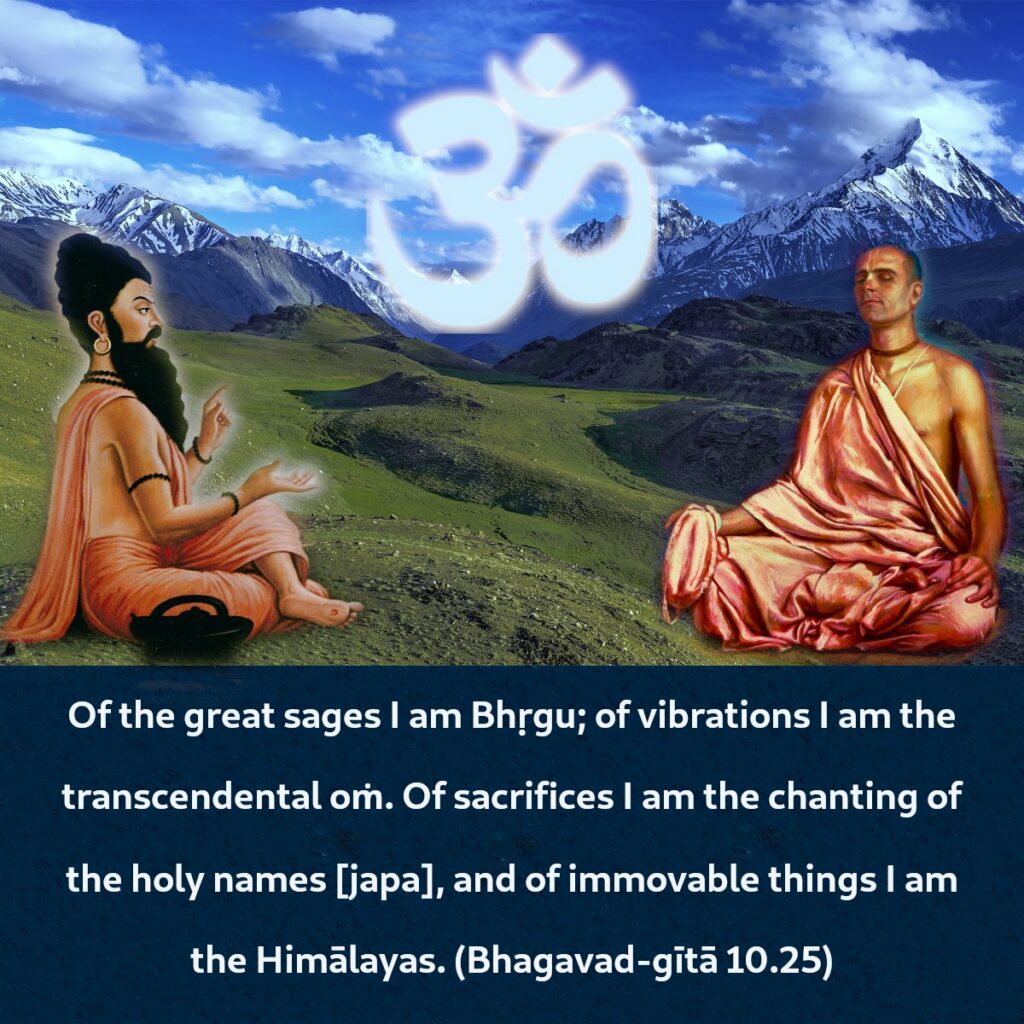
महर्षीणां भृगुरहं गिरामस्म्येकमक्षरम् |
यज्ञानां जपयज्ञोऽस्मि स्थावराणां हिमालय: || 25||
maharṣhīṇāṁ bhṛigur ahaṁ girām asmyekam akṣharam
yajñānāṁ japa-yajño ’smi sthāvarāṇāṁ himālayaḥ
mahā-ṛiṣhīṇām—among the great seers; bhṛiguḥ—Bhrigu; aham—I; girām—amongst chants; asmi—I am; ekam akṣharam—the syllable Om; yajñānām—of sacrifices; japa-yajñaḥ—sacrifice of the devotional repetition of the divine names of God; asmi—I am; sthāvarāṇām—amongst immovable things; himālayaḥ—the Himalayas
Translation:
Of the great rishis I am Bhrigu, and of words I am the monosyllable “Om.” Of sacrifices I am the sacrifice of japa; of immovable things I am the Himālaya.
Commentary:
Ekamaksharam -Though there are thousands of words, yet the single syllable OM (Pranava) is the Lord Himself. He is Pranava. The sanctity and the divinity of this syllable ‘OM’ is declared many times in the Scriptures. It is the greatest purifier. It is the sound symbol of Brahman. Its repetition removes all sins. Contemplation of its meaning and significance leads to Moksha. Of what avail is it to waste the precious breath of life in endless talking of a thousand useless and undesirable matters? May all the seekers take to Pranava with faith, and thereby derive the highest spiritual reward.
Japayajnosmi: The Lord declares that He is the sacrifice of silent repetition (japa) among the sacrifices. The sacred power of Japayajna is thus proved by the Lord Himself. It is the most powerful act of sacrifice. All the impurities, vicious tendencies, and violent passions are removed by Japayajna. Other sacrifices mentioned in the Vedas are difficult to perform for the common man, because they require wealth, labour and the help of many people. But nothing is needed for this Japa Yajna. Everyone can do it. There are several Mantras mentioned in the scriptures for Japa. The seeker can choose any one of them and perform this sacrifice to his heart’s content with ease and facility. The Lord is pleased with this yajna. Nay, it is the Lord Himself. Let all the aspirants carry on this Yajna for self-purification and attain Self-realisation.
Sri Ramakrishna Says —
DR. SREENATH (to his friends): “Everything is under the control of Prakriti. Nobody can escape the fruit of past action. This is called prarabdha.”
MASTER: “Why, if one chants the name of God, meditates on Him, and takes refuge in Him —”
DR. SREENATH (to his friends): “But, sir, how can one escape prarabdha, the effect of action performed in previous births?”
MASTER: “No doubt a man experiences a little of the effect; but much of it is cancelled by the power of God’s name. A man was born blind of an eye. This was his punishment for a certain misdeed he had committed in his past birth, and the punishment was to remain with him for six more births. He, however, took a bath in the Ganges, which gives one liberation. This meritorious action could not cure his blindness, but it saved him from his future births.”
DR. SREENATH (to his friends): “But, sir, the scriptures say that nobody can escape the fruit of karma.”
Dr. Sreenath was ready to argue with the Master.
MASTER (to M.): “Why don’t you tell him that there is a great difference between the Isvarakoti and an ordinary man? An Isvarakoti cannot commit sin. Why don’t you tell him that?”
M. remained silent and then said to Rakhal, “You tell him.”
After a few minutes the physicians left the room. (Source: Gospel of Sri Ramakrishna)
Sant Chokhamela was a revered 14th-century poet-saint from Maharashtra, India, and a prominent figure in the Bhakti (Varkari) movement. He was born into the Mahar caste, which was considered “untouchable” in the deeply stratified society of that era. Despite the harsh social discrimination he faced, Chokhamela was an ardent devotee of Lord Vitthal (also known as Pandurang), the presiding deity of the great temple in Pandharpur. Because of his caste, he was strictly forbidden from entering the temple to see his beloved Lord. Instead, he would stand outside at the threshold of the temple, deeply absorbed in chanting the Lord’s name.
Later in his life, Chokhamela was forced, along with other laborers of his caste, to build a wall in the town of Mangalvedha. Tragically, the wall collapsed during construction, crushing Chokhamela and several other workers to death.
When the great saint Sant Namdev (another prominent devotee of Lord Vitthal and a friend of Chokhamela) heard of this tragedy, he traveled to Mangalvedha to retrieve Chokhamela’s remains so he could give him proper last rites in Pandharpur.
When Namdev arrived at the site of the collapsed wall, he was faced with a pile of bones belonging to many different workers. He had no way of knowing which bones belonged to Chokhamela.
According to the Varkari tradition, Sant Namdev picked up the bones one by one and held them to his ear. To his amazement, some of the bones were continuously chanting the name of the Lord: “Vitthal, Vitthal, Vitthal.” Because Chokhamela had spent every waking moment of his life chanting the Lord’s name, the divine vibration had seeped into his very skeleton. Even in death, his bones could not stop chanting.
Namdev carefully collected the chanting bones and brought them to Pandharpur. He buried them right outside the main gate of the Lord Vitthal temple (known as the Namdev Payari).
To this day, devotees visiting the Pandharpur temple first pay their respects at the shrine of Sant Chokhamela before stepping inside, honoring the saint whose devotion was so deep that even his bones chanted the name of the Lord.
Janabai spent her entire life in Pandharpur, sweeping, grinding grain, fetching water, and doing the grueling daily chores of a servant. However, she never saw her work as a burden. Instead, she completely immersed herself in devotion to Lord Vitthal (Pandurang), chanting His name constantly.
In those days, making cow dung cakes (govrya) and drying them in the sun was a common daily chore, as they were used as fuel for cooking fires. One day, Janabai was gathering cow dung and patting it into cakes. She placed them out in the sun to dry in a large open space shared by the community. Another woman from the neighborhood was also drying her cow dung cakes in the exact same area. When it was time to collect the dried cakes, a bitter dispute broke out. The wind had blown things around, and the piles had become mixed up. The neighbor aggressively claimed that the entire pile of dried cow dung cakes belonged to her, accusing Janabai of trying to steal them.
Janabai gently protested, saying that half of the pile belonged to her household. The neighbor, however, escalated the argument and dragged Janabai before the village elders (the Panchayat) to settle the dispute. The village elders were perplexed. Cow dung cakes all look exactly the same; there were no marks or names carved into them. The elders asked Janabai, “How can you possibly prove which of these belong to you?”
Janabai smiled peacefully and replied, “It is very simple. I never stop chanting the name of my Lord Vitthal, even while I am working. Every time I patted a cow dung cake into shape, I was chanting His name. Therefore, my cow dung cakes will be chanting His name too.”
She told the elders to pick up the cakes and hold them to their ears.
The skeptical elders and the angry neighbor picked up the cakes from the pile. To their absolute astonishment, when they held Janabai’s cow dung cakes to their ears, they could clearly hear a rhythmic, divine sound vibrating from within the dry dung:
“Vitthal… Vitthal… Vitthal…”
The neighbor’s cakes, on the other hand, were completely silent.
The neighbor was humbled and immediately fell at Janabai’s feet, begging for forgiveness. The village elders bowed to her, realizing that though she was a lowly maid in the eyes of society, she was a supreme saint in the eyes of God.
The Spiritual Meaning Behind the Story:
- Sanctification of Labor: The story teaches that no work is “low” or “dirty.” Even the mundane and unglamorous task of making cow dung cakes can become a sacred act if done with a pure, devoted heart.
- The Power of the Name: Just like the story of Sant Chokhamela’s bones, Janabai’s story illustrates that true devotion permeates the physical world. Her continuous remembrance of God infused everything she touched with the divine vibration.
“WITH OPEN EYES, I SEE BRAHMAN”
Swami Tapovan Maharaj, revered as Himavat Vibhūti—the glory of the Himalayas—moved about in the challenging terrains of the Himalayas. Beholding the beauty of the sacred mountain peaks, he was inundated with joy. In his autobiography, he remarks, “I do not need the meditation of closed eyes that the yogis practise. With open eyes, I am seeing Brahman! Wherever I look, it is pure spiritual grandeur that my eyes behold. It is all Brahman! Everywhere it is Brahman!” In one of the portions of his autobiography, he dances in ecstasy during snowfall in Uttarkashi. He considered enduring the severe winters of the Himalayas and staying in Uttarkashi and Gangotri during the wintry months a great spiritual achievement. During those months, when no human beings are around, wherever you look, your eyes feast on the manifestation of divine beauty everywhere. He describes it as nothing short of the experience of samādhi. (Source: Srimad Bhagavad Gita – Elixir of Eternal Wisdom | Vol 2)
Bhagavad Gita: Chapter 10 🔻 (42 Verses)