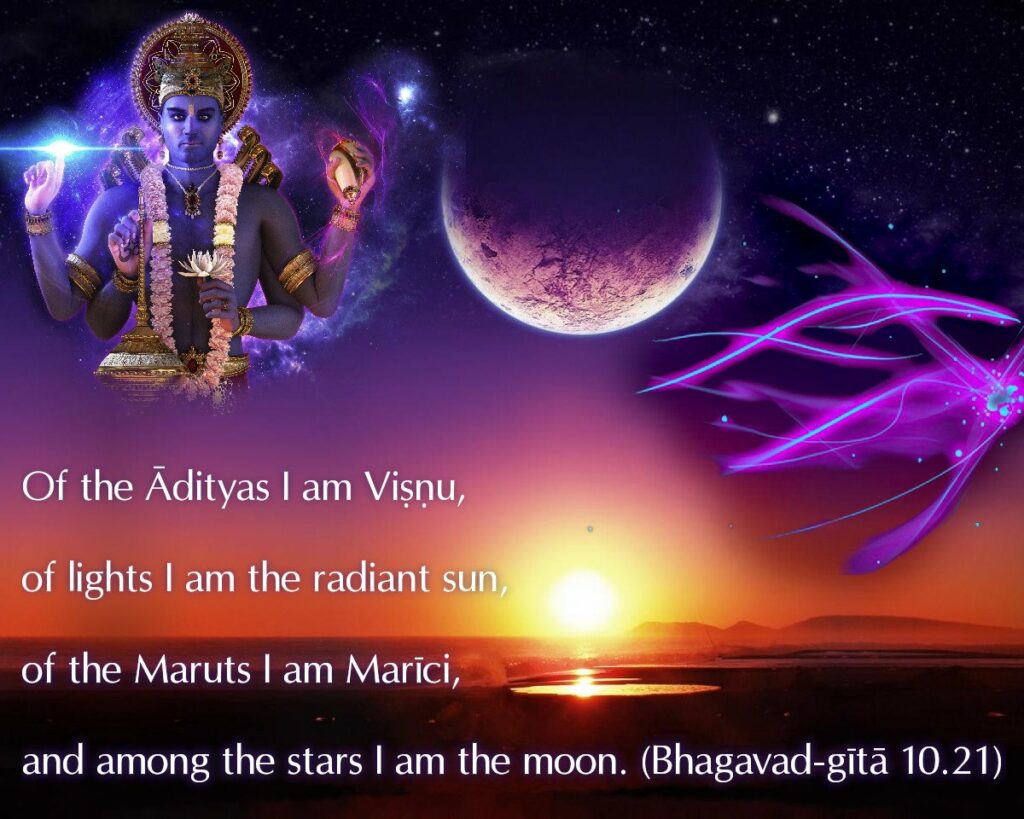
आदित्यानामहं विष्णुर्ज्योतिषां रविरंशुमान् |
मरीचिर्मरुतामस्मि नक्षत्राणामहं शशी || 21||
ādityānām ahaṁ viṣhṇur jyotiṣhāṁ ravir anśhumān
marīchir marutām asmi nakṣhatrāṇām ahaṁ śhaśhī
ādityānām—amongst the twelve sons of Aditi; aham—I; viṣhṇuḥ—Lord Vishnu; jyotiṣhām—amongst luminous objects; raviḥ—the sun; anśhu-mān—radiant; marīchiḥ—Marichi; marutām—of the maruts; asmi—(I) am; nakṣhatrāṇām—amongst the stars; aham—I; śhaśhī—the moon
Translation:
Of the Ādityas I am Vishnu; of lights I am the radiant sun. I am Marichi of the Maruts, and among the orbs of night I am the moon.
Commentary:
The Adityas, sons of Aditi, are twelve (1) Dhata, (2) Mitra, (3) Aryama, (4) Sakra, (5) Varuna, (6) Amsu, (7) Bhaga, (8) Vivasvan, (9) Pusha, (10) Savita, (11) Tvashta, (12) Vishnu. These names are mentioned in the Adi Parva of Mahabharata.
The Lord declares that He is Vishnu among the Adityas, implying that His glory is most manifest in Vishnu. The other beings mentioned should be understood in a similar manner. The Lord has stated that He would mention the most powerful of the manifestations. In the small heap of stones as well as in the Himalayas, He is equally present. Both are His manifestations. And yet, in the Himalayas we see a vaster and mightier manifestation which will satisfy the seeker’s imagination and give him an immediate perception of His Glory.
The Marut Devas are seven: (1) Ahava, (2) Pravaha, (3) Nivaha, (4) Paravaha, (5) Udvaha, (6) Samvaha, (7) Parivaha (Marichi).
—–
A METHOD TO RESOLVE ARGUMENTS
A verse from Sankaracharya’s Bhaja Govindam beautifully illustrates how this can be applied practically. Perhaps two disciples had a quarrel, and one of them became angry with the other. And the disciple who was more evolved spiritually tells the other disciple, “tvayi mayi cānyatraiko viṣṇuḥ vyarthaṃ kupyasi mayyasahiṣṇuḥ—dear, in you, in me and in all, everywhere, there is only one Vishnu. Why unnecessarily quarrel with me? Why are you not able to bear with me—asahiṣṇuḥ?” We are all one, and that knowledge is real love.
In yoga-samādhi, the yogi beholds the entire universe within. The stars, the Sun, the Moon, the whole solar system and the entire universe are beheld within. Through this yogic process, our sages gave shape to Indian astronomy. We can see this in the Bhagavata too, where the universe is described in detail—billions of galaxies, each with millions of solar systems with many planets. After explaining all this, the Bhagavata ecstatically remarks that it is the infinite body of Vishnu. This entire cosmos is described as one whole. (Source: Srimad Bhagavad Gita – Elixir of Eternal Wisdom | Vol 1)
Bhagavad Gita: Chapter 10 🔻 (42 Verses)