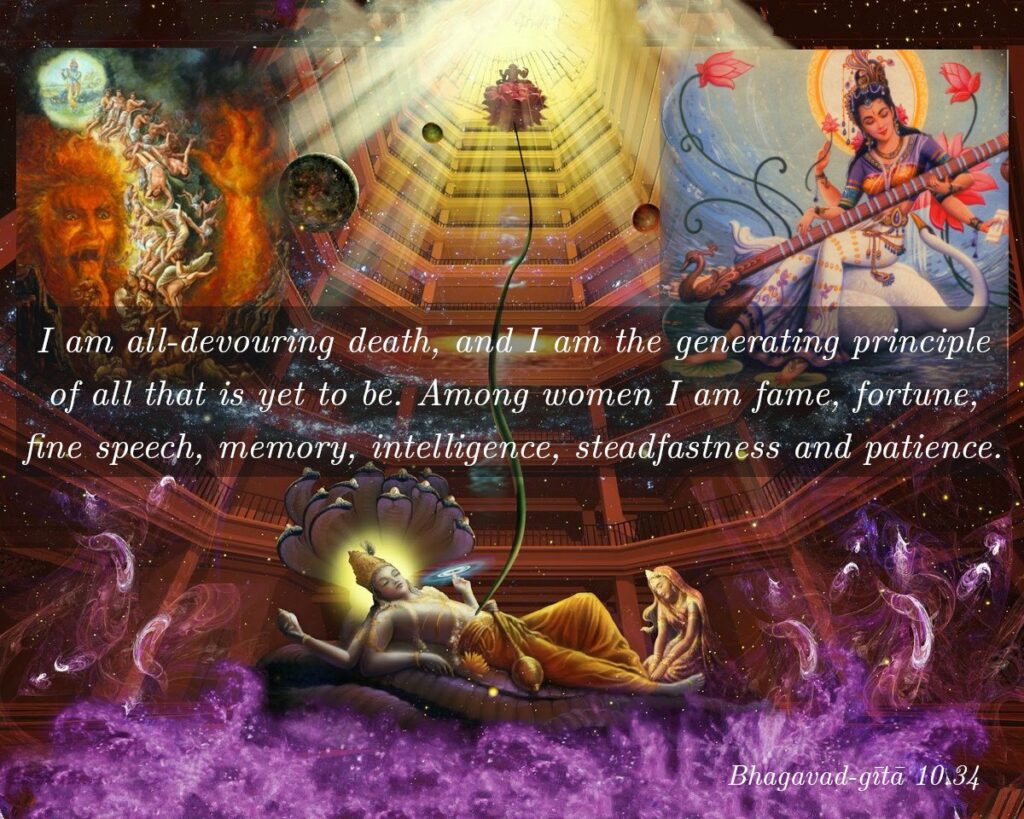
मृत्यु: सर्वहरश्चाहमुद्भवश्च भविष्यताम् |
कीर्ति: श्रीर्वाक्च नारीणां स्मृतिर्मेधा धृति: क्षमा || 34||
mṛityuḥ sarva-haraśh chāham udbhavaśh cha bhaviṣhyatām
kīrtiḥ śhrīr vāk cha nārīṇāṁ smṛitir medhā dhṛitiḥ kṣhamā
mṛityuḥ—death; sarva-haraḥ—all-devouring; cha—and; aham—I; udbhavaḥ—the origin; cha—and; bhaviṣhyatām—those things that are yet to be; kīrtiḥ—fame; śhrīḥ—opulence; vāk—fine speech; cha—and; nārīṇām—amongst feminine qualities; smṛitiḥ—memory; medhā—intelligence; dhṛitiḥ—courage; kṣhamā—forgiveness
Translation:
I am all-seizing Death. I am the prosperity of those who are to be prosperous, and of female powers I am Glory, Fortune, Speech, Memory, Intelligence, Constancy, and Forbearance.
Commentary:
Seven virtues among women are mentioned by the Lord. Where these virtues are, whether in men or women, all are qualified for the highest realisation. Women are not weak; they have also in them the Divinity that lifts them up to the plane of spiritual realisation. The point to note is that where these qualities are found, there the Lord is.
The second line of the verse is interpreted in another way. Prasuti, the daughter of Svayambhuva Manu, married Dakshaprajapati, and to them were born twenty-four daughters. Among them there are Kirti Devi, Medha Devi, Dhriti Devi, Smriti Devi and Kshama Devi. Sri Devi is the daughter of Bhrigu. Vagdevi is the daughter of Brahma (creator). These seven are the presiding Deities of the seven virtues. The Lord here declares that He is all these seven feminine virtues. Whatever the interpretation maybe it is clear that the functioning of these virtues is due to the Lord Himself.
This verse is an inspiring call to women to give up all superstitious notions about their weakness or lowness, and stand up to realise what is their birth-right along with men and Gods.
MAHABALI’S SURRENDER TO LORD VAMANA
Mahabali’s life is a stellar example of this. When Vamana asked for everything from Mahabali, he gave it all away joyfully. When the asuras objected to this, Mahabali told them, “It is the Lord who gave us everything, and now He is taking it away. Why should we grieve over it?” He is kāla, and He will, otherwise, devour us. If you renounce fully from your heart and offer everything to the Lord with devotion, then even death will be delightful. (Source: Srimad Bhagavad Gita – Elixir of Eternal Wisdom | Vol 1)
Bhagavad Gita: Chapter 10 🔻 (42 Verses)