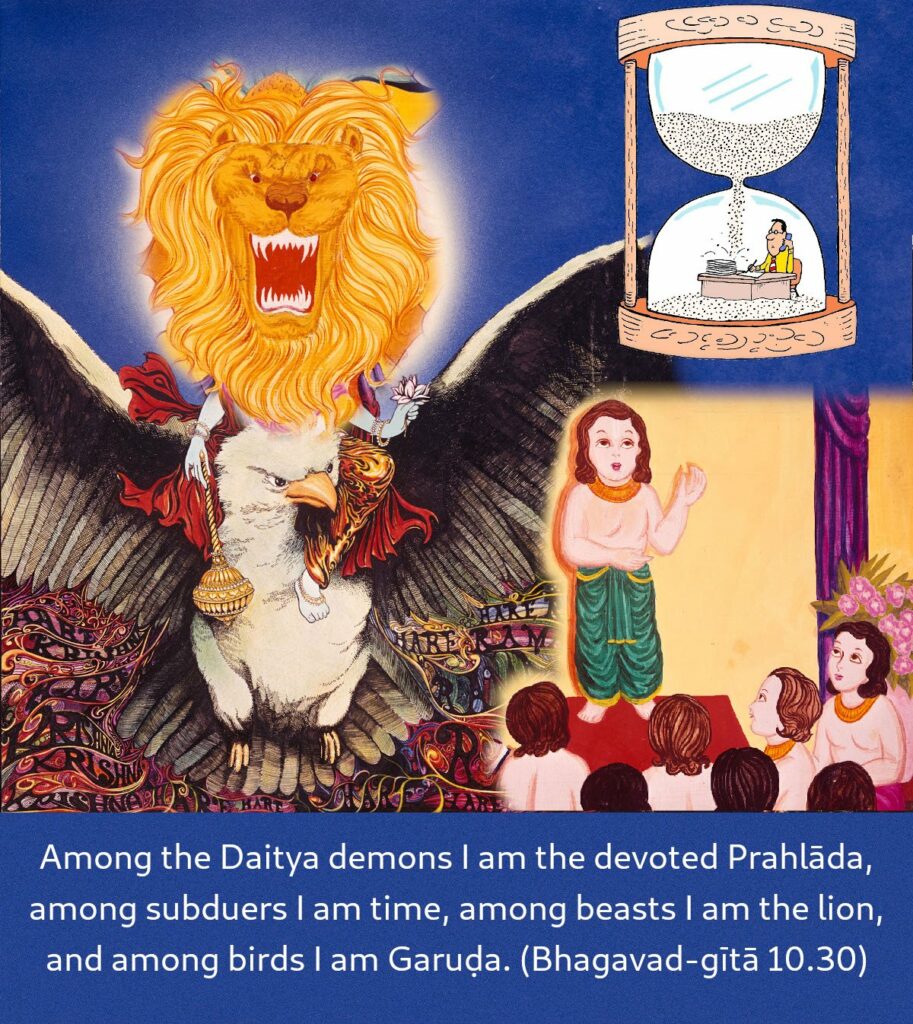
प्रह्लादश्चास्मि दैत्यानां काल: कलयतामहम् |
मृगाणां च मृगेन्द्रोऽहं वैनतेयश्च पक्षिणाम् || 30||
prahlādaśh chāsmi daityānāṁ kālaḥ kalayatām aham
mṛigāṇāṁ cha mṛigendro ’haṁ vainateyaśh cha pakṣhiṇām
prahlādaḥ—Prahlad; cha—and; asmi—I am; daityānām—of the demons; kālaḥ—time; kalayatām—of all that controls; aham—I; mṛigāṇām—amongst animals; cha—and; mṛiga-indraḥ—the lion; aham—I; vainateyaḥ—Garud; cha—and; pakṣhiṇām—amongst birds
Translation:
Of the Daityas I am Prahlāda, and of measurers I am Time. Of beasts I am the lion, and of birds I am Garuda.
Commentary:
Prahlada is a Daitya, born in the race of Asuras, as the son of Hiranyakasipu, the king of Daityas, who denied the very existence of God and conquered the whole world by his power. And yet all the power of Hiranyakasipu was of no avail when he had to deal with his own little child Prahlada, who was born with Brahmajnana by the grace of Narada. The Daitya King tried all weapons at his command to kill Prahlada, but nothing could destroy the child who was one with the Lord Himself. So the Lord here declares that He is Prahlada among the Daityas. In the supreme state of Bhakti, the devotee and the Lord are one. Though the child was born in the demonical race, yet he could attain Divinity and perfection. So, race and birth are of no importance in spiritual enlightenment. Everyone can seek for it and find it by the very purity of his heart and the intensity of his devotion.
The Lord is Time, the reckoner. Time embodies all actions and brings forth their effects inevitably. Time is precious, and the seekers have to use it most carefully for their self-purification and spiritual advancement.
We find that beasts and birds are mentioned among the highest manifestations of the Lord. Gajendra is an elephant, Garuda is a bird – and yet they could attain Divinity by their devotion. Will it then be anything impossible for a rational man to attain the highest state? Turning away from material things of momentary nature, let all men realise the divinity of their real Self.
GARUDA’S APPEARANCE IN THE RAMAYANA
vainateyaśca pakṣiṇām. Vainateya is Garuda, and he is well known as the vehicle of Vishnu. “Among birds, I am Garuda,” says Bhagavan. Garuda is also known as Suparṇa—the golden bird. Garuda is in fact not separate from the Lord. In the Ramayana, when Lakshmana was severely injured by Indrajit’s nāgāstra and was lying as if dead, suddenly a strange presence filled the war field and an immense Being appeared there in the form of a huge bird. The moment Rama saw it, his heart leaped with joy. Lakshmana too woke up free of the bondage of the serpent weapon. Then, Rama asked, “Who are you? When I look at you, I feel I am seeing my own Self.” Without referring to himself as a bird, Garuda replied, “I am your own Self, O Rama. You and I are not different, but now in this human form of yours, you do not remember me.” Garuda, therefore, is Jñāna that makes us free of all bondage. The Bhagavata says, “suparṇam upadhāvata—attain that jñāna which is suparṇa, which is of the form of Garuda.” (Source: Srimad Bhagavad Gita – Elixir of Eternal Wisdom | Vol 1)
Bhagavad Gita: Chapter 10 🔻 (42 Verses)