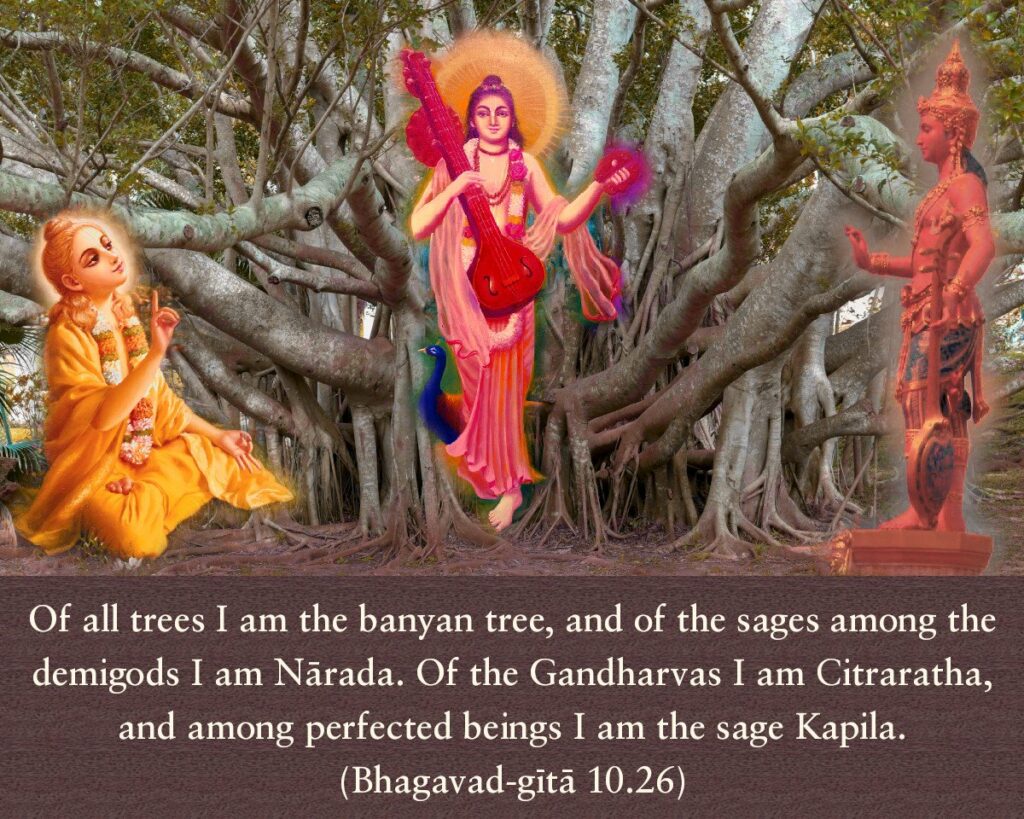
अश्वत्थ: सर्ववृक्षाणां देवर्षीणां च नारद: |
गन्धर्वाणां चित्ररथ: सिद्धानां कपिलो मुनि: || 26||
aśhvatthaḥ sarva-vṛikṣhāṇāṁ devarṣhīṇāṁ cha nāradaḥ
gandharvāṇāṁ chitrarathaḥ siddhānāṁ kapilo muniḥ
aśhvatthaḥ—the peepul tree (sacred fig tree); sarva-vṛikṣhāṇām—amongst all trees; deva-ṛiṣhīṇām—amongst celestial sages; cha—and; nāradaḥ—Narad; gandharvāṇām—amongst the gandharvas; chitrarathaḥ—Chitrarath; siddhānām—of all those who are perfected; kapilaḥ muniḥ—sage Kapil
Translation:
Of all trees, I am the aśvattha(peepal), and of the devarshis I am Nārada. Of the Gandharvas I am Chitraratha, and of the perfected ones I am the sage Kapila.
Commentary:
The sanctity and miraculous power of this Aswattha tree is mentioned in the Puranas. The Aswattha is the very embodiment of Vishnu from the roots to the leaves. Its fruits are Hari; under its shade, great souls reside. Those who seek shelter under it are blessed with fulfillment of all their desires. They derive spiritual benefit and divine virtues. Therefore people worship this tree in various ways. It is also used for medicinal purposes.
THE INSPIRATION FOR THE RAMAYANA AND THE BHAGAVATA
While Narada’s Bhakti-sūtra stands as the supreme authority on bhakti, the Sage’s other work, the Narada-Parivrajaka-Upanishad stands as the authority for the path of renunciation—sannyāsa-dharma. Narada was also the primary inspiration behind two great spiritual texts. One is the great epic Ramayana, and the other the Bhagavata Purana. These two books are epic commentaries on Narada’s Bhakti-sūtra. Narada narrated a condensed version of the Ramayana to Valmiki, and from that came forth the magnificent story of Rama written by the sage Valmiki. He appeared before Sage Vyasa at the right moment and initiated the Bhagavata.
Vyasa, the mighty sage who had written all the eighteen Puranas and the Mahabharata, was in a peculiar state of depression. He felt unfulfilled, not for himself, but out of his deep compassion, he wanted to reach out to every spiritual seeker. His works—the Puranas and the Mahabharata—had somehow failed to touch the hearts of all. Vyasa was rather discouraged about this. He was staying in his ashram at Badri when, at that opportune moment, sage Narada appeared there. He came floating in the sky and manifested before Vyasa with melodious music flowing out of his veeṇa. Vyasa revealed the sadness in his heart to Narada and sought guidance from the sage.
Narada replied, “O Sage, your pain is like the delivery pain. A divine work is waiting inside you; it is waiting to come out. It will soon manifest. Just keep quiet and merge your mind in samādhi, and you shall give birth to the most magnificent spiritual book, the Srimad Bhagavata, the story of Lord Krishna. In that work, you will speak only about God and nothing else. That book will be revered and worshipped by all. It will infuse bhakti, jñāna and vairāgya in the deserving devotees, and through that book, a galaxy of saints shall come forth through their stories.”
Thus initiated by Narada, Vyasa was truly inspired. Narada made Vyasa sit in samādhi. Vyasa had the vision of the Bhagavata in this state of samādhi.* And through him, the divine story of the Lord descended to the world. Thus Narada was the cause behind the creation of the Bhagavata. In the Bhagavata, we see that Narada initiated great devotees such as Prahlada, Dhruva, and Prachinabarhis; he was also the guru for many devotees, including even Krishna’s father Vasudeva. In the Ekadasa Skandha, Vasudeva prays to Narada to initiate him into the mysteries of Bhagavata Dharma. And with great compassion, Narada initiated Vasudeva. (Source: Srimad Bhagavad Gita – Elixir of Eternal Wisdom | Vol 1)
TYAGARAJA SWAMI RECEIVES SPIRITUAL SUCCOUR
Narada is one of the nitya-sūris—eternal saints. Vyasa Bhagavan writes in the Brahmasutra that sages like Narada are ever present here. Even today, if a seeker suffers and deserves to be guided by sages like Narada or Vasishtha, they will appear before him and guide him. Narada is a guru in the world of music as well. Recently, a century and a half ago, the great Saint Tyagaraja went through a similar stage of gloom. He was overcome with several doubts regarding the science of music and spiritual life, which bothered him.
One day, a Brahmin appeared in his house and requested something to eat. With great bhakti, Tyagaraja Swami and his devout wife served food to the Brahmin. After taking bhiksha, the Brahmin handed over a book titled Swarārṇava to Tyagaraja and told him that that book would clear all his doubts and give him spiritual fulfilment. Tyagaraja started leafing through the book, and as he read the verses, he saw that all his doubts were disappearing, and he was also feeling spiritually nourished and fulfilled. With his eyes still poring over the book, he asked, “O Revered Brahmin! How did you get this book? Are you a musician?” He heard the reply, “I play the veeṇa. My mother too plays the veeṇa.” When Tyagaraja looked up, he saw no one there. The Brahmin had disappeared. Intuitively, he felt that it was the great sage Narada who had appeared in the form of the Brahmin to give him the greatest blessing. (Source: Srimad Bhagavad Gita – Elixir of Eternal Wisdom | Vol 1)
Bhagavad Gita: Chapter 10 🔻 (42 Verses)