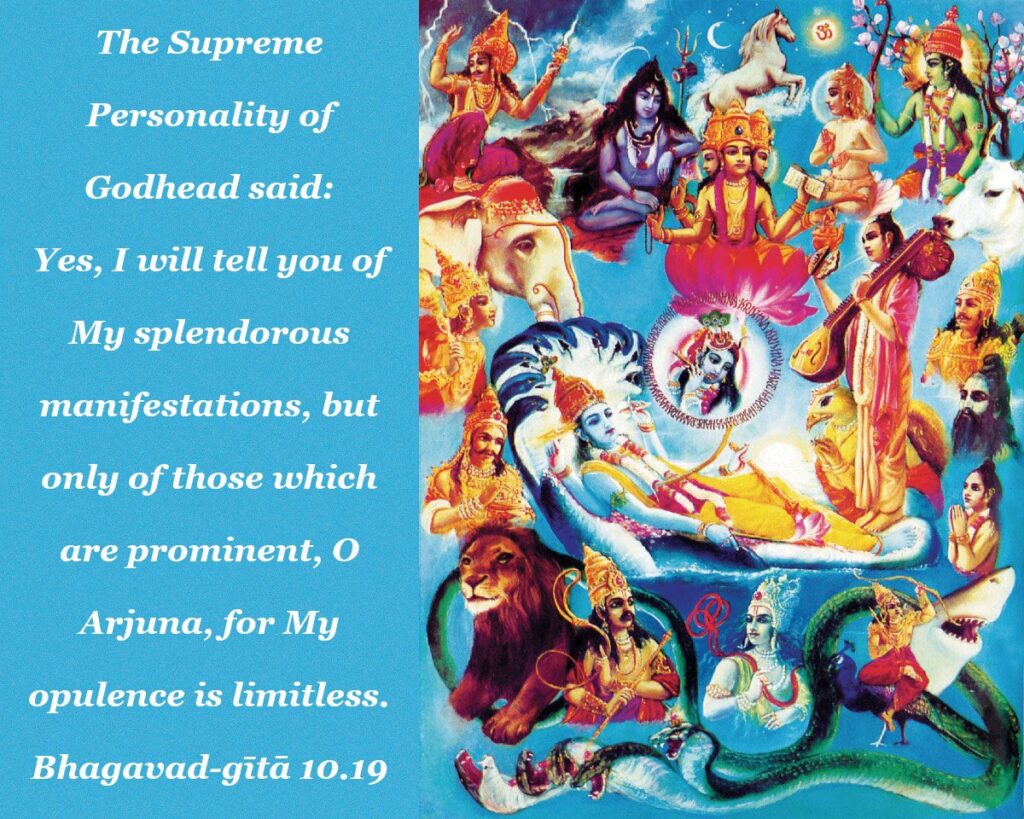
श्रीभगवानुवाच |
हन्त ते कथयिष्यामि दिव्या ह्यात्मविभूतय: |
प्राधान्यत: कुरुश्रेष्ठ नास्त्यन्तो विस्तरस्य मे ||19||
śhrī bhagavān uvācha
hanta te kathayiṣhyāmi divyā hyātma-vibhūtayaḥ
prādhānyataḥ kuru-śhreṣhṭha nāstyanto vistarasya me
śhrī-bhagavān uvācha—the Lord spoke; hanta—yes; te—to you; kathayiṣhyāmi—I shall describe; divyāḥ—divine; hi—certainly; ātma-vibhūtayaḥ—my divine glories; prādhānyataḥ—salient; kuru-śhreṣhṭha—best of the Kurus; na—not; asti—is; antaḥ—limit; vistarasya—extensive glories; me—my
Translation:
The Lord said: I will tell you now of My divine attributes, Ο best of the Kurus— only of those that are pre-eminent; for there is no limit to My extent.
Commentary:
Indeed, where can there be an end to the glorious manifestation of the Lord? He is infinite, and so His Glory is infinite. That is why the Lord declares only the most excellent in which the seeker could easily discover the Lord’s presence. In fact, there is not a particle of matter or energy or intelligence or virtue which is not a manifestation of the Lord. This universality of outlook and inner understanding is the highest form of devotion.
—–
Sri Ramakrishna Says —
MASTER (to the devotees): “To lean against a bolster!” (Rich and aristocratic persons seeking comfort generally sit in this fashion.) You see, it is very difficult to give up vanity. You may discriminate, saying that the ego is nothing at all; but still it comes, nobody knows from where. A goat’s legs jerk for a few moments even after its head has been cut off. Or perhaps you are frightened in a dream; you shake off sleep and are wide awake, but still you feel your heart palpitating. Egotism is exactly like that. You may drive it away, but still it appears from somewhere. Then you look sullen and say: ‘What! I have not been shown proper respect!'”
KEDAR: “‘One should be lowlier than a straw and patient as a tree.'”
MASTER: “As for me, I consider myself as a speck of the dust of the devotee’s feet.”
Vaidyanath arrived. He was a well-educated man, a lawyer of the High Court of Calcutta. With folded hands he saluted the Master and took his seat at one side.
SURENDRA (to the Master): “He is one of my relatives.”
MASTER: “Yes, I see he has a nice nature.”
SURENDRA: “He has come here because he wants to ask you a question or two.”
MASTER (to Vaidyanath): “All that you see is the manifestation of God’s Power. No one can do anything without this Power. But you must remember that there is not an equal manifestation of God’s Power in all things. Vidyasagar once asked me whether God endowed some with greater power than others. I said to him; ‘If there are no greater and lesser manifestations of His Power, then why have we taken the trouble to visit you? Have you grown two horns?’ So it stands to reason that God exists in all beings as the All-pervasive Power; but the manifestations of His Power are different in different beings.” (Source: Gospel of Sri Ramakrishna)
—–
“Why do I feel so restless for Rakhal, Narendra, and the other youngsters? Hazra once asked me, ‘When will you think of God if you are always anxious about these boys?’ (Keshab and the others smile.) That worried me greatly. I prayed to the Divine Mother: ‘Mother, see what a fix I am in! Hazra scolds me because I worry about these young men.’ Afterwards I asked Bholanath about it. He said to me that such a state of mind is described in the Mahabharata. How else will a man established in samadhi occupy his mind in the phenomenal world, after coming down from samadhi? That is why he seeks the company of devotees endowed with sattva. I gave a sigh of relief when Bholanath told me of the Mahabharata.
“Hazra is not to blame. During the period of struggle one should follow the method of discrimination — ‘Not this, not this’ — and direct the whole mind to God. But the state of perfection is quite different. After reaching God one reaffirms what formerly one denied. To extract butter you must separate it from the buttermilk. Then you discover that butter and buttermilk are intrinsically related to one another. They belong to the same stuff. The butter is not essentially different from the buttermilk, nor the buttermilk essentially different from the butter. After realizing God one knows definitely that it is He who has become everything. In some objects He is manifested more clearly, and in others less clearly. (BG 10.17, BG 10.19)
“When a flood comes from the ocean, all the land is deep under water. Before the flood, the boat could have reached the ocean only by following the winding course of the river. But after the flood, one can row straight to the ocean. One need not take a roundabout course. After the harvest has been reaped, one need not take the roundabout course along the balk of the field. One can cross the field at any point.
“After the realisation of God, He is seen in all beings. But His greater manifestation is in man. Again, among men, God manifests Himself more clearly in those devotees who are sattvic, in those who have no desire whatever to enjoy ‘woman and gold’. Where can a man of samadhi rest his mind, after coming down from the plane of samadhi? That is why he feels the need of seeking the company of pure-hearted devotees, endowed with sattva and free from attachment to ‘woman and gold’. How else could such a person occupy himself in the relative plane of consciousness? (Source: Gospel of Sri Ramakrishna)
Bhagavad Gita: Chapter 10 🔻 (42 Verses)