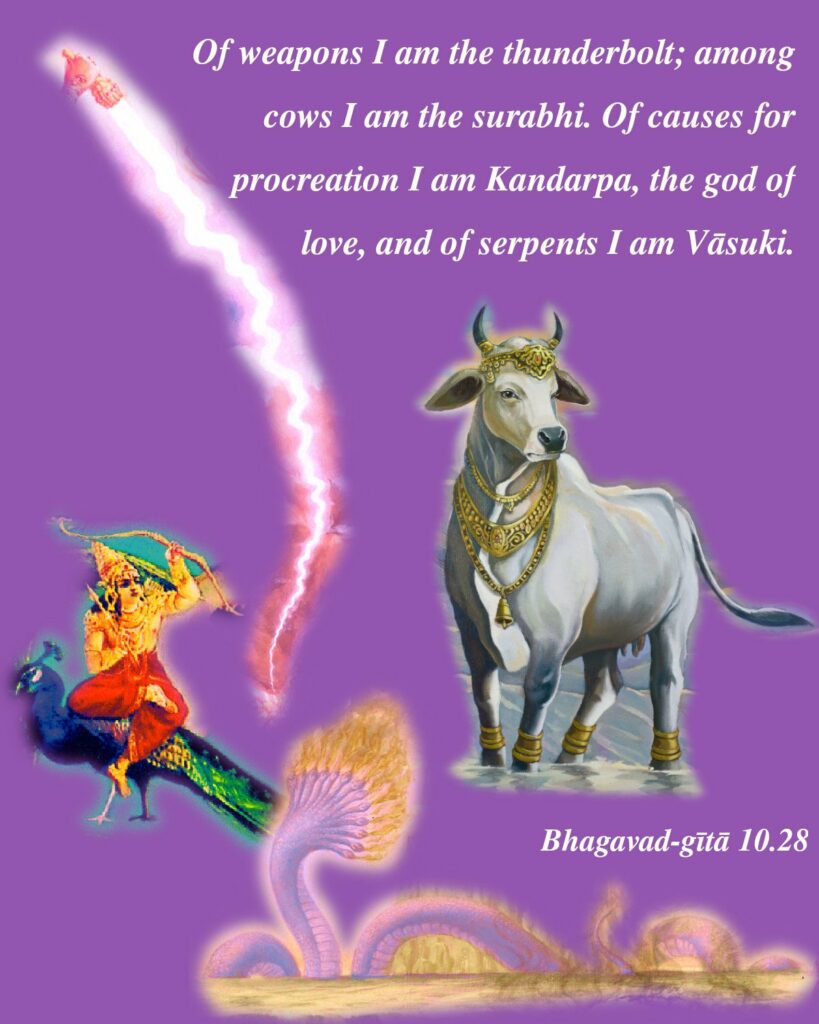
आयुधानामहं वज्रं धेनूनामस्मि कामधुक् |
प्रजनश्चास्मि कन्दर्प: सर्पाणामस्मि वासुकि: || 28||
āyudhānām ahaṁ vajraṁ dhenūnām asmi kāmadhuk
prajanaśh chāsmi kandarpaḥ sarpāṇām asmi vāsukiḥ
āyudhānām—amongst weapons; aham—I; vajram—the Vajra (thunderbolt); dhenūnām—amongst cows; asmi—I am; kāma-dhuk—Kamdhenu; prajanaḥ—amongst causes for procreation; cha—and; asmi—I am; kandarpaḥ—Kaamdev, the god of love; sarpāṇām—amongst serpents; asmi—I am; vāsukiḥ—serpent Vasuki
Translation:
Of weapons I am the thunderbolt; of cows I am Kāmadhenu. I am Manmadha, the cause of offspring and of serpents I am Vāsuki.
Commentary:
AN IDEAL OF SELFLESSNESS AND SACRIFICE
“āyudhānāmahaṃ vajram—among the weapons, I am the Vajrāyudha,” says Bhagavan. The gadha and the chakra are the weapons of Lord Narayana. No other weapon can equal the Sudarshana Chakra, but Bhagavan does not refer to those divine weapons. Here, the Lord purposely refers to the Vajra, the weapon of Indra. This is because the weapons that the Lord wears are all part and parcel of His being; they are not separate from Him. The Vajrāyudha, on the other hand, represents immense austerity. The uniqueness of the Vajrāyudha is that it is infused with the spiritual power of the great sage Dadheechi.
This story is present in the Bhagavata. The devas could not, by any means, kill the fierce and mighty asura Vritra by their own power. Ultimately, they found out that he could be killed only by the power of austerity—by the presence of a great spiritual sage inside their weapon. They approached Sage Dadheechi and begged him to hand over his spiritual power. The Sage, who was a personification of austerity and perfection, voluntarily gave them his entire spiritual energy to make the Vajrāyudha for universal welfare. Remaining in samādhi, he gave up his body for the conquest of evil. Thus was created the thunderbolt weapon with which Vritra was vanquished.
The way the Vajrāyudha was made puts forth an ideal for a spiritual seeker. The willing sacrifice of a person for a higher cause or the well-being of many invites the Divine to manifest. This holy act is represented allegorically by the weapon of Vajra. The Lord is present where true sacrifice is present. (Source: Srimad Bhagavad Gita – Elixir of Eternal Wisdom | Vol 1)
Bhagavad Gita: Chapter 10 🔻 (42 Verses)