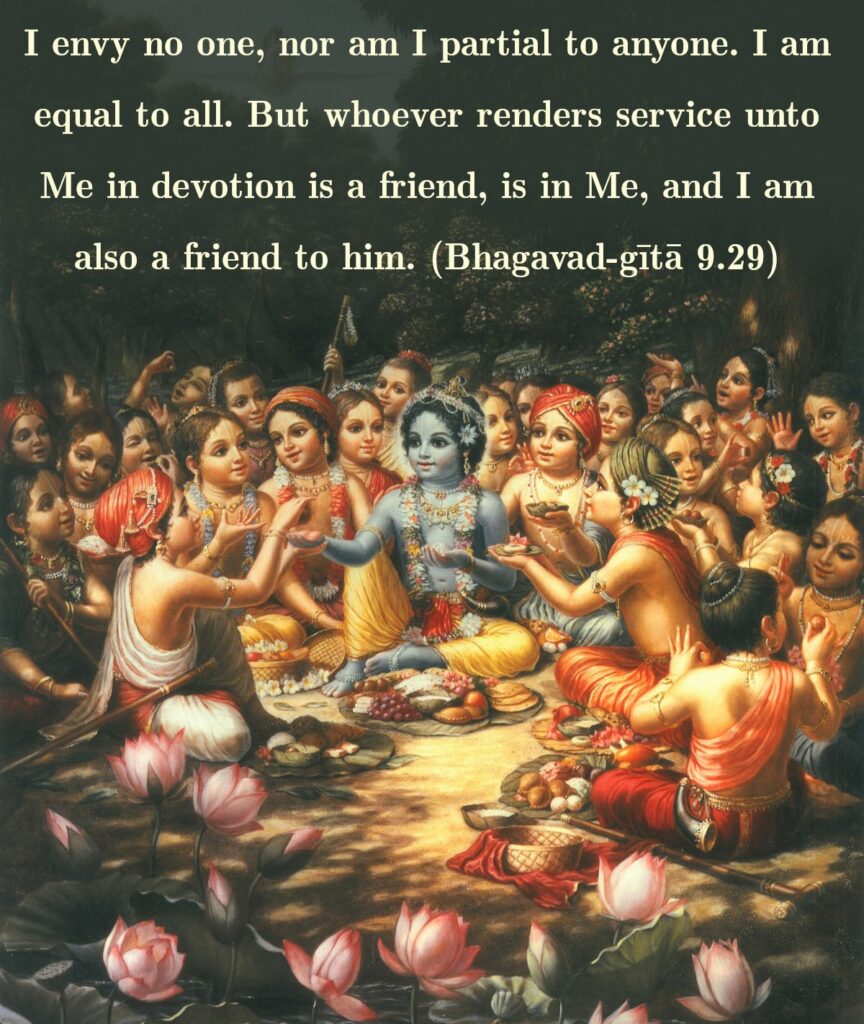
समोऽहं सर्वभूतेषु न मे द्वेष्योऽस्ति न प्रिय: |
ये भजन्ति तु मां भक्त्या मयि ते तेषु चाप्यहम् || 29||
samo ’haṁ sarva-bhūteṣhu na me dveṣhyo ’sti na priyaḥ
ye bhajanti tu māṁ bhaktyā mayi te teṣhu chāpyaham
samaḥ—equally disposed; aham—I; sarva-bhūteṣhu—to all living beings; na—no one; me—to Me; dveṣhyaḥ—inimical; asti—is; na—not; priyaḥ—dear; ye—who; bhajanti—worship with love; tu—but; mām—Me; bhaktyā—with devotion; mayi—reside in Me; te—such persons; teṣhu—in them; cha—and; api—also; aham—I
Translation:
I am the same toward all beings; to Me there is none hateful or dear. But those who worship Me with devotion— they are in Me, and I too am in them.
Commentary:
This declaration of the Lord that He is the same to all beings should be carefully noted by all aspirants. The Lord does not hate any being, nor is any being dear to Him. His grace is overflowing for all people. To make Him responsible for the good and evil things that come to man in the course of this life is utter nonsense. And yet even learned people are so deluded that they complain against God in moments of crisis and calamity. The Lord has nothing to do with the ups and downs, losses and gains, pleasures and pains of all beings. Each one reaps the fruits of his own thoughts and actions. One reaps what he sows. The law is universal and eternal. Let the seeker realise the full responsibility for the good and bad that comes to him. Let him never shift the blame to anyone else.
Though the Lord is the same to all beings, they are not all the same to Him. Hatred and malice lead people into evil and this evil causes sorrow and misery. Some enlightened souls avoid such thoughts and feelings and cultivate an attitude of love and friendliness, so they enjoy life better. They come nearer to God and experience bliss and blessedness.
Let no one imagine that God’s grace has not come to him. God’s grace, like the wind, is blowing everywhere. Intrepid sailors spread the sails and make rapid progress on the ocean of spirituality, whereas the lazy remain where they are.
The devotee is assured that the Lord is in them and they are in Him. This is due to the devotion of the aspirant. The Lord is like the fire in the cold season. The nearer one moves towards it, the warmer he feels. The farther away he is, the colder he feels. This is the natural law. The Lord states very clearly that he lives in the hearts of his devotees who worship him with love and devotion. Such a man is the very temple of God. They are God Himself because the Lord is directly manifest in them.
Single-minded devotion leads man to the Supreme Lord, who is present in all beings and who manifests Himself in the heart of the true devotee.
—–
—–
Swami Vivekananda Says —
We do not look at our own faults; the eyes do not see themselves, they see the eyes of everybody else. We human beings are very slow to recognise our own weakness, our own faults, so long as we can lay the blame upon somebody else. Men in general lay all the blame of life on their fellow-men, or, failing that, on God, or they conjure up a ghost, and say it is fate. Where is fate, and who is fate? We reap what we sow. We are the makers of our own fate. None else has the blame, none has the praise. The wind is blowing; those vessels whose sails are unfurled catch it, and go forward on their way, but those which have their sails furled do not catch the wind. Is that the fault of the wind? Is it the fault of the merciful Father, whose wind of mercy is blowing without ceasing, day and night, whose mercy knows no decay, is it His fault that some of us are happy and some unhappy? We make our own destiny. His sun shines for the weak as well as for the strong. His wind blows for saint and sinner alike. He is the Lord of all, the Father of all, merciful, and impartial. Do you mean to say that He, the Lord of creation, looks upon the petty things of our life in the same light as we do? What a degenerate idea of God that would be! We are like little puppies, making life-and-death struggles here, and foolishly thinking that even God Himself will take it as seriously as we do. He knows what the puppies’ play means. Our attempts to lay the blame on Him, making Him the punisher, and the rewarder, are only foolish. He neither punishes, nor rewards any. His infinite mercy is open to every one, at all times, in all places, under all conditions, unfailing, unswerving. Upon us depends how we use it. Upon us depends how we utilise it. Blame neither man, nor God, nor anyone in the world. When you find yourselves suffering, blame yourselves, and try to do better. [Source]
We get only that for which we are fitted. Let us give up our pride and understand this, that never is misery undeserved. There never has been a blow undeserved: there never has been an evil for which I did not pave the way with my own hands. We ought to know that. Analyse yourselves and you will find that every blow you have received, came to you because you prepared yourselves for it. [Source]
We all find ourselves in the position for which we are fit, each ball finds its own hole; and if one has some capacity above another, the world will find that out too, in this universal adjusting that goes on. So it is no use to grumble. There may be a rich man who is wicked, yet there must be in that man certain qualities that made him rich; and if any other man has the same qualities, he will also become rich. What is the use of fighting and complaining? That will not help us to better things. He who grumbles at the little thing that has fallen to his lot to do will grumble at everything. Always grumbling, he will lead a miserable life, and everything will be a failure. But that man who does his duty as he goes, putting, his shoulder to the wheel, will see the light, and higher and higher duties will fall to his share.[Source]
That self is indeed Brahman, as well as identified with the intellect, the Manas and the vital force, with the eyes and ears, with earth, water, air and the ether, with fire, and what is other than fire, with desire and the absence of desire, with anger and the absence of anger, with righteousness and unrighteousness, with everything—identified, as is well known, with this (what is perceived) and with that (what is inferred). As it does and acts, so it becomes; by doing good it becomes good, and by doing evil it becomes evil—it becomes virtuous through good acts and vicious through evil acts. Others, however, say, ‘The self is identified with desire alone. What it desires, it resolves; what it resolves, it works out; and what it works out, it attains.’ (Brihadaranyaka Upanishad 4.4.5)
Sri Ramakrishna Says —
Sri Ramakrishna and the devotees returned to the Master’s room. The conversation turned to Shyamapada Bhattacharya.
BALARAM: “Shyamapada said, ‘When he, the Master, placed his foot on Narendra’s chest, Narendra went into bhava; but I didn’t have that experience.’”
MASTER: “Shall I tell you the truth about it? It is very difficult to gather the dispersed mind when it is attached to ‘woman and gold’. The pundit told me he was called upon to act as arbiter to settle people’s quarrels. Besides, he has to worry about his children. But the minds of Narendra and other youngsters are not scattered like that; they are not yet touched by ‘woman and gold’. But Shyamapada is a grand person.” (Source: Gospel of Sri Ramakrishna)
—
MASTER: “Brahman is beyond vidya and avidya, knowledge and ignorance. It is beyond maya, the illusion of duality.
“The world consists of the illusory duality of knowledge and ignorance. It contains knowledge and devotion, and also attachment to ‘woman and gold; righteousness and unrighteousness; good and evil. But Brahman is unattached to these. Good and evil apply to the jiva, the individual soul, as do righteousness and unrighteousness; but Brahman is not at all affected by them.
“One man may read the Bhagavata by the light of a lamp, and another may commit a forgery by that very light; but the lamp is unaffected. The sun sheds its light on the wicked as well as on the virtuous.
“You may ask, ‘How, then, can one explain misery and sin and unhappiness?’ The answer is that these apply only to the jiva. Brahman is unaffected by them. There is poison in a snake; but though others may die if bitten by it, the snake itself is not affected by the poison. ( Source: Gospel of Sri Ramakrishna)
—-
“Hindus, Mussalmans, Christians, Saktas, Saivas, Vaishnavas, the Brahmajnanis of the time of the rishis, and you, the Brahmajnanis of modern times, all seek the same object. A mother prepares dishes to suit the stomachs of her children. Suppose a mother has five children and a fish is bought for the family. She doesn’t cook pilau or kalia for all of them. All have not the same power of digestion; so she prepares a simple stew for some. But she loves all her children equally. (Source: Gospel of Sri Ramakrishna)
—–
MASTER: “Some people develop bhakti and others do not; how do you explain that, sir?”
PUNDIT: “There is no partiality in God. He is the Wish-fulfilling Tree. Whatever a man asks of God he gets. But he must go near the Tree to ask the boon.”
The pundit said all this in Hindusthani. The Master explained it to M. in Bengali. (Source: Gospel of Sri Ramakrishna)
—–
KEDAR: “Those rishis could not recognize Rama as an Incarnation of God. They must have been fools.”
MASTER (seriously): “Please don’t say such a thing. People worship God according to their tastes and temperaments. The mother cooks the same fish differently for her children, that each one may have what suits his stomach. For some she cooks the rich dish of pilau. But not all the children can digest it. For those with weak stomachs she prepares soup. Some, again, like fried fish or pickled fish. It depends on one’s taste.
“The rishis followed the path of jnana. Therefore they sought to realise Brahman, the Indivisible Existence-Knowledge-Bliss Absolute. But those who follow the path of devotion seek an Incarnation of God, to enjoy the sweetness of bhakti. The darkness of the mind disappears when God is realised. In the Purana it is said that it was as if a hundred suns were shining when Rama entered the court. Why, then, weren’t the courtiers burnt up? It was because the brilliance of Rama was not like that of a material object. As the lotus blooms when the sun rises, so the lotus of the heart of the people assembled in the court burst into blossom.” (See also: BG 11.12)
As the Master uttered these words, standing before the devotees, he suddenly fell into an ecstatic mood. His mind was withdrawn from external objects. No sooner did he say, “the lotus of the heart burst into blossom”, than he went into deep samadhi. He stood motionless, his countenance beaming and his lips parted in a smile.
After a long time he returned to the normal consciousness of the world. He drew a long breath and repeatedly chanted the name of Rama, every word showering nectar into the hearts of the devotees. The Master sat down, the others seating themselves around him. (Source: Gospel of Sri Ramakrishna)
—–
ACTOR: “Revered sir, what you have just said about enjoyment is very true. One ultimately courts disaster if one prays to God for enjoyment. Various desires come to the mind and by no means all of them are good. God is the Kalpataru, the Wish-fulfilling Tree. A man gets whatever he asks of God. Suppose it comes to his mind: ‘God is the Kalpataru. Well, let me see if a tiger will appear before me.’ Because he thinks of the tiger, it really appears and devours him.”
MASTER: “Yes, you must remember that the tiger comes. What more shall I tell you? Keep your mind on God. Don’t forget Him. God will certainly reveal Himself to you if you pray to Him with sincerity. Another thing, Sing the name of God at the end of each performance. Then the actors, the singers, and the audience will go home with the thought of God in their minds.” (Source: Gospel of Sri Ramakrishna)
—–
PUNDIT: “Does God listen to our prayers?“
MASTER: “God is the Kalpataru, the Wish-fulfilling Tree. You will certainly get whatever you ask of Him. But you must pray standing near the Kalpataru. Only then will your prayer be fulfilled. But you must remember another thing. God knows our inner feeling. A man gets the fulfilment of the desire he cherishes while practising sadhana. As one thinks, so one receives. (Source: Gospel of Sri Ramakrishna)
One day the Mother invited Amzad for lunch and served him on the porch of her house. Owing to caste prejudices, Nalini, the Mother’s niece, threw the food at Amzad’s leaf plate from a distance. Holy Mother noticed this and said: “How can one enjoy food when it is served with such scorn? Let me wait on him properly.” After Amzad had finished his meal, Holy Mother cleaned the place where he had sat with her own hands. Nalini shrieked: “Aunt, you have lost your caste!”
“Keep quiet,” the Mother scolded her. Then she added: “As Sharat is my son, exactly so is Amzad.” Sharat was a direct disciple of Ramakrishna, the secretary of the Ramakrishna Mission, and a monk endowed with saintly virtues; Amzad was a Muslim and a convicted robber. Thus Holy Mother demonstrated that she is the Mother of the good and the bad. She also showed that kind treatment can enkindle faith in the heart of a weak, lowly man and prove to him that he is a son of the Divine Mother. Her example brought to life the words of Krishna: “I am the same towards all beings; to Me there is none hateful or dear. But those who worship Me with devotion—they are in Me, and I too am in them.” (Source: Sri Sarada Devi and Her Divine Play)
- The sages look with equal eye on a Brahmana endowed with knowledge and humility, on a cow, on an elephant, on a dog and on the outcaste who feeds on dog’s flesh. (BG 5.18)
Someone once asked Paramhansa Yogananda if he believed in hell. Paramhansaji smiled and asked: “Where do you think you are?” A very good question, indeed.
We write our own ticket by the way we think and act. No amount of rationalization or assurance from others will change this fact. If we seek darkness we will find darkness; if we seek the light we will find the light. Nothing more; nothing less.
“Ask, and it shall be given you; seek, and ye shall find; knock, and it shall be opened unto you: For every one that asketh receiveth; and he that seeketh findeth; and to him that knocketh it shall be opened” (Matthew 7:7-8).
Just be aware of the consequences.
Ramcharitmanas (Uttar Kand)
“Jati-pati-puchha nahi koi, hari ko bhaje so hari ko hoi.”
“Caste or lineage does not matter; whoever worships Hari becomes His own.”
Question: How does God look upon all beings?
Answer: He is the same to all beings.
Question: Why then do some people suffer and others enjoy life?
Answer: It is the result of their own actions. Those who worship the Lord enjoy life, others suffer.
Question: How is God to be worshipped?
Answer: With devotion.
Question: Where does God manifest Himself?
Answer: He manifests Himself in the hearts of the true devotees. In all beings, the Lord exists as ‘sat’ but to those of devotion, He reveals Himself and gives them Moksha.
Bhagavad Gita: Chapter 9 🔻 (34 Verses)