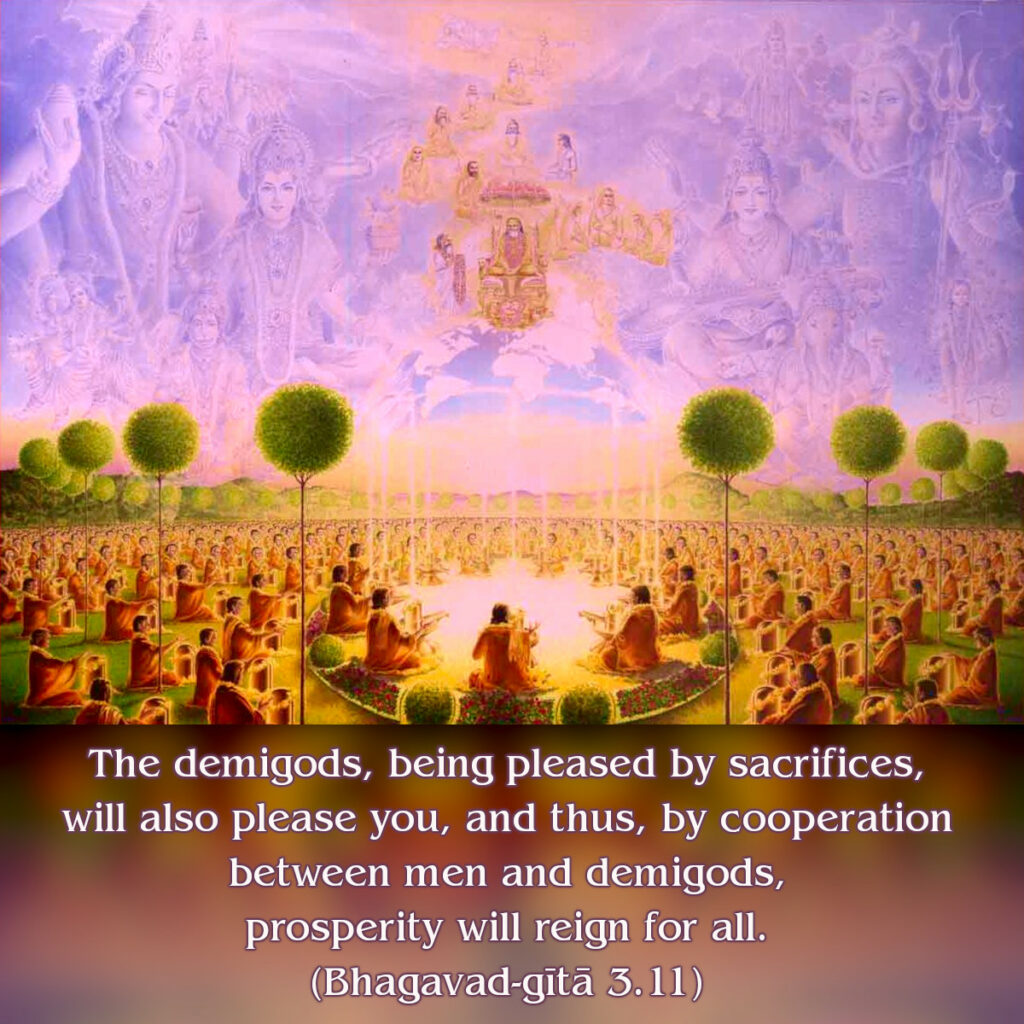
देवान्भावयतानेन ते देवा भावयन्तु व: |
परस्परं भावयन्त: श्रेय: परमवाप्स्यथ || 11||
devān bhāvayatānena te devā bhāvayantu vaḥ
parasparaṁ bhāvayantaḥ śhreyaḥ param avāpsyatha
devān—celestial gods; bhāvayatā—will be pleased; anena—by these (sacrifices); te—those; devāḥ—celestial gods; bhāvayantu—will be pleased; vaḥ—you; parasparam—one another; bhāvayantaḥ—pleasing one another; śhreyaḥ—prosperity; param—the supreme; avāpsyatha—shall achieve
Translation:
Nourish the Gods with Yajna, and they shall nourish you, and thus nourishing one another both men and Gods you shall attain the highest good.
Commentary:
It is the Supreme Lord who appears in the form of different Gods (shining ones) embodying the multifarious powers of the One, ruler of the Universe. So whom-so-ever one worships, without desiring for any material benefits, he is liberated by the mercy of the Supreme Being.
Highest good: In the world, there are many things good and enjoyable, like wealth, children, popularity, prosperity, etc. Of all these, the highest good, namely liberation, is attained by the worship of the Supreme Being, by the worship of the Truth which is covered up the inscrutable power of Maya. Man’s effort and God’s grace are both necessary for liberation.
Even in the common affairs of life, the man who links himself with the Lord finds protection from dangers in the daily turmoil of life and obtains all-around prosperity. Better it is to depend on the Lord than on ordinary mortals who are subject to all the ills of life. They may help or not help according to their self-interest. In any way, such contact with mortal benefactors comes to an end with death. The contact with the Lord continues forever and if man’s devotion is intense enough, he is liberated even in this birth.
DO DEVAS AND THEIR WORLDS EXIST?
When asked by a devotee whether the devas and their worlds exist, Bhagavan Ramana Maharshi replied that they do exist just as this earth and this world exist; they are as real as you are in the body. Maharshi added that this world that we see is relative; it is only a superimposition on the Self. So too, all the worlds and everything that is seen is only a superimposition on the seer; they exist in you, the seer. All the great sages have accepted the relative existence of the higher and lower beings apart from the human world.
Half-baked scientific knowledge has done great harm by draining our reverence towards these higher aspects. Modern society has become dry and unpoetic. It worships dead matter, molecules, atoms, hormones, chemicals—nothing living, let alone the Divine. Factual thinking and demystifying have sucked away the poetic beauty of life.
Ancient sages were not mere thinkers; they were poets—kavis. They were mystics. They perceived the devas through their yogic vision. Each limb of our body is governed by a deva. Each and every force in nature is a deva. In fact, what we call ‘nature’ is a congregation of devas—divine beings. Of course, the cosmic intelligence has purposely withheld from the gross-minded the power to behold these subtle astral beings. (Source: Srimad Bhagavad Gita – Elixir of Eternal Wisdom | Vol 1)
Bhagavad Gita: Chapter 3 🔻 (43 Verses)
Question: How can man attain the highest good?
Answer: Man attains the highest good by the desireless performance of yajna.