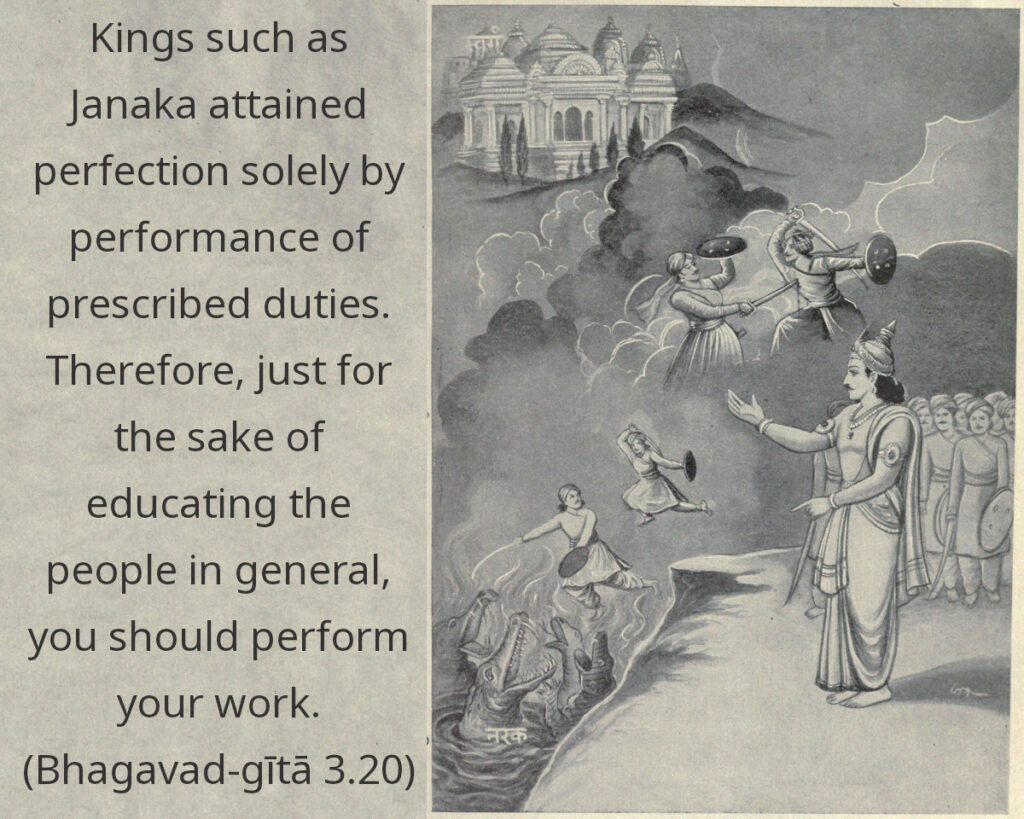
कर्मणैव हि संसिद्धिमास्थिता जनकादय: |
लोकसंग्रहमेवापि सम्पश्यन्कर्तुमर्हसि || 20||
karmaṇaiva hi sansiddhim āsthitā janakādayaḥ
loka-saṅgraham evāpi sampaśhyan kartum arhasi
karmaṇā—by the performance of prescribed duties; eva—only; hi—certainly; sansiddhim—perfection; āsthitāḥ—attained; janaka-ādayaḥ—King Janak and other kings; loka-saṅgraham—for the welfare of the masses; eva api—only; sampaśhyan—considering; kartum—to perform; arhasi—you should;
Translation:
King Janaka and others attained perfection by action. Even having in view the need to show the right path to the masses, you should work.
Commentary:
The principle that man attains liberation by Nishkama karma is illustrated by the example of King Janaka and others like Asvapati, Ikshvaku, Ambarisha, Bhagiradha. They were all emperors who followed the doctrine of Nishkama karma and attained the highest spiritual goal. It is an ancient way of life, and men of the greatest responsibilities in the world understood the secret of the work and practised it in their daily life. Arjuna, a prince of the Royal family of Bharata, could do it. It is an answer to the doubt whether man could attain Moksha while engaged in the practical duties of the world, and whether work could lead to liberation. Nishkama karma purifies the mind and knowledge dawns at once. It is said in the Yoga Vasista that Janaka performed many acts of righteousness without attachment, purified his mind thereby, and by enquiry into the Self, realised the Supreme Being.
The Lord further emphasises the need for good work even from a worldly point of view. Man should work at least to serve mankind, to show them the right path, and to set an example to them. Service to humanity has indeed a very high place in religion and philosophy. Even to help a single individual is indeed a great work. To liberate oneself, and then to lead others to spiritual illumination is undoubtedly the highest act of service to mankind. Wealth and lands, power and position could be won and lost. But emancipation and God-realisation is a blessing to humanity. So the Lord advises Arjuna to work, not only for self-purification but to show the path of work to mankind and help the masses by his personal example.
Sri Ramakrishna Says —
(To Hazra) “A perfect soul, even after attaining Knowledge, practises devotions or observes religious ceremonies to set an example to others. I go to the Kali temple and I bow before the holy pictures in my room; therefore others do the same. Further, if a man has become habituated to such ceremonies, he feels restless if he does not observe them.
“One day I saw a sannyasi under the banyan-tree. He had put the salagram on the same carpet with his guru’s sandals. He was worshipping them. I said to him, ‘If you have attained Knowledge to that extent, then why such formal worship at all?’ He replied: ‘What difference does it make? Since I do everything else, why not this too? Sometimes I offer the flowers at the guru’s feet and sometimes to God.’ (Source: Gospel of Sri Ramakrishna)
—–
Referring to Keshab’s association with “woman and gold”, which had hindered his work as a spiritual teacher, Sri Ramakrishna said to Vijay, “He — do you understand?”
VIJAY: “Yes, sir.”
MASTER: “He couldn’t achieve very much because he wanted to satisfy both God and the world.”
VIJAY: “Chaitanya said to Nityananda: ‘Nitai, I shall not be able to do the people any good unless I renounce the world. All will imitate me and want to lead the life of a householder. No one will try to direct his whole mind to the Lotus Feet of God, renouncing “woman and gold”.'”
MASTER: “Yes. Chaitanyadeva renounced the world to set an example to mankind.
“The sannyasi must renounce ‘woman and gold’ for his own welfare. Even if he is unattached, and consequently not in danger, still, in order to set an example to others, he must not keep ‘woman and gold’ near him. The sannyasi, the man of renunciation, is a world teacher. It is his example that awakens the spiritual consciousness of men.” (Source: Gospel of Sri Ramakrishna)
Disciple: “Have any realized God through mere work?”
Swami Saradananda: “Through selfless work the mind gets purified. And when the mind becomes pure, there arise knowledge and devotion in it. Knowledge is the very nature of the Self but being covered with ignorance it is not manifest. The object of selfless work is to remove this covering. As a matter of fact knowledge dawns as soon as the mind becomes pure. In the Mahabharata you have the story of the chaste lady who attained knowledge through service to her husband and through other household duties. In the Gitâ also you find, ‘By work alone Janaka and others attained perfection.’ Not one but many attained perfection through work, for the text adds ‘and others.”
Disciple: “Does work here mean Japa, meditation, etc?”
Swami Saradananda: “No. That meaning is given by the commentators. If it were so then Shri Krishna would have asked Arjuna to ring bells and wave lights before an image of God. Instead, he made him fight.” (Source: Spiritual Talks by the First Disciples of Sri Ramakrishna)
Swami Turiyananda: “Once Girish Bâbu put the question to the Master, ‘Why have you to practise so hard?’ The Master replied: ‘You know, there is eternal union of Hara (Shiva) with Gauri. Still, why did she practise so much austerity? All that was as an example to others. If I do so much, others will do at least one-sixteenth part of it? Is it not so ?” (Source: Spiritual Talks by the First Disciples of Sri Ramakrishna)
JANAKA — THE JĪVANMUKTA KING
Janaka, as we know, was a virtuous king and a Jñāni. References to him appear in various places in our scriptures. In the Ramayana, we see him as the father of Sita Devi. Whenever Sita expressed deep spiritual insights during her conversations with Rama, Rama would address her with all love as ‘Janakātmaja’—one born from the Self-knowledge of Janaka. In the Mahabharata, Janaka appears as the Guru for the great sage Śuka, son of Sage Vyasa. Vyasa sends Śuka to Janaka for confirmation of Śuka’s Realisation. Śuka needed an authentic confirmation from a Brahmanishṭha. When Janaka confirmed this to Śuka, he got firmly established in the Self without a trace of doubt. This story is found in the Yoga Vasishtha and the Devi Bhagavata.
In the Ashtavakra Samhita, we see a magnificent dialogue between Janaka and the sage Ashtavakra. The most well-known scene of Janaka is in the Brihadaranyaka Upanishad, where a grand exchange takes place between the sage Yajnavalkya and others in Janaka’s royal assembly on the topic of Brahmavidyā. All these reveal Janaka as an Illumined Sage. Even though an emperor, he was called Videha—the one who is body-less, that is, a jīvanmukta. We must remember that he was not a monk but a busy ruler and a family man too. Such a one ever remained as Brahman. This reveals that the secret of a jīvanmukta is beyond the ken of sensory perceptions. “ Who can infer his inner state?” asks Bhagavan Ramana Maharshi. (Source: Srimad Bhagavad Gita – Elixir of Eternal Wisdom | Vol 1)
A CONVERSATION BETWEEN RAMA AND SITA
In the Valmiki Ramayana, when Rama entered the forest of Dandaka, the rishis who lived there implored him to protect them from the flesh-eating demons, who were a constant source of trouble for them. Rama said to them, “Yes, I have come here only to do that. My dharma is to protect the sages, and I shall do that.” Hearing this, Sita asked Rama, “Why should you interfere in the life of other people? Why don’t you give up all these weapons, follow the dharma of Sages and Brahmins, and be peaceful, ever immersed in meditation like them in this forest?”
These words of Sita were like melodious music to Rama’s ears. He appreciated her wisdom and replied, “By speaking thus, you reveal that you are indeed the daughter of Janaka. But, O Janaki, I cannot give up my dharma. I am born as a Kshatriya; I am a ruler. That is my dharma. Protecting the sages is indeed a highly noble deed. It must be done. I will never give that up.” This conversation happens in the Valmiki Ramayana, which reveals that Rama, although a Knower of Brahman—a jīvanmukta—still performed his dharma as a warrior.
During their stay in the forest, many a time, Rama taught the knowledge of the Self to Sita and Lakshmana. In the Valmiki Ramayana, he tells Kaikeyi,* “O Mother, know me to be equal to a rishi. I am established in the dharma of the sages, the Upanishad dharma.” That is Rama! (Source: Srimad Bhagavad Gita – Elixir of Eternal Wisdom | Vol 1)
Bhagavad Gita: Chapter 3 🔻 (43 Verses)