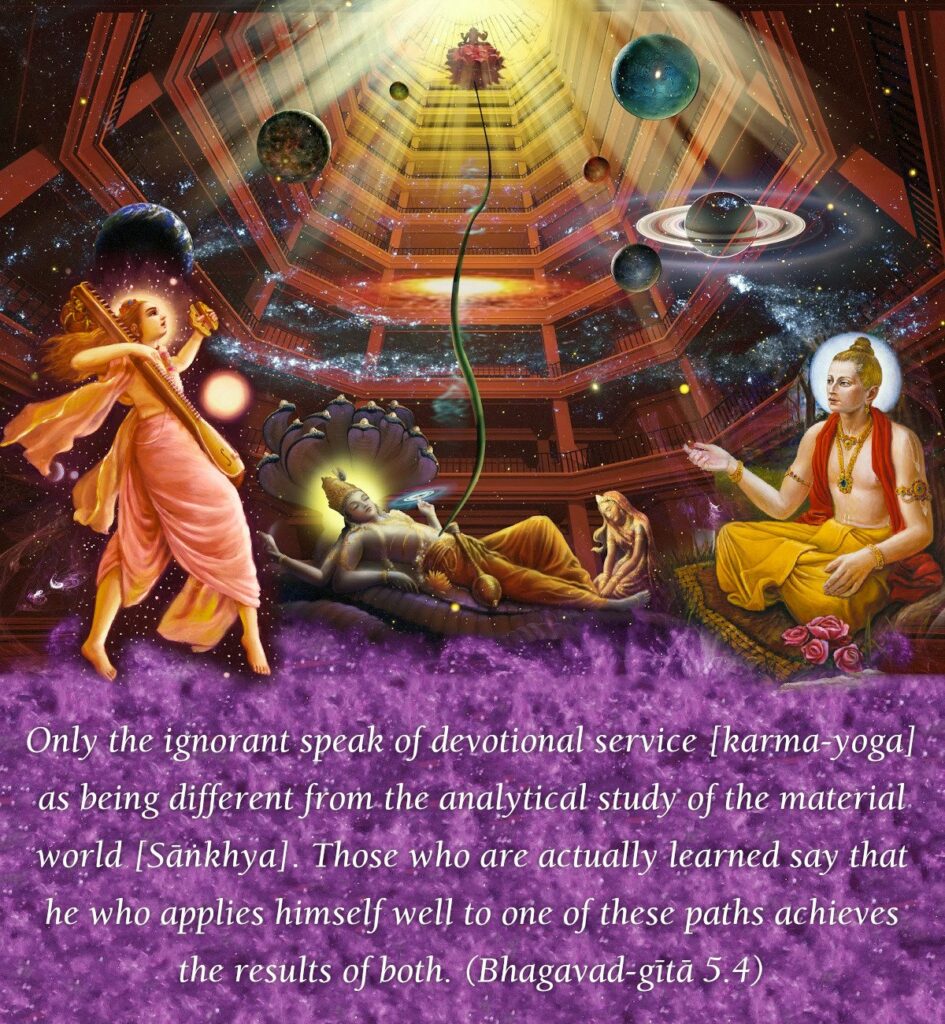
साङ्ख्ययोगौ पृथग्बाला: प्रवदन्ति न पण्डिता: |
एकमप्यास्थित: सम्यगुभयोर्विन्दते फलम् || 4||
sānkhya-yogau pṛithag bālāḥ pravadanti na paṇḍitāḥ
ekamapyāsthitaḥ samyag ubhayor vindate phalam
sānkhya—renunciation of actions; yogau—karm yog; pṛithak—different; bālāḥ—the ignorant; pravadanti—say; na—never; paṇḍitāḥ—the learned; ekam—in one; api—even; āsthitaḥ—being situated; samyak—completely; ubhayoḥ—of both; vindate—achieve; phalam—the result
Translation:
Children, not the wise, say that Jnana yoga and karma yoga are distinct: He who is truly established in either of them obtains the fruit of both.
Commentary:
The Pandit mentioned here is the sage who knows the Truth and lives in it, and not a man of mere theoretical knowledge of the Sastras and the scriptures. Only the ignorant say that karma yoga and jnana yoga are distinct and separate. The Lord makes the categorical declaration that the fruit of both the yogas is the same and that the Sadhaka who takes to one of them and is well established in it, will attain the highest fruit of both. Direct perception of Atma is the aim of all yogas. Some highly evolved men follow Jnana marga. They carry on the inquiry into the real nature of things and separate the Drik (the Seer) from the Drisya (the phenomenal world) as the mythical swan is able to separate milk and water. Thus they realise Atma through Jnana marga. Others, according to their natural tendencies, take to Karma marga, and through desireless action and surrender of the fruits to the Lord, reach the same goal of Atma-sakshatkara by their purified minds. The reward of freedom, liberation, is the same for both, only the paths differ. So, in both, the seeker aims at the absorption of the ego into the Self, and thereby transcends the feeling of personal doership. When the Jiva-idea is given up, what remains is only Sivatvam and nothing else. So the Lord exhorts the aspirant to take up either of the two yogas and practice it well.
Truly established in: The condition is that the practice of any yoga should be perfect and the sadhaka should be firmly established in it. He should become an expert in the technique of the yoga which he follows. Then alone the desired result follows.
The history of the world provides many examples of great men who followed different paths and achieved the highest aim of life. The wisest of men in the Jnana marga have done the greatest service to humanity by their work. The greatest Karma yogis have always experienced Atma Jnana through a realisation of the universality of the Self in all their acts and achievements. Of course, it is quite clear that what man is aiming at is the destruction of his personal separateness from the universal, the merging of the Self in the universal Self and the realisation of the universe in his own self.
No wise man has ever disputed the truth of the different religions and creeds of the world. They practice not only tolerance but universal acceptance of all doctrines as paths to one goal. The radio of a circle reaches the centre from different positions and paths. The rivers reach the ocean through different ways. So one should give up narrowness and do not corp and cavil at those who do not follow the same path as his. Let there be a greater understanding and larger outlook in these matters which concern the people most. This is the message of the Lord.
—–
Swami Vivekananda Says —
The yogas of work, of wisdom, and of devotion are all capable of serving as direct and independent means for the attainment of moksha. “Fools alone say that work and philosophy are different, not the learned.” The learned know that, though apparently different from each other, they at last lead to the same goal of human perfection.[Source]
Swami Turiyananda: “Some look upon these works as inferior to meditation. They do not know what they say. What is meditation? Why is it so highly looked upon? Because it is the way to the soul’s union with God. Now let us see what Swamiji who initiated the works meant. Did he ask you to merely attend on the patients or to worship Nârâyana in and through them? How then is this worship of Nârâyana different from meditation? It may be one cannot serve in this spirit, but one has no right therefore to call it inferior. Swamiji proclaimed this new path after realizing the Self as immanent in all things. But people do not understand it, and so want to move in the old grooves of spiritual practice. Three days of such service done in the right way will bring about spiritual realization. Such indeed has been the experience of everyone who has tried it. K-has told me that in those days when he was working in the hospital, he would always feel highly lifted up in spirit. Is not every man God Himself? ‘The Lord abides in every heart.’ If one fails to realize this, it is one’s own fault, none else’s.
“Once when I made known to Shri Ramakrishna that my life’s ideal was to attain Nirvâna, he reproved me for entertaining such a low ideal. He said, ‘The ordinary man yearns for Nirvana. Have you not seen in a game of dice how cautiously the neophyte moves his pieces, keeping them in pairs to escape being checkmated, and how anxious is he to reach “home”! But the expert takes no caution. He deliberately turns down his pieces even when very near “home” so that the play might go on. And the dice become so attuned in his hands that he can cast any number he likes. Yes, the “expert” remains in the world and yet enjoys its fun. I was extremely astonished at the statement, and on my expressing a doubt, he reassured me that it was quite possible through the grace of the Mother. ‘She graciously makes the dice so attuned,’ he said metaphorically.” (Source: Spiritual Talks by the First Disciples of Sri Ramakrishna)
Related Articles:
- Some by meditation perceive the Self in themselves through the mind, some by devotion to knowledge, and some by devotion to work. (BG 13.25)
Question: Are Sankhya and Karma yogas separate?
Answer: No. They appear different but produced the same fruit.
Question: What then should be the objective of the seeker?
Answer: He should sincerely practice his chosen system and get firmly established in it. He will then attain the fruit of both the yogas.
Bhagavad Gita: Chapter 5 🔻 (29 Verses)