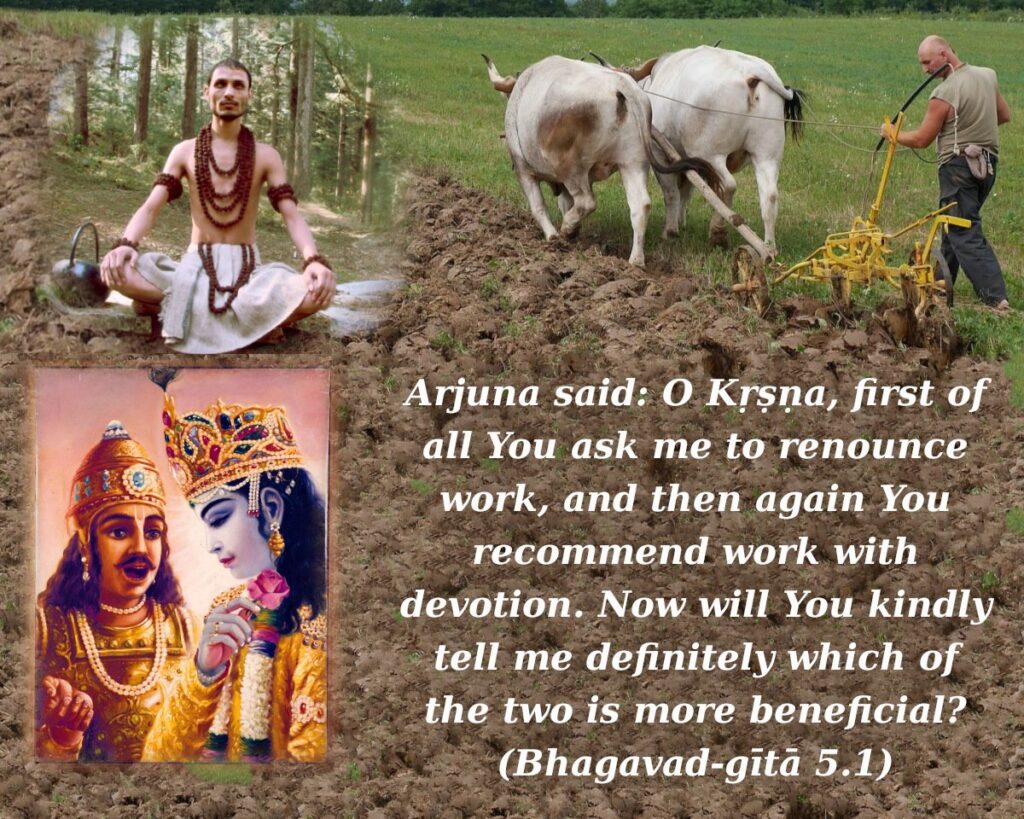
अर्जुन उवाच |
संन्यासं कर्मणां कृष्ण पुनर्योगं च शंससि |
यच्छ्रेय एतयोरेकं तन्मे ब्रूहि सुनिश्चितम् || 1||
arjuna uvācha
sannyāsaṁ karmaṇāṁ kṛiṣhṇa punar yogaṁ cha śhansasi
yach chhreya etayor ekaṁ tan me brūhi su-niśhchitam
arjunaḥ uvācha—Arjun said; sanyāsam—renunciation; karmaṇām—of actions; kṛiṣhṇa—Shree Krishna; punaḥ—again; yogam—about karm yog; cha—also; śhansasi—You praise; yat—which; śhreyaḥ—more beneficial; etayoḥ—of the two; ekam—one; tat—that; me—unto me; brūhi—please tell; su-niśhchitam—conclusively
Translation:
Arjuna Said: O Krishna! You praise renunciation of actions and again the yoga of action. Of these two which is s better? That one, tell me conclusively.
Commentary:
The Lord has taught two main doctrines, one of Karma and the other of Jnana through renunciation of actions.
These two paths are equally emphasised. Arjuna listened attentively to the teaching on both sides and felt a natural doubt about the superiority of either of the two. The Lord clears the doubt.
——
DO WE NEED TO RENOUNCE FAMILY?
Bhagavan Ramana Maharshi’s presence had the power to induce the state of dispassion in many. A householder-devotee is said to have complained to the Sage, “Bhagavan! I find family life quite unconducive for pursuing spiritual practice. It is challenging to do Self-enquiry while working in the world. Shall I renounce the field of action and take to sannyāsa?” The Sage smiled compassionately and replied, “What has the world or family done to you that you want to renounce them? They are all in your mind. Now you think yourself to be a householder; if you were to renounce and don ochre robes, you would think yourself to be a renunciate. In both cases, ignorance remains unaffected. Whether a family man or a sannyāsi, you identify with the body. Instead, if you enquire ‘WHO AM I’, know that you are not the body and realise the real nature of the ‘I’, the Self within, then, whether you work in the world or not, you are a sannyāsi.” This was the beautiful answer of the Sage. (Source: Srimad Bhagavad Gita – Elixir of Eternal Wisdom | Vol 1)
Related Articles:
Bhagavad Gita: Chapter 5 🔻 (29 Verses)