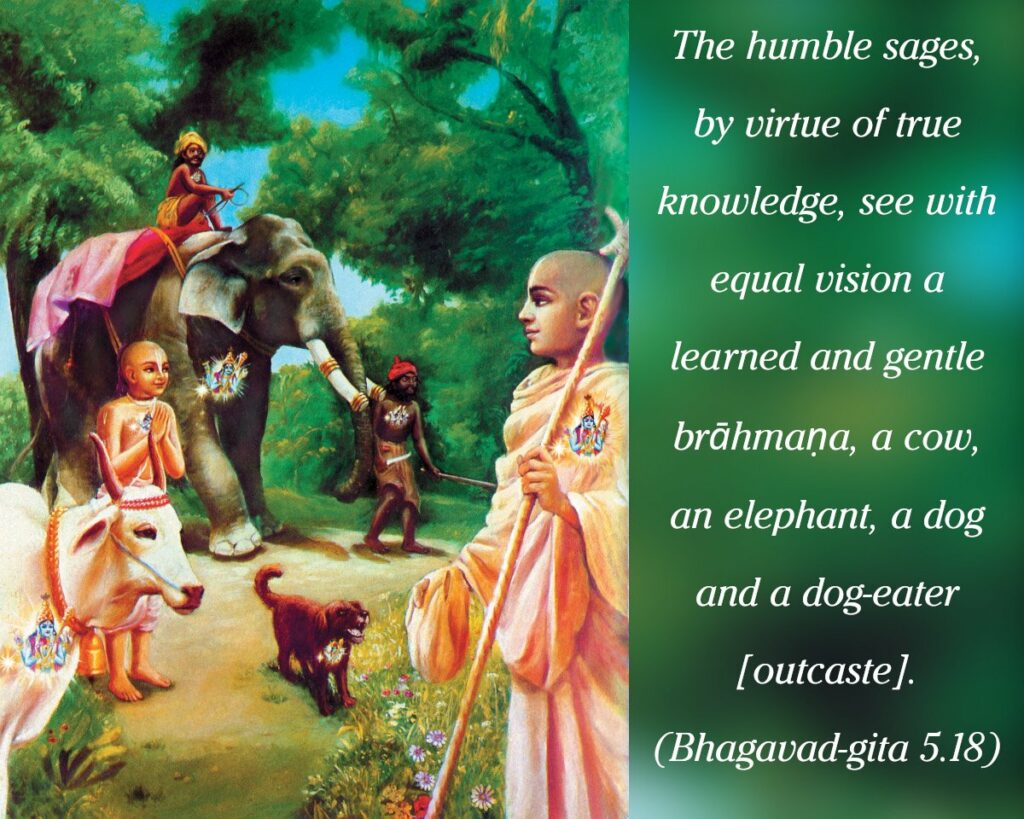
विद्याविनयसम्पन्ने ब्राह्मणे गवि हस्तिनि |
शुनि चैव श्वपाके च पण्डिता: समदर्शिन: || 18||
vidyā-vinaya-sampanne brāhmaṇe gavi hastini
śhuni chaiva śhva-pāke cha paṇḍitāḥ sama-darśhinaḥ
vidyā—divine knowledge; vinaya—humbleness; sampanne—equipped with; brāhmaṇe—a Brahmin; gavi—a cow; hastini—an elephant; śhuni—a dog; cha—and; eva—certainly; śhva-pāke—a dog-eater; cha—and; paṇḍitāḥ—the learned; sama-darśhinaḥ—see with equal vision
Translation:
The sages look with equal eye on a Brahmana endowed with knowledge and humility, on a cow, on an elephant, on a dog and on the outcaste who feeds on dog’s flesh.
Commentary:
Sages who have acquired Brahmajnana see everything as Brahman. In all the varied manifestations of nature, they see the underlying substratum (i.e) Atma, and so they do not make any distinction between one thing and another. For them, all that exists, whatever the name and form may be, is made of one substance – Brahman (Atma). So they have love and compassion for all the creatures without distinction of high or low, caste and creed, and so on. The Brahmana here stands for the highest purity. The outcaste (svapaka) represents the lowest order of human beings. The sage looks upon both with an equal eye, because the background for the highest spiritual giant and the meanest wretch is Brahman and nothing else. Is the vision of the sage confined to humans only? No. His vision embraces all the created beings. So the elephants, dogs the cows are mentioned to represent the animal kingdom. It means animals, birds, reptiles and all living creatures without any exception at all, are included in the universal vision of the sage. All are Brahman. One who looks upon all these equally is the man of real Knowledge.
Each man is looking at things from a particular plane of vision. The most ignorant man looks upon objects only from the physical plane. He considers only the colour, stature, race, caste and so on. This is bodily outlook ‘dehadrishti’ the mere apprehension of the outermost fringes of all beings, the mere flesh and blood estimate. They are pleased or displeased according to these physical distinctions. The second class of persons look upon objects from the mental plane. They consider the character of man, his mental makeup, his intellectual powers, and other talents which are exhibited in him. This is mental-outlook (manodrishti). The highest class of people look upon all things from the spiritual plane, and they find God or the Reality in everyone. They penetrate to the innermost recesses of the heart through the outer coverings of the mind and body. Their vision is that of the One Brahman (Atma) being the essence of all things. This is Atmic outlook (Atmadrishti). All that exists is God. Out of that one substance, all the apparent distinctions and differences of name and form are created by the power of Maya. If a number of golden ornaments are given for sale to a jeweller, he sees them all as gold, and weighs and values them accordingly. All pots are made of earth. The reality in all of them is the earth. Thus the sages see the all-pervading Atma everywhere. Hence they possess equal vision. This is Jnana.
Love for all is the highest attribute of God. The Jnani has such love extended to all beings. This is the universality of the Gita message. All artificial limitations are transcended by the realisation of the Self. Brotherhood of man is no doubt a great ideal. But the love of the Jnani does not stop there. He finds the same Self in all beings. The ultimate goal is cosmic love, the identification of one’s self with all that exists. In the human organism, there are different organs, like hands, legs, eyes etc. If one of the limbs is affected, the whole body feels the pain. So it is that the Jnani feels pained when any part of the universe suffers. We come across exceptional men who ave reached this state, who take upon themselves the sorrows and sufferings of other beings, just because they see the same Self in all.
This universal love is the test of jnana. To know that Atma is the one indwelling principle of creation as a whole is to enter the plane of cosmic love and unity. In this, the application of the Vedantic doctrine of oneness in practical life is clearly declared.
—–
Swami Vivekananda Says —
Those of you who have studied the Gita will remember the memorable passages: “He who looks upon the learned Brahmin, upon the cow, the elephant, the dog, or the outcast with the same eye, he indeed is the sage, and the wise man.”[Source]
The real Vedantist alone will give up his life for a fellow-man without any compunction, because he knows he will not die. As long as there is one insect left in the world, he is living; as long as one mouth eats, he eats. So he goes on doing good to others; and is never hindered by the modern ideas of caring for the body. When a man reaches this point of abnegation, he goes beyond the moral struggle, beyond everything. He sees in the most learned priest, in the cow, in the dog, in the most miserable places, neither the learned man, nor the cow, nor the dog, nor the miserable place, but the same divinity manifesting itself in them all. He alone is the happy man; and the man who has acquired that sameness has, even in this life, conquered all existence.[Source]
Last of all will come self-surrender. Then we shall be able to give ourselves up to the Mother. If misery comes, welcome; if happiness comes, welcome. Then, when we come up to this love, all crooked things shall be straight. There will be the same sight for the Brahmin, the Pariah, and the dog. Until we love the universe with same-sightedness, with impartial, undying love, we are missing again and again. But then all will have vanished, and we shall see in all the same infinite eternal Mother.[Source]
One day the Mother (Sri Sarada Devi) invited Amzad for lunch and served him on the porch of her house. Owing to caste prejudices, Nalini, the Mother’s niece, threw the food at Amzad’s leaf plate from a distance. Holy Mother noticed this and said: “How can one enjoy food when it is served with such scorn? Let me wait on him properly.” After Amzad had finished his meal, Holy Mother cleaned the place where he had sat with her own hands. Nalini shrieked: “Aunt, you have lost your caste!”
“Keep quiet,” the Mother scolded her. Then she added: “As Sharat is my son, exactly so is Amzad.” Sharat was a direct disciple of Ramakrishna, the secretary of the Ramakrishna Mission, and a monk endowed with saintly virtues; Amzad was a Muslim and a convicted robber. Thus Holy Mother demonstrated that she is the Mother of the good and the bad. She also showed that kind treatment can enkindle faith in the heart of a weak, lowly man and prove to him that he is a son of the Divine Mother. Her example brought to life the words of Krishna: “I am the same towards all beings; to Me there is none hateful or dear. But those who worship Me with devotion—they are in Me, and I too am in them.” (BG 9.29) (Source: Sri Sarada Devi and Her Divine Play)
SANT NAMADEVA AND THE DOG
This is an incident from the life of the great devotee Namadeva. Namadeva spent many days immersed in meditation in a forest. Whenever he woke up from meditation, he would sing song after song of love and ecstasy on his beloved Lord Vittala. Two days passed in this way. On the third day, his wife, searching for him everywhere, finally found him in the jungle. She beseeched him to eat the roti and dal she had brought as he had not eaten anything for two days. He said, “Dear, put it down. My Vittala is dancing in my Heart. When I open my eyes, the trees are all His forms, the green leaves are nothing but His hair, the sky is He, the earth is He, you are He, and the roti also appears as Him. How can I eat now? The eater, the food, and the eating are all Vittala. Keep it down and go.” Accustomed to her husband’s ways, she did so and left.
After some time, a dog came by. Namadeva was in deep meditation. The dog took the roti, which was kept nearby and ran away with it. When Namadeva opened his eyes and saw this, he ran behind the dog. He went near the dog, cajoled it, did a namaskāra to it and said, “O Vittala, you are eating the dry roti without ghee? Come, let me put some ghee on it.” Saying this, he smeared ghee on all the rotis and offered them along with the dal. He had the full vision of the divinity hidden in the dog. He did not see the dog; he saw only his beloved Vittala. When the devotee sees God, there is no dog; the dog is gone.
Those who have paṇḍā—the knowledge of the Self—are paṇḍitāḥ. Such ones are inwardly illumined. Theirs is a divine vision through which they behold the Self in everyone’s heart. When a Jñāni looks at the world, he beholds the same Self everywhere. Only when you know the Self in yourself will you be able to behold it everywhere. The same Light is seen shining all around by the Illumined Sage. In that state, he beholds everyone and everything as the Self. Such a one is a samadarśī.
Waves, eddies, bubbles and icebergs are seen in the ocean, but they are all made of water. When we see them as water, we only see the advaita—the non-dual Truth.* A gold bangle, a gold bracelet, and a gold ring are of different names and shapes, but when we behold only the gold in them, we see the oneness or sameness of gold in them. Similarly, when the Self is known, the sage beholds That behind all the names and forms. He does not fail to behold the divine element in all. (Source: Srimad Bhagavad Gita – Elixir of Eternal Wisdom | Vol 1)
Seeing behind the deed
At Ramakrishna Mission, Narendrapur, the rule of law implemented by Swami Lokeswaranandaji was the rule of love. One night as I was returning to the hostel through the vast acres of property, barely populated, I saw a man stealing jackfruits and caught him red-handed. We took away the jackfruits and kept him captive. We eagerly waited for the morning when we could present the thief before Lokeswarananda Maharaj and boast of our bravery. We secretly wished that Maharaj would hand him over to us and we could thrash him properly. When we brought the thief with all the stolen jackfruits before Maharaj, he said, “Since you have brought him to me, I should give the judgment, isn’t it? So, you please go.” We had to come out; but we decided to hide and see what Maharaj would do.
We heard him asking the thief, “Do you have a family?” “I have my wife and sons, Maharaj.” “And what is the means of your livelihood?” “Maharaj, I am a daily-wage labourer. But when there is no work available, I struggle to run the family.” At this reply, we could see a deep strain of pain on Maharaj’s face. He then asked, “What will you do with these few jackfruits?” “I will sell them and with whatever little money I get I will buy some provisions for the family.”
Maharaj stood up, and sent him off with some money along with all the jackfruits and something else which we could not make out. He also said, “Whenever you are in need, come to me. But do not steal.”
Seeing this, I walked up to Maharaj and asked, “What did you do Maharaj?” He replied, “Did you not hear that he struggles to feed his family? What suffering!” Maharaj’s expression revealed his intense sadness.
— Dr. Prashanta Giri
Connection to the story: The boys saw a criminal; Maharaj saw the Divine wrapped in the garb of a suffering laborer. His sama-darśhinaḥ (equal vision) allowed him to treat the man with the exact same dignity and care he would offer to a respected guest.
THE SAGE’S SAME-SIGHTEDNESS
Bhagavan Ramana Maharshi was the perfect embodiment of the same-sightedness eulogised in this verse. Whatever or whoever came to him, he saw only the Self in them. Brahmins, outcastes, aristocrats, simple villagers, animals, birds, and trees… all, all were the same for him because he saw only the Self in them and not the body or the mind. They too behaved freely with him.
With the same dignity of a human being, the cow Lakshmi would move amidst the crowd, go to the Sage, and with great love, put her face on his tummy. He would say, “She has put on the attire of a cow; you have put on the attire of a human being, that is all.” It is well known among Maharshi’s devotees that the cow Lakshmi was proclaimed as an Enlightened Being by the Sage, and the samādhi of the cow is maintained and worshipped in the ashram to this day.
There was a dog in the ashram which used to sit in the hall of Maharshi like a monk, with closed eyes. The dog always sat only on an ochre robe. He would eat only after the Sage tasted the food. Maharshi used to consider the dog as a monk, a saint. There were also birds—peacocks, crows, and many other creatures, even squirrels. With all of them, the Sage behaved as if they were human beings.
In those days, people would not freely mix with the outcastes, who used to cut wood in the hills. They would frequently come to Skandashram, the hermitage on the hill, where Maharshi was living with some disciples. Maharshi would give them water and sometimes gruel. One day, they came there saying that they were hungry. At that time, Mother Alagammal, who had renounced the world, was also residing there. She was very orthodox and would cook her own food with utmost cleanliness, untouched by others. Using this opportunity to free her of her orthodox ways, Maharshi asked her to give food to these ‘untouchables’.
He said, “See, they are all very hungry. Bring the food you have cooked for yourself and distribute it among them.”
Mother hesitated and said, “If I give them food before I eat, I will have to take a bath and cook again.”
Maharshi reproached her, “Do you think they are all unclean and untouchable? Come and look at them. They are all Arunachala-svarūpa. Do not see them as their body; see them as the Self.”
These powerful words worked like magic, and Mother Alagammal had the vision of the Divine in all the bodies. Her orthodoxy vanished at that very moment. She was established in Ātmabhāva. Without any hesitation, she distributed the food among them. (Source: Srimad Bhagavad Gita – Elixir of Eternal Wisdom | Vol 1)
SANT JNANESWARA AND THE BUFFALO
Here is a beautiful anecdote about saint Jnaneswar that reveals this vision of the Self in every creature. It is said that Jnaneswara and his brothers were once seated amongst the learned Brahmins of Paithan. Intending to deride Jnaneswara, the leader of the assembly said, “What kind of a jñāni are you? What is the jñāna that you speak about?” Jnaneswara, quoting this Gita verse, replied, “Looking at everything, everyone as the same Self, is Jñāna.” Hearing this, the scholars laughed. Pointing to a buffalo, the leader challenged Jnaneswara, “You say that a Brahmin and a buffalo are the same. Will this buffalo chant the Vedas?” Jnaneswara said, “Of course not, as it is not the nature of a buffalo to chant the Vedas. A buffalo is a buffalo, and a Brahmin’s body is a Brahmin’s body. But the same Self resides in both. Anything is possible for the omnipotent One within.”
To reveal this to them, Jnaneswara performed a miracle there. He touched the buffalo and said, “O Vittala, chant the Veda.” Soon the buffalo started chanting the Veda in its deep buffalo voice! Seeing this spectacle, all were awestruck. They fell flat at Jnaneswara’s feet and said, “O Lord, you are not an ordinary person. You could make even the buffalo chant the Vedas!” Jnaneswara said, “This is just a feat performed to reveal to you that the same Self inhabits all forms.” (Source: Srimad Bhagavad Gita – Elixir of Eternal Wisdom | Vol 1)
Question: Who is a wise man?
Answer: He who looks with an equal eye on all beings is the man of real wisdom.
Bhagavad Gita: Chapter 5 🔻 (29 Verses)