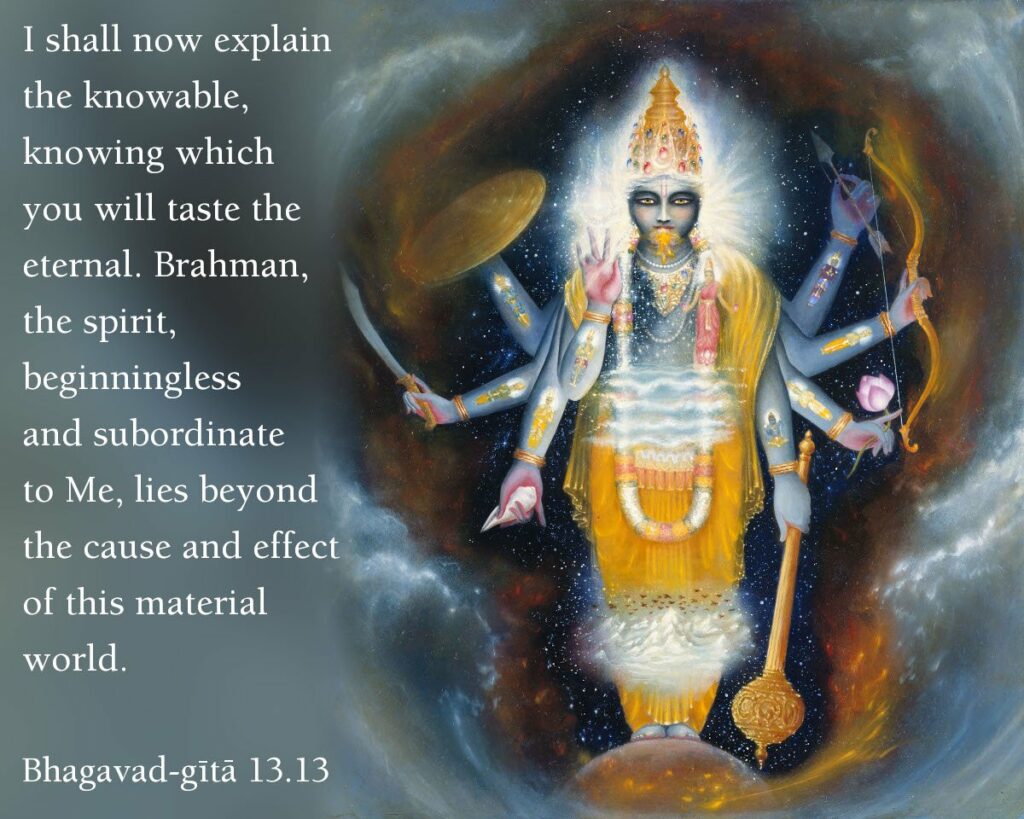
ज्ञेयं यत्तत्प्रवक्ष्यामि यज्ज्ञात्वामृतमश्रुते |
अनादिमत्परं ब्रह्म न सत्तन्नासदुच्यते || 13||
jñeyaṁ yat tat pravakṣhyāmi yaj jñātvāmṛitam aśhnute
anādi mat-paraṁ brahma na sat tan nāsad uchyate
jñeyam—ought to be known; yat—which; tat—that; pravakṣhyāmi—I shall now reveal; yat—which; jñātvā—knowing; amṛitam—immortality; aśhnute—one achieves; anādi—beginningless; mat-param—subordinate to Me; brahma—Brahman; na—not; sat—existent; tat—that; na—not; asat—non-existent; uchyate—is called
Translation:
I will now describe that which ought to be known, through the knowing of which one attains Immortality. It is the Supreme Brahman, which is without beginning and is said to be neither being nor non-being.
Commentary:
From this verse onwards in six verses, the Lord explains the nature of that which is to be known, the supreme Brahman. The former verses (8-12) dealt with knowledge and its qualities. But that is not enough. Knowledge of what? What is it that the man of wisdom knows? What does knowledge lead to? What is that to be known? These questions are answered now by the Lord. Having abandoned bad qualities, the aspirant acquires good qualities, and then abandoning both, he attains the supreme Brahman. This is the state of perfection. All the other states are imperfect.
Some of the religions are content with the teaching of ethical principles and a moral code of conduct. It is good in itself, but that is not enough. The aspirant should purify himself by ethical conduct, and then find his identity with the Supreme. That is the ultimate goal. There is no resting ground anywhere below that state. Therefore in the Gita, the Lord takes his disciple to the highest rung of the spiritual ladder and leaves him there – the Advaita realisation of Nirguna Brahman. The Gita explains Dvaita Visishtadvaita and Advaita one after another and so it is said to be the one complete spiritual Sastra.
Pravakshyami: The enthusiasm of the Lord in this spiritual teaching is indicated by this word.
Amritam asnute: The reward of the Brahman is stated even at the beginning – the reward is Immortality. Knowing this, the seeker is inspired with zeal to move forward towards the goal – Immortality, Moksha, Perfection! That is the reward. Why should man cling to wretched perishable stuff and exhaust his precious life in animal activities, when there is Perfection awaiting him at the end of this ‘sadhana’?
nasaduchyate: The supreme Brahman is not an object of sense-perception. That is the idea of ‘na sat’ (non existence). It does not mean that it has non existence. A body exists and when it dies it ceases to exist. This is true of all objects. But Brahman is not said to exist or not exist in this sense. It is beyond existence and non-existence.
Sri Ramakrishna Says —
At four o’clock in the afternoon Mr. Mukherji, a relative of Prankrishna, arrived in the company of a brahmin well versed in the scriptures.
MUKHERJI: “I am very happy to meet you, sir.”
MASTER: “God dwells in all beings. He is the gold in all. In some places it is more clearly manifest than in others. God dwells in the worldly-minded, no doubt, but He is hidden there, like gold under deep layers of clay.”
MUKHERJI: “Sir, what is the difference between worldly and other-worldly things?”
MASTER: “While striving for the realisation of God, the aspirant has to practise renunciation, applying the logic of ‘Neti, neti’ — ‘Not this, not this’. But after attaining the vision of God, he realises that God alone has become all things.
“At one time Rama was overpowered by the spirit of renunciation. Dasaratha, worried at this, went to the sage Vasishtha and begged him to persuade Rama not to give up the world. The sage came to Rama and found him in a gloomy mood. The fire of intense renunciation had been raging in the Prince’s mind. Vasishtha said: ‘Rama, why should You renounce the world? Is the world outside God? Reason with me.’ Rama realised that the world had evolved from the Supreme Brahman. So He said nothing.
“Buttermilk is made from the same substance as butter. One who realises this knows that butter goes with buttermilk and buttermilk with butter. After separating the butter with great effort — that is to say, after attaining Brahmajnana — you will realise that as long as butter exists, buttermilk also must exist. Wherever there is butter there must be buttermilk as well. As long as one feels that Brahman exists, one must also be aware that the universe, living beings, and the twenty-four cosmic principles exist as well.
“What Brahman is cannot be described in words. Everything has been polluted, like food that has touched the tongue — that is, everything has been described in words. But no one has been able to describe Brahman. It is therefore unpolluted. I said this to Vidyasagar and he was delighted.
“But the Knowledge of Brahman cannot be realised if the aspirant is worldly-minded even in the slightest degree. He succeeds in acquiring this Knowledge only when his mind is totally free from ‘woman and gold’. Parvati once said to Her father, ‘Father, seek the company of holy men if you want the Knowledge of Brahman.'” (Source: Gospel of Sri Ramakrishna)
—-
MASTER (smiling, to M.): “He went there [referring to Bodh-Gaya].”
M. (to Narendra): “What are the doctrines of Buddha?”
NARENDRA: “He could not express in words what he had realised by his tapasya. So people say he was an atheist.”
MASTER (by signs): “Why atheist? He was not an atheist. He simply could not express his inner experiences in words.
Do you know what ‘Buddha’ means? It is to become one with Bodha, Pure Intelligence, by meditating on That which is of the nature of Pure Intelligence; it is to become Pure Intelligence Itself.”
NARENDRA: “Yes, sir. There are three classes of Buddhas: Buddha, Arhat, and Bodhisattva.”
MASTER: “This too is a sport of God Himself, a new lila of God.
“Why should Buddha be called an atheist? When one realises Svarupa, the true nature of one’s Self, one attains a state that is something between asti, is, and nasti, is-not.”
NARENDRA (to M.): “It is a state in which contradictions meet. A combination of hydrogen and oxygen produces cool water; and the same hydrogen and oxygen are used in the oxy-hydrogen blowpipe.
“In that state both activity and non-activity are possible; that is to say, one then performs unselfish action.
“Worldly people, who are engrossed in sense-objects, say that everything exists — asti. But the mayavadis, the illusionists, say that nothing exists — nasti. The experience of a Buddha is beyond both ‘existence’ and ‘non-existence’.”
MASTER: “This ‘existence’ and ‘non-existence’ are attributes of Prakriti. The Reality is beyond both.”
The devotees remained silent a few moments. (Source: Gospel of Sri Ramakrishna)
—–
MASTER (to M. and the others): “Is it an easy thing to obtain the Knowledge of Brahman? It is not possible unless the mind is annihilated. The guru said to the disciple, ‘Give me your mind and I shall give you Knowledge.’ In this state one enjoys only spiritual talk and the company of devotees.
(To Ram) “You are a physician. You know that medicine works only when it mixes with the patient’s blood and becomes one with it. Likewise, in the state of Brahmajnana one sees God both within and without. One sees that it is God Himself who has become the body, mind, life, and soul.”
M. (to himself): “Assimilation!”
MASTER: “A man attains Brahmajnana as soon as his mind is annihilated. With the annihilation of the mind dies the ego, which says ‘I’, ‘I’. One also attains the Knowledge of Brahman by following the path of devotion. One also attains It by following the path of knowledge, that is to say, discrimination. The jnanis discriminate, saying, ‘Neti, neti’, that is, ‘All this is illusory, like a dream.’ They analyse the world through the process of ‘Not this, not this’; it is maya. When the world vanishes, only the jivas, that is to say, so many egos, remain.
“Each ego may be likened to a pot. Suppose there are ten pots filled with water, and the sun is reflected in them. How many suns do you see?”
A DEVOTEE: “Ten reflections. Besides, there certainly exists the real sun.”
MASTER: “Suppose you break one pot. How many suns do you see now?”
DEVOTEE: “Nine reflected suns. But there certainly exists the real Sun.”
MASTER: “All right. Suppose you break nine pots. How many suns do you see now?”
DEVOTEE: “One reflected sun. But there certainly exists the real sun.”
MASTER (to Girish): “What remains when the last pot is broken?”
GIRISH: “That real sun, sir.”
MASTER: “No. What remains cannot be described. What is remains. How will you know there is a real sun unless there is a reflected sun? ‘I- consciousness’ is destroyed in samadhi. A man climbing down from samadhi to the lower plane cannot describe what he has seen there.” (Source: Gospel of Sri Ramakrishna)
Râmlâl (nephew of Shri Ramakrishna) came from Dakshineswar. He had long lived with and served the Master and had often sent him into ecstasy by singing devotional songs. He was, therefore, dearly loved by the Order of Ramakrishna. In course of conversation he said:
“Formerly, the Master and Hriday used to live in the large room of the Kuthi (a building in the Dakshineswar temple) and the Master’s mother used to sleep in an adjoining small room. Many nights they used to hear a man with shoes on going up and down the stairs, and opening doors and windows. It was a ghost-possibly of a European. For the Kuthi had been a European residence before the temple was built. The Master used to say, ‘We cannot say that this world is entirely false. For we are actually seeing it with our eyes. Nor can we say that it is real. For just see how this garden has changed. Formerly it was a graveyard, and this Kuthi, the house of a European. But now! And some days after, this temple also will vanish, and who knows what will come next ?’ – Swami Premananda (Source: Spiritual Talks by the First Disciples of Sri Ramakrishna)
From the Life of Anandamayi Ma —
Solan, September 12th, 1948.
From Mataji one can but rarely get a definite decision on any problem. That is why I wondered of what use it was to write down her utterances? I asked SRI MA about it.
Mataji: At least you have understood that there is a state, where problems are no no longer settled in any particular way. In the course of your life you have after careful consideration come to a decision on many questions, have you not? But now you will have to realise that no solution is ever conclusive; in other words, you will have to go beyond the level where there is certainty and uncertainty. The resolution of a problem arrived at by the mind must of necessity be from a particular point of view; consequently there will be room for contradiction, since your solution represents but one aspect. What then have you actually solved? You will find a complete and final solution of each particular question from its own particular angle of emergence; and you will also find that there is a place where all problems (actual and possible) have but one universal solution, in which there is no longer any room left for contradiction. The question of solution or non-solution will then cease to arise: whether one says ‘yes’ or ‘no’, – everything is THAT. (Source: Words of Sri Anandamayi Ma by Atmananda)
Related Articles:
- As I surpass the Perishable and as I am higher even than the Imperishable, I am extolled in the world and in the Vedas as the Supreme Self. (BG 15.18)
- O I give heat; I hold back and send forth rain. I am immortality, O Arjuna, and also death. I am being and I am non-being. (BG 9.19)
Bhagavad Gita: Chapter 13 🔻 (35 Verses)