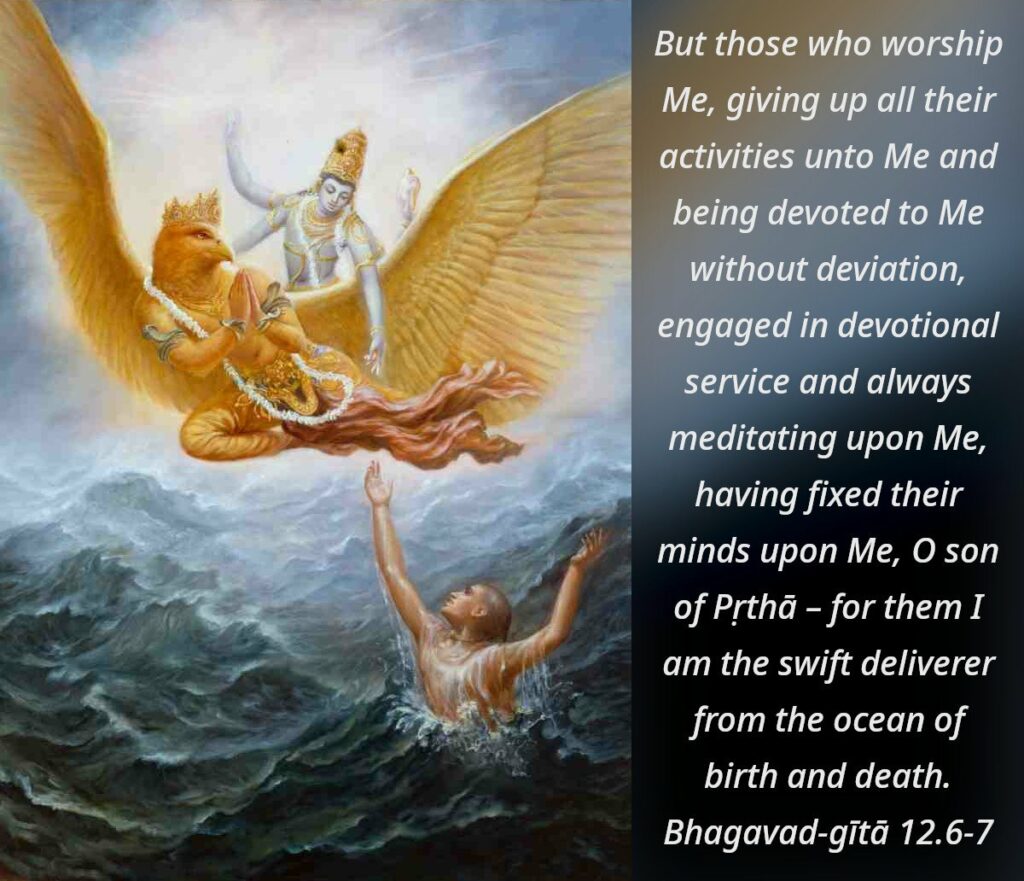
ये तु सर्वाणि कर्माणि मयि संन्न्यस्य मत्पर: |
अनन्येनैव योगेन मां ध्यायन्त उपासते || 6||
तेषामहं समुद्धर्ता मृत्युसंसारसागरात् |
भवामि नचिरात्पार्थ मय्यावेशितचेतसाम् || 7||
ye tu sarvāṇi karmāṇi mayi sannyasya mat-paraḥ
ananyenaiva yogena māṁ dhyāyanta upāsate
teṣhām ahaṁ samuddhartā mṛityu-saṁsāra-sāgarāt
bhavāmi na chirāt pārtha mayy āveśhita-chetasām
ye—who; tu—but; sarvāṇi—all; karmāṇi—actions; mayi—to Me; sannyasya—dedicating; mat-paraḥ—regarding Me as the Supreme goal; ananyena—exclusively; eva—certainly; yogena—with devotion; mām—Me; dhyāyantaḥ—meditating; upāsate—worship; teṣhām—of those; aham—I; samuddhartā—the deliverer; mṛityu-saṁsāra-sāgarāt—from the ocean of birth and death; bhavāmi—(I) become; na—not; chirāt—after a long time; pārtha—Arjun, the son of Pritha; mayi—with Me; āveśhita chetasām—of those whose consciousness is united
Translation:
O Arjuna! Those verily who renounce all actions in Me, think of Me as the only refuge and worship Me with single-minded devotion and Dhyana, to them I become the saviour and quickly lift them up from the ocean of death and ‘samsara’.
Commentary:
In the first verse the path to be followed by the seeker and in the second, the highest reward of such ‘sadhana’ is mentioned. The path of ‘sadhana’ includes three things 1. Renouncing all actions to Him 2. Considering Him as the sole refuge and the highest goal, 3. Worshipping Him with an undivided mind. In this way, if man worships God, He becomes the Saviour and lifts him up from the ocean of samsara. What a wonderful reward for His worshippers! The Lord’s offer should inspire all human beings with joy and faith. They can derive consolation that they shall be freed from the fearful agonising tortures of worldly life. For the individual Jiva who is whirled about from birth to death and from death to birth again and again from time immemorial (Punarapi jananam punarapi maranam), these words of the Lord indeed have the potency of Nectar! What the life-boat is for the drowning man so is the Lord for unfortunate humanity. He would lift them up from this terrible ocean of ‘samsara’. But man should lift up his hand towards God, obtain His grace by devotion and self-surrender. For others who deny Him, who do not think of Him, there is no hope. The Lord is indifferent to them. They should have to wander about in the wilderness of ignorance and death. If man does what is expected of him, the Lord is ever by his side to help him. What can God do, if man refuses to accept Him and seek His help? Therefore the wise man, understanding his terrible fate in the wheel of ‘samsara,’ should strive in every way to obtain God’s grace. Nothing else can cure the disease of worldly life.
Yetu – all men are qualified to obtain God’s grace.
Sarvani karmani: All actions done by man should be surrendered to God.
Ananyenaiva yogena: After speaking of several yogas like Karma, Jnana and Dhyana etc. the Lord brings out another yoga-‘ananya yoga’. This is not a separate yoga, but no other yoga can yield proper fruit if it is not ‘ananya yoga.’ Single-mindedness and renunciation of all worldly thoughts and actions is the essence of this yoga. Then any yoga acquires tremendous power.
Mam dhyayanta upasate: Here the word ‘dhyana’ is added to ‘upasana’. It is not simply worshiping without understanding, but worship combined with deep insight into the meaning and significance of the worship. When doing ‘Japa’, the sacred ‘mantra’ should not only be uttered but its meaning also should be contemplated. Similarly, when worshipping the Lord, His Divine Nature, Form and so should and qualities should be thought of deeply in a concentrated manner. Patanjali explains the same thing in his Yoga Sutras.
“Tatra pratyayaikatanata dhyanam” (3-2)
Samuddharta: God is a perfect Saviour.
Mrutyusamsara sagarat: Samsara’ is compared to an ocean. It is fearful like the ocean, infected with deadly dragons of desire and hatred (Kama and Krodha), never at rest and peace, always bubbling and boiling. Man is naturally terrified by it. And yet, some people think of the pleasures of ‘samsara’ wish for such fleeting joys. It is nothing but ignorance. They have yet to realise the foul and filthy nature of ‘samsara’, and the terrible end that comes to them through it. The Lord states it here – “Mrityusamsara”. Nothing can be a truer description of the wheel of birth and death and the horrible sorrow and suffering during the interval between the two. Man who is bound to this track should naturally seek God’s grace, the embodiment of bliss and blessedness.
na chirat: Man is saved quickly (Gajendra, Prahlada. Ambarisha and Draupadi are examples).
—–
Swami Vivekananda Says —
“Those who with constant attention always worship You, and those who worship the Undifferentiated, the Absolute, of these who are the greatest yogis?” — Arjuna asked of Shri Krishna. The answer was: “Those who concentrating their minds on Me worship Me with eternal constancy and are endowed with the highest faith, they are My best worshippers, they are the greatest yogis. Those that worship the Absolute, the Indescribable, the Undifferentiated, the Omnipresent, the Unthinkable, the All-comprehending, the Immovable, and the Eternal, by controlling the play of their organs and having the conviction of sameness in regard to all things, they also, being engaged in doing good to all beings, come to Me alone. But to those whose minds have been devoted to the unmanifested Absolute, the difficulty of the struggle along the way is much greater, for it is indeed with great difficulty that the path of the unmanifested Absolute is trodden by any embodied being. Those who, having offered up all their work unto Me, with entire reliance on Me, meditate on Me and worship Me without any attachment to anything else — them, I soon lift up from the ocean of ever-recurring births and deaths, as their mind is wholly attached to Me.”
Jnana-yoga and bhakti-yoga are both referred to here. Both may be said to have been defined in the above passage. Jnana-yoga is grand; it is high philosophy; and almost every human being thinks, curiously enough, that he can surely do everything required of him by philosophy; but it is really very difficult to live truly the life of philosophy. We are often apt to run into great dangers in trying to guide our life by philosophy. This world may be said to be divided between persons of demoniacal nature who think the care-taking of the body to be the be-all and the end-all of existence, and persons of godly nature who realize that the body is simply a means to an end, an instrument intended for the culture of the soul. The devil can and indeed does cite the scriptures for his own purpose; and thus the way of knowledge appears to offer justification to what the bad man does, as much as it offers inducements to what the good man does. This is the great danger in jnana-yoga. But bhakti-yoga is natural, sweet, and gentle; the bhakta does not take such high flights as the jnana-yogi, and, therefore, he is not apt to have such big falls. Until the bondages of the soul pass away, it cannot of course be free, whatever may be the nature of the path that the religious man takes.[Source]
Sri Ramakrishna Says —
GIRISH: “What will happen to this sinner?”
Sri Ramakrishna sang in a tender voice, turning his eyes upward:
Meditate on the Lord, the Slayer of hell’s dire woes,
He who removes the fear of death;
Thinking of Him, the soul is freed from worldly grief
And sails across the sea of life in the twinkling of an eye.
Consider, O my mind, why you have come to earth;
What gain is there in evil thoughts and deeds?
Your way lies not through these: perform your penance here
By meditating long and deep on the everlasting Lord.
MASTER: “‘Sails across the sea of life in the twinkling of an eye.’ One attains the vision of God if Mahamaya steps aside from the door. Mahamaya’s grace is necessary: hence the worship of Sakti. You see, God is near us, but it is not possible to know Him because Mahamaya stands between. Rama, Lakshmana, and Sita were walking along. Rama walked ahead, Sita in the middle, and Lakshmana last. Lakshmana was only two and a half cubits away from Rama, but he couldn’t see Rama because Sita — Mahamaya — was in the way. (Source: Gospel of Sri Ramakrishna)
—
NILKANTHA: “What shall I say, sir? Please be gracious to us.”
MASTER (smiling): “You are ferrying many people across the ocean of the world. How many hearts are illumined by hearing your music!”
NILKANTHA: “You talk of ferrying. But bless me that I may not be drowned in the ocean myself.”
MASTER (smiling): “If you get drowned, it will be in the Sea of Immortality.” (Source: Gospel of Sri Ramakrishna)
Related Articles:
- O Parth, for those yogis who always think of Me with exclusive devotion, I am easily attainable because of their constant absorption in Me. (BG 8.14)
- Having come to Me, these high-souled men are no more subject to rebirth, which is transitory and the abode of pain; for they have reached the highest perfection. (BG 8.15)
- O Arjuna! All worlds up to Brahmaloka are subject to return; having attained me there is no re-birth. (BG 8.16)
- Those persons who worship Me, meditating on their identity with Me and ever devoted to Me— to them I carry what they lack and for them I preserve what they already have. (BG 9.22)
Question: What is the nature of Samsara?
Answer: Like the ocean, it is boundless, unfathomable. It leads to birth and death.
Question: How to escape from it?
Answer: By seeking God’s grace, man is lifted out of the ocean.
Question: How to win God’s grace?
Answer: By renouncing all actions to Him, by thinking of Him as the sole refuge, fixing the mind in Him, and worshipping Him with single-minded devotion man obtains God’s grace.
Bhagavad Gita: Chapter 12 🔻 (20 Verses)