यस्मान्नोद्विजते लोको लोकान्नोद्विजते च य: |
हर्षामर्षभयोद्वेगैर्मुक्तो य: स च मे प्रिय: || 15||
yasmān nodvijate loko lokān nodvijate cha yaḥ
harṣhāmarṣha-bhayodvegair mukto yaḥ sa cha me priyaḥ
yasmāt—by whom; na—not; udvijate—are agitated; lokaḥ—people; lokāt—from people; na—not; udvijate—are disturbed; cha—and; yaḥ—who; harṣha—pleasure; amarṣha—pain; bhaya—fear; udvegaiḥ—anxiety; muktaḥ—free; yaḥ—who; saḥ—they; cha—and; me—to Me; priyaḥ—very dear
Translation:
He by whom the world is not afflicted and whom the world cannot afflict, he who is free from joy and anger, fear and anxiety— he is dear to Me.
Commentary:
Lokan no dvijate: The devotee should not have any fear of the world. People may say a hundred things to him and about him, he should not swerve from the path of truth and righteousness. “Be fearless” is the command. The Lord has already mentioned fearlessness (vigatabhih) – and declares it again as ‘abhyam’.
Harshamarshabhayodvegaih: To be free from these fits of joy, hatred, anxiety, fear – is to be almost perfect in spiritual realisation. All these are various mental modifications which cause misery to man. The devotee should be free from them. He should maintain equanimity of mind at all times (samatvam yoga uchyate).
—–
—–
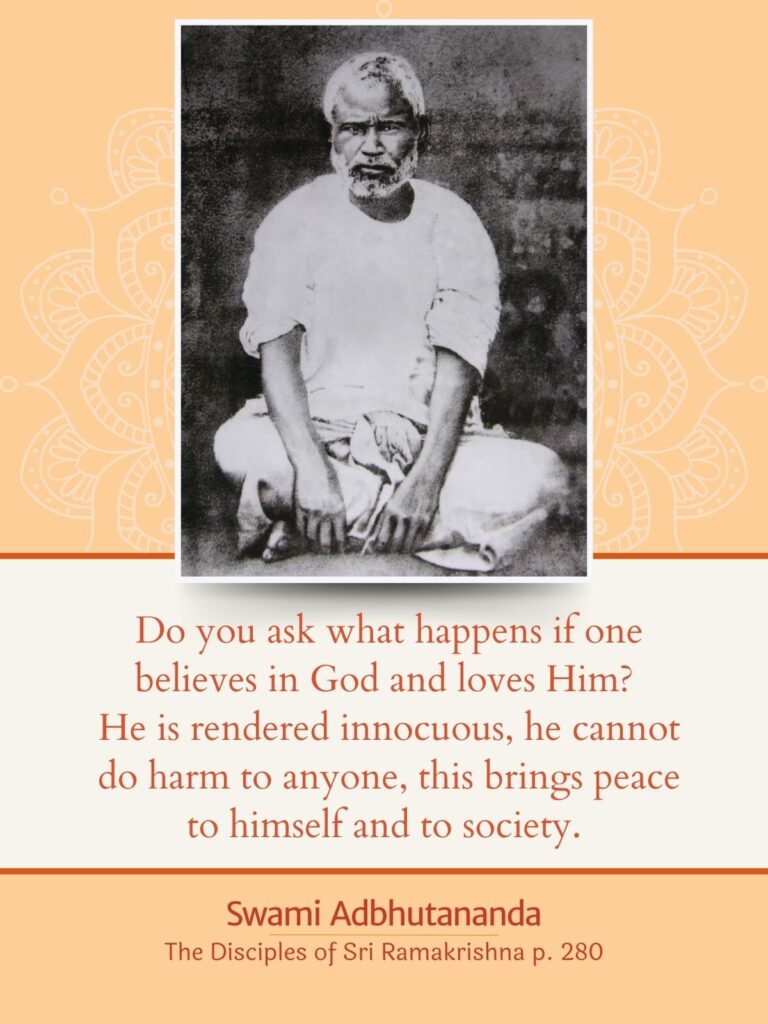
While Swami Ashokananda had laid down few convent rules, his reply to the question, asked by Dorothy, “What is the most important thing in monastic life?” was “To be able to live in a group of diverse people without being agitated by them and without agitating them.” Embedded in that response were a number of hard-core disciplines: detachment, self-abnegation, forbearance, endurance, and, above all, selflessness. (Source: A Heart Poured Out – A Story of Swami Ashokananda)
“Egotism is no good; it is extremely pernicious. Egotism is like drinking wine, it leads astray the senses. The Master used to say that water accumulates only in a low land. Only in humility the good qualities of the mind and heart become manifest. Pride always holds the head high. That which is elastic and unbreakable like steel, that indeed is strength. He alone is strong, who can live in harmony with different natures in a spirit of amicable compromise. (Source: Spiritual Talks by the First Disciples of Sri Ramakrishna)
THE SONG OF THE AVANTI BRAHMIN
In the Bhagavata, Krishna narrates an anecdote to Uddhava. This incident took place when Krishna was in Ujjain under the tutelage of Sandeepani Maharshi. There lived a rich brahmin in the town of Avanti. Though he had enormous wealth, he was never happy. He neither used his wealth to help those in need nor did he help his own kith and kin. He was such a miser that he himself did not enjoy the wealth. Ultimately, due to various reasons, he lost everything. The king’s men took some as tax, robbers looted some, and his own relatives grabbed the rest. Soon he was also driven out of the house. He wandered as a penniless beggar for a while. Then, due to his past karma, he had the good fortune of contact with sages. Due to this, he realised the Truth and was full of peace. He wandered as a mendicant and one day, reached his own village. The villagers, who recognised him as the miserly man, did not give him any food and drove him out. Many youngsters who hated him played pranks on him. They threw dirt on his head and broke his sacred daṇḍa—the staff—and the only vessel he carried. They threw dirt on his body and even defecated in his food. In the midst of it all, he remained calm and quiet. He walked away from there, singing this beautiful song,
नायं जनो मे सुखदुःखहेतुः न देवतात्मा ग्रहकर्मकालाः।
मनः परं कारणमामनन्ति संसारचक्रं परिवर्तयेद्यत्॥ SB 11.23.43
Neither the people around nor any god nor the self gives happiness or pain to me. Planetary position or karma or time are also not the cause of happiness or pain. It is the mind that is the primary cause because of which this wheel of suffering goes on whirling… I have dropped the mind in all its forms by knowing the Truth—I am the Self of all.
Pondering this verse deeply will be greatly beneficial for all spiritual seekers.
This story reveals the state of a yogi who is not affected by anything from the outside world. This is possible because he has learnt the art of not harbouring thoughts; he has gone beyond the mind. He has found an inner anchorage where he remains ever peaceful. Such a person is a true devotee. (Source: Srimad Bhagavad Gita – Elixir of Eternal Wisdom | Vol 3)