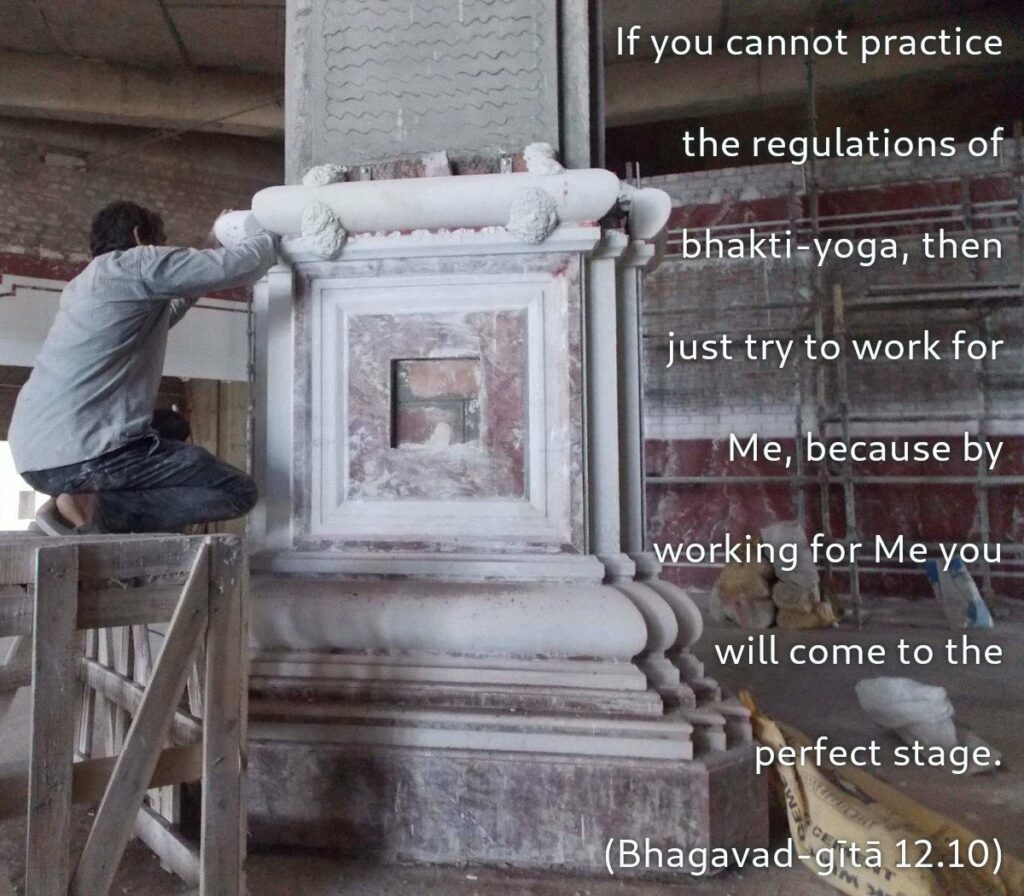
अभ्यासेऽप्यसमर्थोऽसि मत्कर्मपरमो भव |
मदर्थमपि कर्माणि कुर्वन्सिद्धिमवाप्स्यसि || 10||
abhyāse ’py asamartho ’si mat-karma-paramo bhava
mad-artham api karmāṇi kurvan siddhim avāpsyasi
abhyāse—in practice; api—if; asamarthaḥ—unable; asi—you; mat-karma paramaḥ—devotedly work for Me; bhava—be; mat-artham—for My sake; api—also; karmāṇi—work; kurvan—performing; siddhim—perfection; avāpsyasi—you shall achieve
Translation:
Even if you are not capable of practice, do work for My sake; By doing work for my sake also, you shall attain perfection.
Commentary:
Again the Lord offers an alternate path for those who are not able to get steadiness in meditation even by constant practice. They should engage themselves in doing good actions, charitable deeds of helpfulness, and beneficence to all beings. And such actions should be offered to the Lord, without any desire for personal reward. This is simply Nishkama Karma. Japa, prayer, ‘namasamkirtan’, worship, vows of fasting and silence, all these come under good actions for the sake of God. This is the idea of “matkarmaparamobhava”. By such actions, the mind is purified, and by the purity of mind, liberation is attained. Thus Nishkama Karma leads to perfection. This is recommended to those who are not able to still the mind in Dhyana. Only, those actions should be done in a spirit of self-surrender to God. They should be done to win God’s grace and not for obtaining selfish rewards. This idea should be firmly held in the mind while performing all good work in the world.
ANNAMALAI SWAMI’S JOURNEY
We recount here a beautiful anecdote that highlights this process in the life of one of Ramana Maharshi’s disciples, Annamalai, who was a mason by profession. He came to Maharshi as a young man longing for freedom. He wished to get the teaching from the great Jñāni and meditate. With this in mind, he started living with the Sage. The Sage, however, never let him meditate. Instead, he was made to oversee the masonry work in the ashram. He was so busy with this that he had no time for any spiritual practice. But the Sage kept guiding him all the while.
One day, he asked Maharshi, “Bhagavan, I want to meditate. Let me go and sit in a cave in the mountain and meditate.” Maharshi smiled and said, “Do not have any such saṅkalpa, any such thought, about the future. Keep your mind on the Self. Do not think you are the doer. That is meditation. Otherwise, to fructify your saṅkalpa, you will have to take another birth. Hence, here and now, be the Self.” As per Bhagavan’s instruction, he continued to work without rest. One day, he asked the Sage, “Bhagavan, I came here to listen to the highest Truth from you. You talk about the Self to others, but whenever I come to you, you speak to me about brick, lime and construction. How pitiable this is!” Maharshi laughed and said, “What to do! Whenever you come towards me, I see a building walking!”
The fact is that Annamalai Swami had that saṃskāra in him, and it had to be exhausted. Thus, for sixteen years, he toiled selflessly and worked as per his Guru’s instructions. One day, Maharshi called him and said, “Go to Palākothu—the jungle behind the ashram. No more work for you. Now go and stay there and meditate constantly. You need not even come to the ashram to see me. I will come and see you.” He asked Maharshi, “What should I do there?” Maharshi said, “You need not do anything special. Whatever you do, just remember that you are the Self. You are not the body. You are the Self. Just remember this. This seed will sprout as spiritual experience—Ātma-nishṭhā.”
His karma had reached its fruition. As Maharshi himself used to say, ‘Every action carries the seed of its own destruction in its womb.’ Truly enough, Annamalai’s actions had come to an end, and every arrangement was made for him to stay in solitude. He obeyed his Guru’s order and stayed in complete meditation. I very much remember this monk who lived ever absorbed in the Self, unknown to the public. He never even stepped onto the road. Even for a walk, he went only to the hill. Obedience to the Guru was his life-breath.
Here we can see how actions performed as an offering to the divine lead one to the highest state of yoga. Such a life underlines the words of Bhagavan, “madarthamapi karmāṇi kurvan-siddhim-avāpsyasi—do actions for Me, and you shall attain the highest beatitude.” (Source: Srimad Bhagavad Gita – Elixir of Eternal Wisdom | Vol 1)
SWAMI CHIDANANDA IN PANDHARPUR
There is an inspiring story told about Swami Chidananda Saraswati of Hrishikesh. Once, in the prime of his mission, soon after his first world tour, he suddenly disappeared from Hrishikesh. No one could trace him for two years. At the end of the second year, they got the tiding that Swamiji was somewhere in Maharashtra. They searched and found him sweeping the floor of Vitthal Mandir, the temple of Panduranga in Pandharpur, living as a servant of the Lord. He had no place to stay. He was sleeping on the verandah of a grocery shop. Someone was giving him food once a day. Thus he stayed for two years! Saints undertake such sādhanās to make themselves completely free of the ego-sense.
In all devotional traditions, we can see that devotees lived in association with temples or ashrams. Apart from their time of meditation, they would spend all their time and energy serving in the temple in some way—sweeping the floors, collecting flowers, and so on. While doing all this, they would constantly be chanting the name of the Lord. The saint Appar, a great Siva devotee, would always carry a broomstick with him, and he would often be seen sweeping the temple premises, all the while chanting the pañchākshara. These are some special actions which will enhance one’s devotion and meditation. (Source: Srimad Bhagavad Gita – Elixir of Eternal Wisdom | Vol 1)
Question: What is the way for those who are not competent even for Abhyasa yoga?
Answer: They should perform good actions in a selfless spirit and surrender the fruits to God.
Bhagavad Gita: Chapter 12 🔻 (20 Verses)