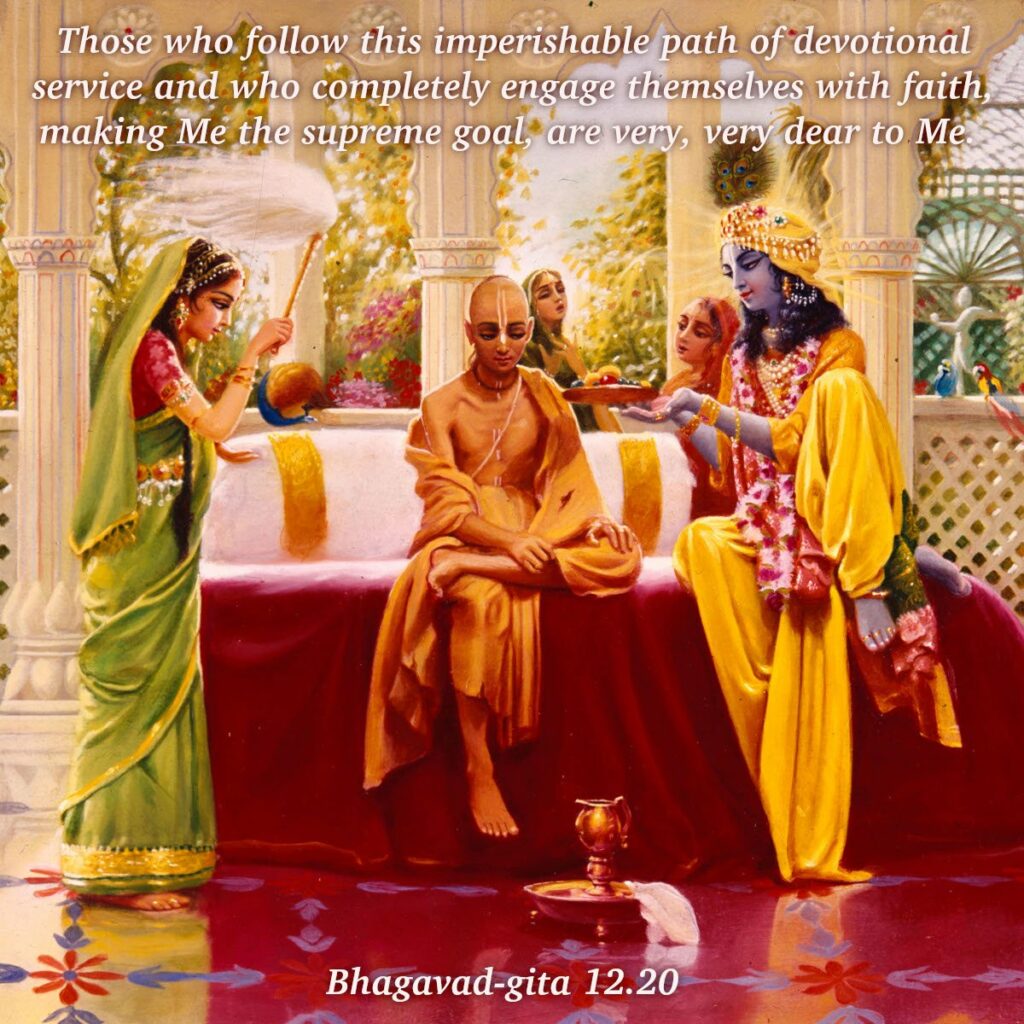
ये तु धर्म्यामृतमिदं यथोक्तं पर्युपासते |
श्रद्दधाना मत्परमा भक्तास्तेऽतीव मे प्रिया: || 20||
ye tu dharmyāmṛitam idaṁ yathoktaṁ paryupāsate
śhraddadhānā mat-paramā bhaktās te ’tīva me priyāḥ
ye—who; tu—indeed; dharma—wisdom; amṛitam—nectar; idam—this; yathā—as; uktam—declared; paryupāsate—exclusive devotion; śhraddadhānāḥ—with faith; mat-paramāḥ—intent on Me as the supreme goal; bhaktāḥ—devotees; te—they; atīva—exceedingly; me—to Me; priyāḥ—dear
Translation:
Who, with faith having Me as their goal follow this immortal and nectar-like Dharma as declared above, such devotees are most dear to Me.
Commentary:
The Lord declares the fruit of practising this immortal Dharma. It is natural that people wish to know the reward of spiritual sadhana. It strengthens their faith and prompts them to act. Therefore the Lord proclaims the reward. What is it? ‘te ativa me priyah’. “Such devotees are most dear to Me.” – says the Lord. That is the reward. What else does man require? Having the Lord’s grace man has everything, and not having it, man has nothing (though he may possess wealth and kingship even). The Lord’s grace leads to freedom and perfection (Moksha). By His Grace, man acquires ‘buddhi yoga’ (the intellectual keenness to know the essence of things and hold on to truth) and by it, he attains Moksha.
Dharmyamritam: This Dharma is spoken of as ‘nectar’ (immortal) because it takes man from death to immortality. Man is transformed into the Immortal Being. Such is the power of this Dharma. The Lord has showered ‘nectar’ and it is the duty of man to collect it in the vessels of their own minds and drink deep this spiritual drink of God. Those who fail to do so are miserable men and they suffer horrid thirst in the desert sands of worldly life.
Sraddhadhanah: How should this Dharma be practised? With faith. The Lord has emphasised faith a hundred times in the course of His teaching. Moreover, the devotee should be perfectly convinced that the Lord is his goal (matparamah). When the disciple carries out the teacher’s injunctions faithfully, the latter is full of confidence about the future prospects of his student. When the father takes care of the child in his arms, the child has no fear. So also, the devotee who has won God’s grace need not have any fear about his life and spiritual fulfillment. Therefore let all the aspirants strive to obtain these virtues and attain freedom.
“Ye tu” – it is clear that no one is prohibited from obtaining God’s grace by following the eternal ‘Dharma’.
NARADA SEES LORD KRISHNA MEDITATING
Once, seeing Lord Krishna meditating, Narada asked Him, “Dear Lord, everyone meditates on Your form and Your feet, but whom are You meditating on?” Krishna said, “My dear Sage, you know the secret? My ishṭa-devatā, My beloved form, is of My devotee. Devotees are My heart, and I am the heart of the devotees.* I meditate on the devotees. This is the secret.”
Here Bhagavan says, “Arjuna, you are My beloved. You shall be liberated.” This is the promise of the Lord. In the Gita 9.31, Bhagavan says, “na me bhaktaḥ praṇaśyati—My beloved devotee shall never perish.”
Here the word śraddadhānāḥ is used. Śraddhā is the most crucial factor in spiritual life. Therefore, it is linked here with the path of bhakti. Śraddhā (faith), bhakti (devotion) and dhyāna-yoga (constant meditation) are the three principles that make one steady in spiritual life. (Source: Srimad Bhagavad Gita – Elixir of Eternal Wisdom | Vol 3)
Question: What is the ‘Dharma’ taught by Lord Krishna?
Answer: It is Immortal, and takes man out of the wheel of birth and death.
Question: How should man follow it?
Answer: With faith and deep devotion.
Question: What is the reward?
Answer: Such a devotee is most dear to the Lord.
Bhagavad Gita: Chapter 12 🔻 (20 Verses)