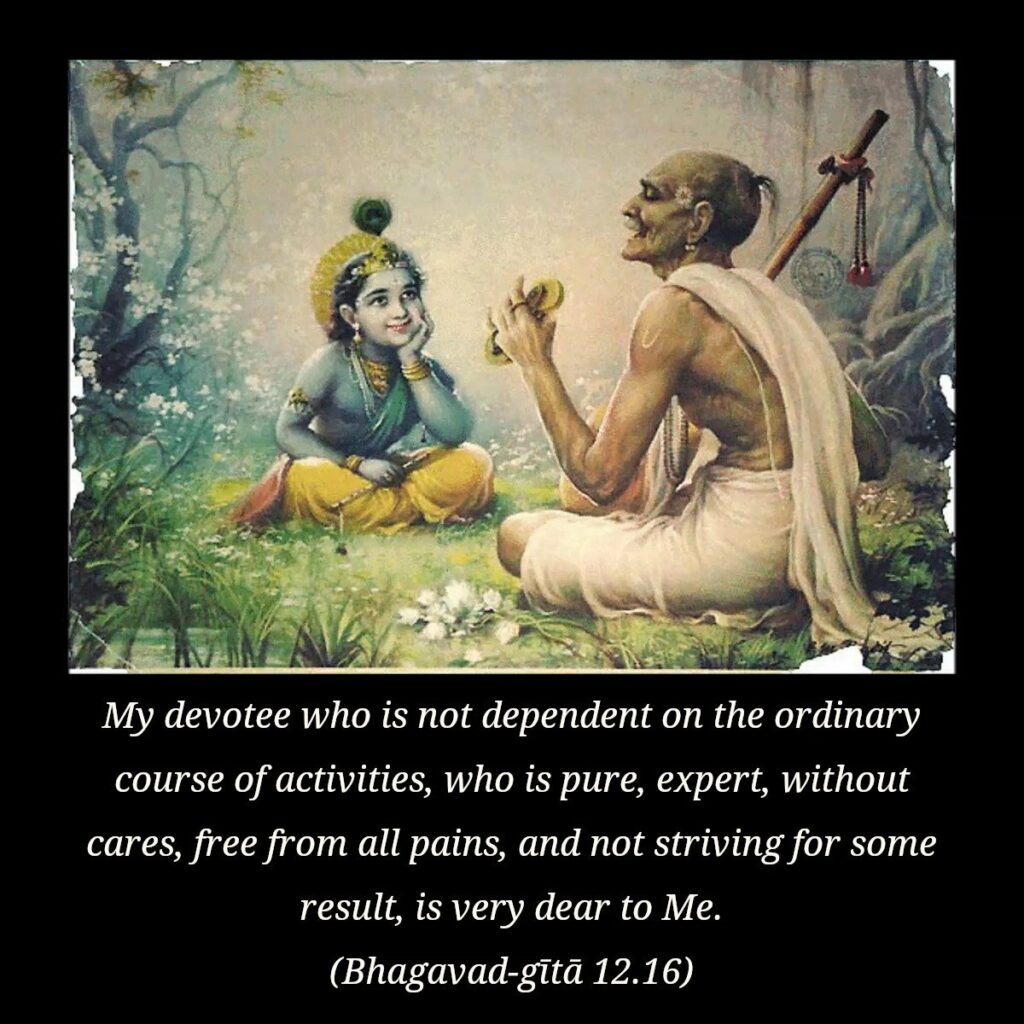
अनपेक्ष: शुचिर्दक्ष उदासीनो गतव्यथ: |
सर्वारम्भपरित्यागी यो मद्भक्त: स मे प्रिय: || 16||
anapekṣhaḥ śhuchir dakṣha udāsīno gata-vyathaḥ
sarvārambha-parityāgī yo mad-bhaktaḥ sa me priyaḥ
anapekṣhaḥ—indifferent to worldly gain; śhuchiḥ—pure; dakṣhaḥ—skillful; udāsīnaḥ—without cares; gata-vyathaḥ—untroubled; sarva-ārambha—of all undertakings; parityāgī—renouncer; saḥ—who; mad-bhaktaḥ—my devotees; saḥ—he; me—to Me; priyaḥ—very dear
Translation:
He who is free from desire, who is pure in body and mind, who is competent and ready-willed, who is unconcerned, free from anxiety and sorrow, who has renounced all sense of doership (or who has renounced all acts of desire, prohibited by the ‘sastras’), who is devoted to Me – is dear to Me.
Commentary:
Suchih: Purity is many times emphasised by the Lord. The devotee should be clean in body and mind, and the place where he lives should also be clean. Such purity of body is essential for purity of mind.
dakshah: He should be competent and ever alert in carrying out his ‘sadhana’. A moment’s negligence is enough for ‘maya’ to strike him down.
gatavyathah: Anxiety and fear are the two real enemies of all men. Having taken refuge with the Lord, it would be foolish for a devotee still to be anxious and struck with fear about anything in the world.
sarvarambhaparityagi: This does not mean that the devotee becomes dull and inactive. It means that he has renounced all sense of doership in all actions. Or it may mean that he has renounced all desire-prompted actions prohibited by the ‘Sastras’. Having given up the feeling of doership, though he is engaged in good work, still he is one who has not done anything.
—–
Sri Ramakrishna Says —
After taking some of the sweets, the Master, with a smile, began to speak to Vidyasagar. Meanwhile the room had become filled with people; some were standing and others were seated.
MASTER: “Ah! Today, at last, I have come to the ocean. Up till now I have seen only canals, marshes, or a river at the most. But today I am face to face with the sagar, the ocean.” (All laugh.)
VIDYASAGAR (smiling): “Then please take home some salt water.” (Laughter.)
MASTER: “Oh, no! Why salt water? You aren’t the ocean of ignorance. You are the ocean of vidya, knowledge. You are the ocean of condensed milk.” (All laugh.)
VIDYASAGAR: “Well, you may put it that way.
The pundit became silent. Sri Ramakrishna said: “Your activities are inspired by sattva. Though they are rajasic, they are influenced by sattva. Compassion springs from sattva. Though work for the good of others belongs to rajas, yet this rajas has sattva for its basis and is not harmful. Suka and other sages cherished compassion in their minds to give people religious instruction, to teach them about God. You are distributing food and learning. That is good too. If these activities are done in a selfless spirit they lead to God. But most people work for fame or to acquire merit. Their activities are not selfless. Besides, you are already a siddha.” (Literally, “perfect” or “boiled”; the word is applied both to the perfected soul and to boiled things.)
VIDYASAGAR: “How is that, sir?”
MASTER (laughing): “When potatoes and other vegetables are well cooked, they become soft and tender. And you possess such a tender nature! You are so compassionate!” (Laughter.)
VIDYASAGAR (laughing): “But when the paste of kalai pulse is boiled it becomes all the harder.”
MASTER: “But you don’t belong to that class. Mere pundits are like diseased fruit that becomes hard and will not ripen at all. Such fruit has neither the freshness of green fruit nor the flavour of ripe. Vultures soar very high in the sky, but their eyes are fixed on rotten carrion on the ground. The book-learned are reputed to be wise, but they are attached to ‘woman and gold’. Like the vultures, they are in search of carrion. They are attached to the world of ignorance. Compassion, love of God, and renunciation are the glories of true knowledge.“
Vidyasagar listened to these words in silence. The others, too, gazed at the Master and were attentive to every word he said.
—–
MASTER: “Just see how picturesque this universe is! How many things there are! The sun, moon, and stars; and how many varieties of living beings! — big and small, good and bad, strong and weak — some endowed with more power, some with less.”
VIDYASAGAR: “Has He endowed some with more power and others with less?”
MASTER: “As the All-pervading Spirit He exists in all beings, even in the ant. But the manifestations of His Power are different in different beings; otherwise, how can one person put ten to flight, while another can’t face even one? And why do all people respect you? Have you grown a pair of horns? (Laughter.) You have more compassion and learning. Therefore people honour you and come to pay you their respects. Don’t you agree with me?”
Vidyasagar smiled.
The Master continued: “There is nothing in mere scholarship. The object of study is to find means of knowing God and realizing Him. A holy man had a book. When asked what it contained, he opened it and showed that on all the pages were written the words ‘Om Rama’, and nothing else.
“What is the significance of the Gita? It is what you find by repeating the word ten times. It is then reversed into ‘tagi’, which means a person who has renounced everything for God. And the lesson of the Gita is: ‘O man, renounce everything and seek God alone.’ Whether a man is a monk or a householder, he has to shake off all attachment from his mind.
“Chaitanyadeva set out on a pilgrimage to southern India. One day he saw a man reading the Gita. Another man, seated at a distance, was listening and weeping. His eyes were swimming in tears. Chaitanyadeva asked him, ‘Do you understand all this?’ The man said, ‘No, revered sir, I don’t understand a word of the text.’ ‘Then why are you crying?’ asked Chaitanya. The devotee said: ‘I see Arjuna’s chariot before me. I see Lord Krishna and Arjuna seated in front of it, talking. I see this and I weep.’ (Source: Gospel of Sri Ramakrishna)
—–
Mahendranath Gupta: “Sir, is there no spiritual discipline leading to realization of the Impersonal God?”
Sri Ramakrishna: “Yes, there is. But the path is extremely difficult. After intense austerities the rishis of olden times realized God as their innermost consciousness and experienced the real nature of Brahman. But how hard they had to work! They went out of their dwellings in the early morning and all day practised austerities and meditation. Returning home at nightfall, they took a light supper of fruit and roots.
“But an aspirant cannot succeed in this form of spiritual discipline if his mind is stained with worldliness even in the slightest degree. The mind must withdraw totally from all objects of form, taste, smell, touch, and sound. Only thus does it become pure. The Pure Mind is the same as the Pure Atman. But such a mind must be altogether free from ‘woman and gold’. When it becomes pure, one has another experience. One realizes: ‘God alone is the Doer, and I am His instrument.’ One does not feel oneself to be absolutely necessary to others either in their misery or in their happiness.
“Once a wicked man beat into unconsciousness a monk who lived in a monastery. On regaining consciousness he was asked by his friends, ‘Who is feeding you milk?’ The monk said, ‘He who beat me is now feeding me.’” (Source: Gospel of Sri Ramakrishna)
FREEDOM OF A JÑĀNI
In one instance, the austere disciple Kāvyakaṇṭha Ganapati Muni told Sri Ramana Maharshi, “It takes very few things and only a little money for the maintenance and survival of the body.” Maharshi smiled and said, “If you know your Self, you can live even without the body.” This is the state of a Jñāni. He does not depend on anything, not even the body, the mind or the ego. He has nothing to seek, even from God. He is rooted in the Truth, in the Atman, where there is no want at all. (Source: Srimad Bhagavad Gita – Elixir of Eternal Wisdom | Vol 1)
“ATTEND TO YOUR BUSINESS”
A sādhaka’s concern should be only on meditation and his spiritual practice. At times, even a Jñāni will reveal this state for the sake of a sādhaka. Many of Sri Ramana Maharshi’s devotees have remarked about how they saw a kind of divine indifference in the Sage. Whatever happened around him, he remained as if unconcerned. This, however, must not be interpreted as being uncaring. It was a state wherein he was established in the Self where there was no world. Once, Kunjuswami, a devotee of Maharshi, spoke about this to the Sage. He said, “Bhagavan, many people around you are behaving wrongly. Yet you never correct them. This makes them think that you accept their actions. Is this right?” Maharshi turned his attention towards this devotee and told him, “I have not come here to correct anyone. Everyone has some flaws in them; if I start correcting, then not even a crow would fly over the ashram.” He added, “Be concerned about the mission for which you have renounced everything. Turn your whole attention inward. Enquire ‘WHO AM I?’ and realise your Self. That is what you are here for.” This was his teaching always.
Even during the World War, devotees noticed that the great sage did not utter a single word about those happenings. It is not that he was uncaring. Firstly, there was no world in his awareness at all. Secondly, even if he had factually accepted that there is a world, what could he have achieved by discussing it? At times like these, ‘indifference to the non-essentials’ can serve as a powerful fortress for a sādhaka.
Until this state of indifference sets in, a sādhaka’s mind is in constant agitation. Agitation is vyathā. Every sādhaka carries in his mind some jungles of past happenings or fears or worries about the future. This could even lead them to depression. Many are the sādhakas who renounce the world and join a spiritual institution. With plenty of time available and no work to do, the mind builds a cocoon of depression, brooding about the past and thinking about the future—this is vyathā. Such a situation requires the skilful application of the jagan-mithyā medicine that the world is not real. This is not a philosophy; it is a medicine which will protect us from all unnecessary stress. Any kind of anxiety is a sure symptom of ignorance. A devotee who has surrendered to the Lord is gata-vyathaḥ. When not even a blade of grass moves without His will, why unnecessarily worry over the happenings around. Always meditate on Him. This is the attitude of a pure lover of God. (Source: Srimad Bhagavad Gita – Elixir of Eternal Wisdom | Vol 3)
A PITFALL IN SPIRITUAL LIFE
There were many brahmacharis who lived and served in an ashram. One day, two brahmacharis were watching the world cup cricket match. They started a casual discussion about who would win the world cup. This turned into a heated debate. A saintly swami of that ashram was seated nearby, doing his usual japa. He sat there unconcerned. These brahmacharis went to the swami and asked, “Swamiji, what is your opinion? Who will win?” Swamiji smiled and said, “Whoever wins, you have both failed in your spiritual life!” This was his conclusion. That is the teaching here. One should be an udāsīnaḥ in matters not concerned with one’s inner evolution. (Source: Srimad Bhagavad Gita – Elixir of Eternal Wisdom | Vol 3)
Bhagavad Gita: Chapter 12 🔻 (20 Verses)