यो यो यां यां तनुं भक्त: श्रद्धयार्चितुमिच्छति |
तस्य तस्याचलां श्रद्धां तामेव विदधाम्यहम् || 21||
yo yo yāṁ yāṁ tanuṁ bhaktaḥ śhraddhayārchitum ichchhati
tasya tasyāchalāṁ śhraddhāṁ tām eva vidadhāmyaham
yaḥ yaḥ—whoever; yām yām—whichever; tanum—form; bhaktaḥ—devotee; śhraddhayā—with faith; architum—to worship; ichchhati—desires; tasya tasya—to him; achalām—steady; śhraddhām—faith; tām—in that; eva—certainly; vidadhāmi—bestow; aham—I
Translation:
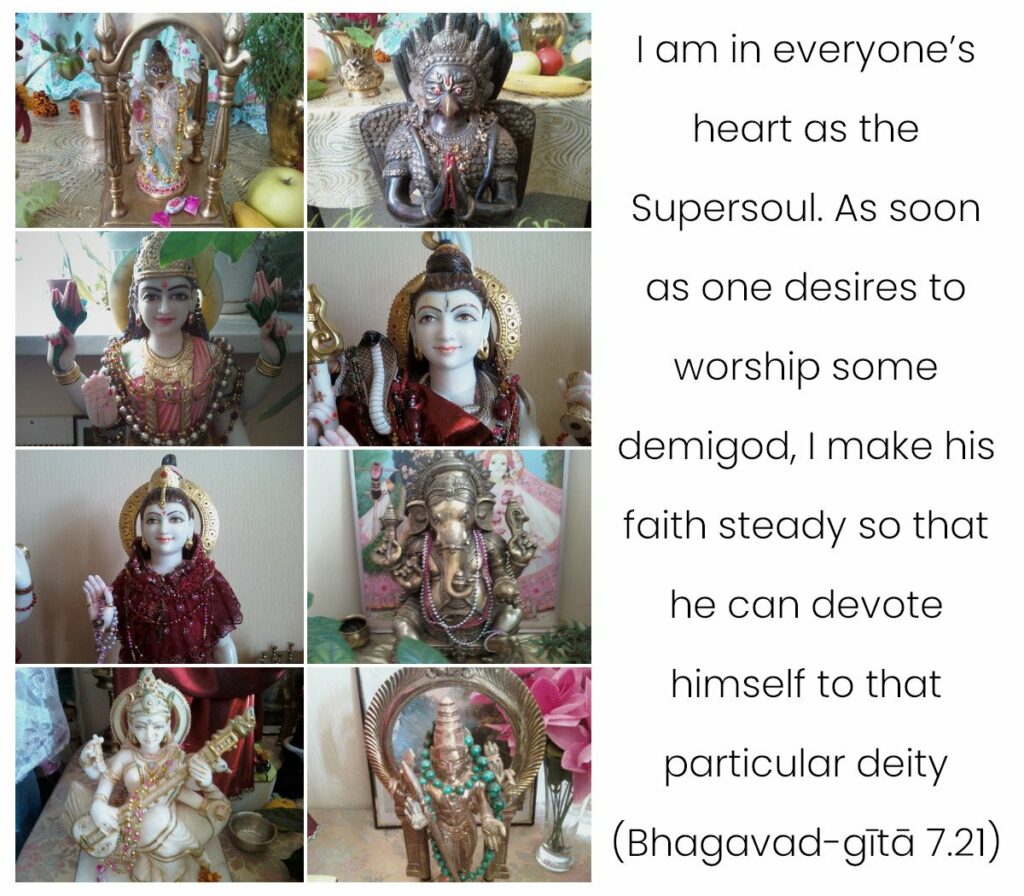
Whatever may be the form a devotee seeks to worship with faith— in that form alone I make his faith unwavering.
Commentary:
The Lord here declares that He confirms the faith of those people who worship different Gods for different purposes. The love of the Supreme Being is infinite. He is present in all these different Devas. So when man worships them with faith, his faith is made unswerving by the Lord Himself. The point to note is that if there is faith in some form or other, such faith is strengthened by the Lord.
This is the unique feature of the Hindu concept of God. Each man is free to worship the Divine in any form. There is no restriction or compulsion in the choice of the object of worship. The path may be different. Whatever path one may follow, he has to come ultimately to the One Supreme Being. Since this universal vision is hard to acquire, men are given infinite choice to worship any form which appeals to their imagination, according to their past samskaras. The only condition is that there should be faith in the worship. Progress should be maintained whether the pace is slow or quick. And also, the destination should be kept in view, and there should be no deviation or back-sliding. Such men are blessed by the Lord with increased faith and stronger devotion to their respective Gods. So it is man’s duty to start worship of his chosen Deity. Faith and devotion are conferred on him by the Lord Himself.
—–
Related Articles:
- O Arjuna! In whatsoever form one seeks Me, I reach him in that form, for all mankind are but following the paths I laid down for them. (BG 4.11)
- Even those devotees who, endowed with faith, worship other gods, worship Me alone, Ο son of Kunti, though in a wrong way. (BG 9.23)
- Some by meditation perceive the Self in themselves through the mind, some by devotion to knowledge, and some by devotion to work. (BG 13.25)
- And that which is the seed of all beings— that am I, Ο Arjuna. There is no being, whether moving or unmoving, that can exist without Me. (10.39)
- There is no end of My divine manifestations, Ο dreaded Arjuna. This is but a partial statement by Me of the multiplicity of My attributes. (10.40)
- Whatever glorious or beautiful or mighty being exists anywhere, know that it has sprung from but a spark of My splendour. (10.41)
- But what need is there of your acquiring this detailed knowledge, Ο Arjuna? With a single fragment of Myself I stand supporting the whole universe. (10.42)
In Jayrambati on the morning of 8 June 1913, Surendranath Bhaumik and Dr. Durgapada Ghosh came to the Mother and bowed down to her. They had been visiting and were to take their leave that afternoon. She blessed them by placing her hands on their heads and then she asked them to take their seats. After a brief conversation, Surendra said to the Mother: “Mother, while worshipping the Master I find one difficulty. Suppose a devotee has a general belief that his Ishta-Devi [the chosen goddess] and the Master are one and the same. He worships the Ishta-Devi through the image of the Master. Afterwards he surrenders the fruits of his japa to the image of the Master, uttering the words, ‘O Maheshwari [the supreme goddess], through thy grace,’ and so forth. This creates confusion in my mind.”
Holy Mother said with a smile: “Don’t worry, my child. Our Master alone is Maheshwara [the supreme god] as well as Maheshwari. He alone is the embodiment of all the deities. He alone is the embodiment of all mystic syllables. Through him one can worship all gods and goddesses. You can address him as Maheshwara as well as Maheshwari.” (Source: Sri Sarada Devi and Her Divine Play)
Sri Ramakrishna Says —
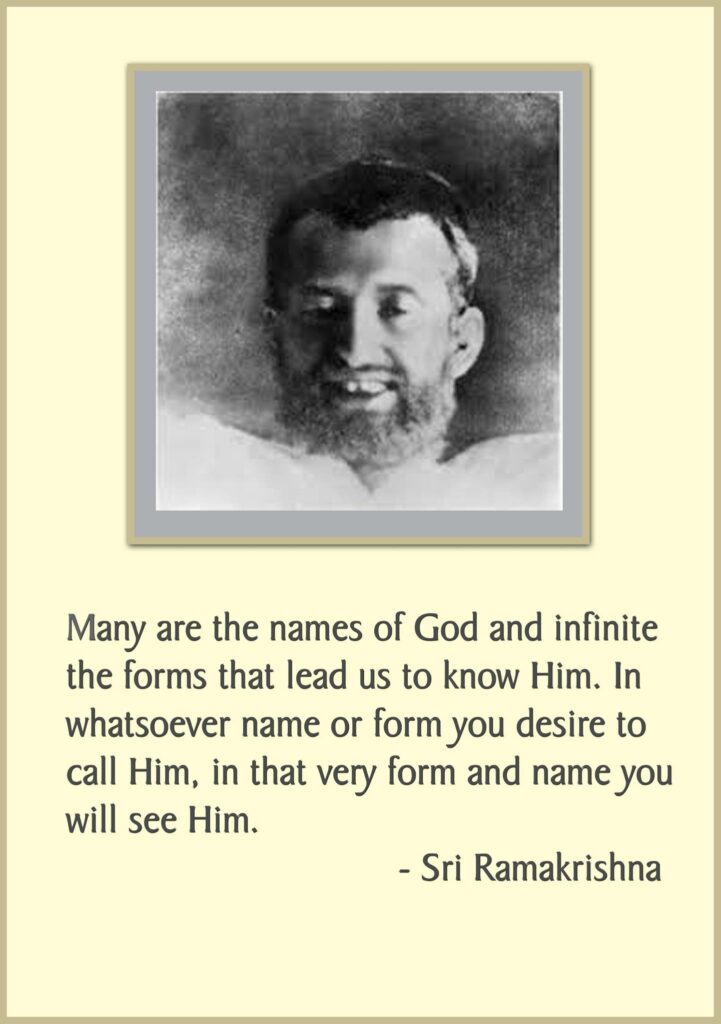
(To Ram and the other devotees) “If you asked me which form of God you should meditate upon, I should say: Fix your attention on that form which appeals to you most; but know for certain that all forms are the forms of one God alone.
“Never harbour malice toward anyone. Siva, Kali, and Hari are but different forms of that One. He is blessed indeed who has known all as one.
(Source: Gospel of Sri Ramakrishna)
—
MASTER: “Please cure my illness. I cannot chant the name and glories of God.”
DOCTOR: “Meditation is enough.”
MASTER: “What do you mean? Why should I lead a monotonous life? I enjoy my fish in a variety of dishes: curried fish, fried fish, pickled fish, and so forth! Sometimes I worship God with rituals, sometimes I repeat His name, sometimes I meditate on Him, sometimes I sing His name and glories, sometimes I dance in His name.”
DOCTOR: “Neither am I monotonous.”
MASTER: “Your son Amrita does not believe in the Incarnation of God. What is the harm in that? One realises God even if one believes Him to be formless. One also realises God if one believes that God has form.
Two things are necessary for the realisation of God: faith and self-surrender. Man is ignorant by nature. Errors are natural to him. Can a one-seer pot hold four seers of milk? Whatever path you may follow, you must pray to God with a restless heart. He is the Ruler of the soul within. He will surely listen to your prayer if it is sincere. Whether you follow the ideal of the Personal God or that of the Impersonal Truth, you will realise God alone, provided you are restless for Him. A cake with icing tastes sweet whether you eat it straight or sidewise. (Source: Gospel of Sri Ramakrishna)
—
One should not condemn any method practised by a person who genuinely believes in his heart of hearts that it will enable him to realize God. The spiritual attitude of no one should be interfered with. For, if one rightly grasps any attitude, through it alone one can realize the divine Lord, who is the embodiment of all attitudes. Stick to your own attitude and continue calling on Him. But never condemn anybody’s attitude nor try to make another’s attitude your own.
(Source: Sri Ramakrishna The Great Master)
—–
The Master (Sri Ramakrishna) established relationships with devotees according to their natures. The Master established a particular spiritual relationship with each devotee based on that person’s inner nature. He used to say, “I see vividly what is inside human beings, as one sees the items in a glass case.” A person can never act contrary to his or her nature, so the devotees were incapable of acting in a way inconsistent with the relationship adopted by the Master. If a man imitated another person, going against his own nature by doing so, the Master would be displeased and would point out that man’s mistake. For example, he used to call Girish “Bhairava” [a form of Shiva]. One day at the Dakshineswar Kali temple when he was in ecstasy, he saw Girish in that form. He put up with Girish’s importunities and harsh words because he could see the wonderful tenderness and complete dependence hidden under the veil of his rough mannerisms. Once another devotee of the Master used that kind of rude language towards him, imitating Girish. The Master was very displeased and later pointed out his error.
The Master guided devotees individually along their respective spiritual paths. Established in bhavamukha, the Master had full knowledge of the innate spiritual mood of each man and woman devotee and established a permanent loving relationship with each of them accordingly. (Source: Sri Ramakrishna and His Divine Play)
During Muslim festivals, the Holy Mother Sarada Devi would send offerings to the darga (a tomb of a Muslim saint) in Shiromanipur. One day Mapheti asked: “Mother, you are a Hindu. Why do you send sweets and other offerings during Muslim festivals?”
She replied: “My son, is God different? All are one. You see, the Master practised Islam sadhana and prayed like the Muslims. Names of God are many but He is one.”
Mapheti once had a divine vision of the Mother. From then on he believed that Holy Mother was a pir, or saint. (Source: Sri Sarada Devi and Her Divine Play)
Question: What is the chief quality of worship?
Answer: Faith.
Question: How does the Lord help such men?
Answer: By confirming their faith in worshipping their chosen Deity.
Related Articles:
- O Arjuna! In whatsoever form one seeks Me, I reach him in that form, for all mankind are but following the paths I laid down for them. (BG 4.11)
Bhagavad Gita: Chapter 7 🔻 (30 Verses)
📗Admin Notes:
- Farmer crying while listening to Bhagavad Gita without Knowing the meaning of Slokas which brought to his mind the thoughts of his beloved Krishna. Incident from Chaitanya Mahaprabhu’s Life.
- The Story of Ekūdāna the Arahat
- ‘Chal Hat’ story
- Ramananda Saraswati Maharaj says “What we do is not of much significance in spiritual life. Our goal/ideal and feeling/attitude are highly important.” Maa Sarada Devi-Gardener-Priest.
- “Dhikr” in Sufism. Whatever brings the awareness of God is Dhikr.