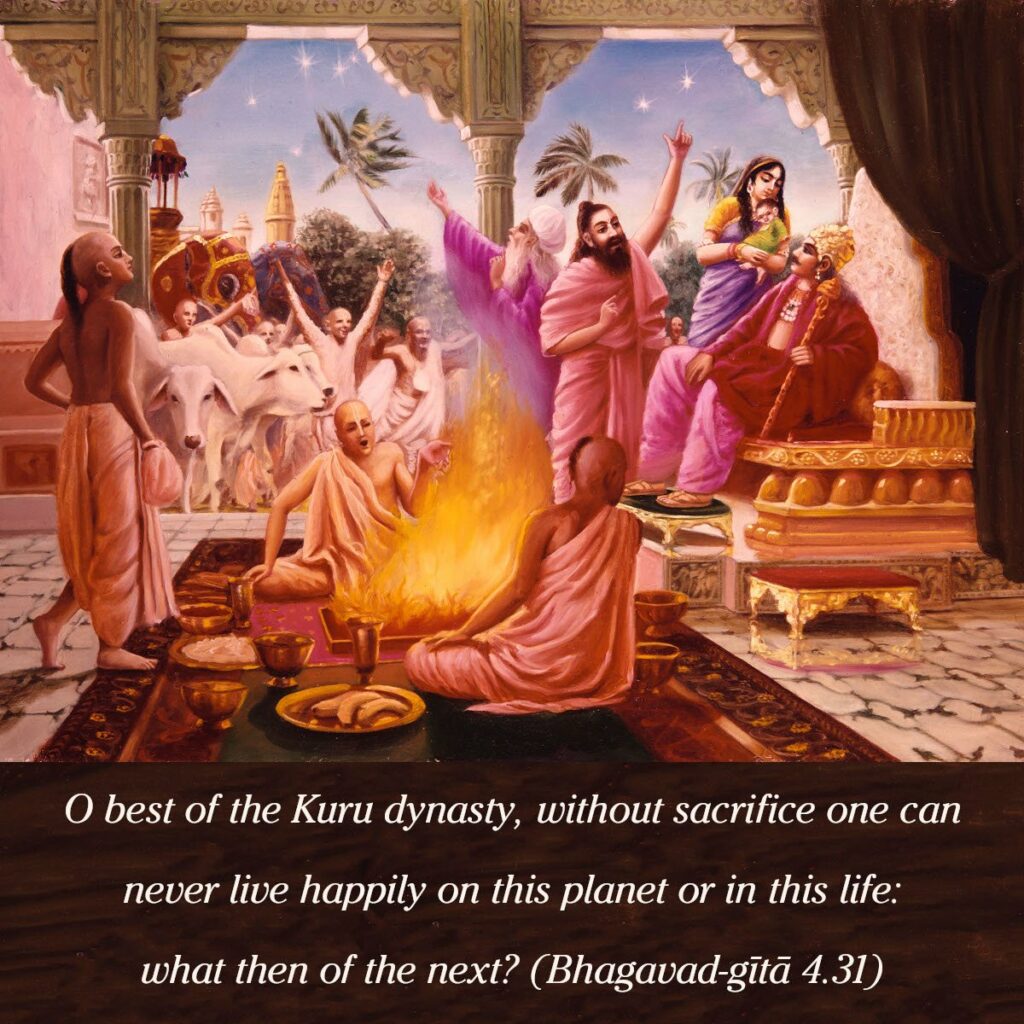
यज्ञशिष्टामृतभुजो यान्ति ब्रह्म सनातनम् |
नायं लोकोऽस्त्ययज्ञस्य कुतोऽन्य: कुरुसत्तम || 31||
yajña-śhiṣhṭāmṛita-bhujo yānti brahma sanātanam
nāyaṁ loko ’styayajñasya kuto ’nyaḥ kuru-sattama
yajña-śhiṣhṭa amṛita-bhujaḥ—they partake of the nectarean remnants of sacrifice; yānti—go; brahma—the Absolute Truth; sanātanam—eternal; na—never; ayam—this; lokaḥ—planet; asti—is; ayajñasya—for one who performs no sacrifice; kutaḥ—how; anyaḥ—other (world); kuru-sat-tama—best of the Kurus, Arjun
Translation:
Those who eat the remnants of sacrifice which is nectar, go to eternal Brahman; to the non- sacrificer, even this world is not, how then can he get a higher world?
Commentary:
Thus far having explained various yajnas, the Lord now states their great merit. The remnants of food offered as sacrifice are equal to nectar, and by tasting it one reaches eternal Brahman. So the seeker should perform some form of yajna, some devotional act, some righteous deed, some oblation to the Divine, and then only should he take his food. Such food confers immortality. It has already been said that yajna destroys all sin and evil. Now the highest reward is offered to the sacrificer- the attainment of Brahman. The purified mind merges in Atma, and Atma alone shines in its original untainted light. This is the Atmic state, the realisation of Brahman. How wonderful is the fruit of sacrifice!
The greatness of the result is proof of the excellence of the cause. Yajna is the cause and the result is the direct realisation of Brahman. In this world, man endures all troubles for the purpose of acquiring a bit of wealth or pleasure or fame. After all, they are brief and short-lived. But the knowledge of Self is an eternal blessing for man. Should we not aspire for it? If the same energy one expends for possessing this or that worldly object, is directed towards the spiritual goal, man can achieve the highest even in this life. The Lord has offered ample choice in selecting the yajna most available to each individual. Various paths are open for this spiritual quest. Let people be alert and watchful, and they shall attain the goal.
The non- sacrificer loses both worlds. What enjoyment or happiness or joy can he have even in this world? Indisciplined men who have neither will nor knowledge cannot hope to make anything even in this earthly life. It is all misery, doubt and despair for them, and such men proceed from sorrow to sorrow. It should be understood that success in attaining purity is also the fruit of sacrifice (i.e.,) the result of self-discipline and proper action. If one cannot do this, how can one hope to enter a higher world? The Lord calls on mankind – “O ye mortal beings! Having attained this human birth, if you do nothing for your spiritual uplift, you cannot get anything even in this life, much less in the next world.”
Those who eat the remnant of sacrifice: Food is not a necessary ingredient in such yajnas like sense-restraint, self-control, pranayama, etc. So in these cases, the word food may be understood as the nectar of peace and joy arising from spiritual practices.
THE SAGE OF KANCHI — sahasra-bhojanam
Any simple act can be transformed into yajña. It need not be anything big or elaborate. Even a small action can become a yajña provided one has created that spirit in oneself. Action is only an outward indication, whereas this mystical yajña happens in the Heart. Thus any act can be transformed as a powerful spiritual experience. A rich man visited the Sage of Kanchi, Chandrasekharendra Saraswati Swami and asked him, “Mahaswami! I have come from a distant place. I want to perform a special yajña of offering food to a thousand people.” Acharya was happy to hear this and gave him blessings for the yajña. A poor old lady standing nearby listened to this and expressed to the Sage, “O Periyava—great one! I too have been dreaming of performing such an offering, but not to this level. I am not able to feed even eleven people. I am too poor. What can I do!”
The Swami said, “Why, you can feed millions! I will tell you a way. Take a sack full of rice and wander about in every nook and corner of the villages. Wherever you find an anthill or a line of ants, offer some rice to them. And while making this offering, remember that it is not just the ants that are eating, it is the Vaiśvānara, the Yajña-Vishnu, who is within the ants who is receiving the rice. Keep in your mind that you are feeding the Lord in those ant-bodies and thus offer the rice. That is a wonderful yajña.” With great devotion, the lady did as advised and returned after some days to meet the Swami. Then the Swami said, “You will attain Vishnu-loka because you have fed Yajña-vishnu in so many forms.” She was delighted to hear this.
Thus, a great yajña was performed in such a simple way. It did not require a lot of wealth or any elaborate rituals. Those who perform such yajña will attain Vishnu-loka. This means they will attain the eternal Brahman. A mind that is cleansed and purified by yajña easily merges in samādhi. This is yānti brahma sanātanam.
A person who does not help or serve others in this world will be ignored or even hated by all. nāyaṃ loko’styayajñasya kuto’nyaḥ kurusattama. Without mutual service, we cannot survive in this plane of existence. Then what to speak of the ‘other’? kuto’nyaḥ? In the Bhagavata, Lord Kapila says, “If you are not compassionate to fellow creatures, and you perform elaborate pūja with expensive articles, you are not worshipping Me; you are only insulting Me.”
Here amṛtabhujaḥ means those who enjoy immortality. When the mind is cleansed by the yajña, the Substratum shines forth. That is the Self, the Atman. The mind merges instantaneously in that, the Eternal Reality—sanātanam. (Source: Srimad Bhagavad Gita – Elixir of Eternal Wisdom | Vol 1)
Question: What is the nature of Brahman?
Answer: Eternal and imperishable.
Question: Who attains Brahman?
Answer: Those who take the remnant of sacrifice.
Question: What is the fate of the non-sacrificer?
Answer: He loses both this world and the next.
Bhagavad Gita: Chapter 4 🔻 (42 Verses)