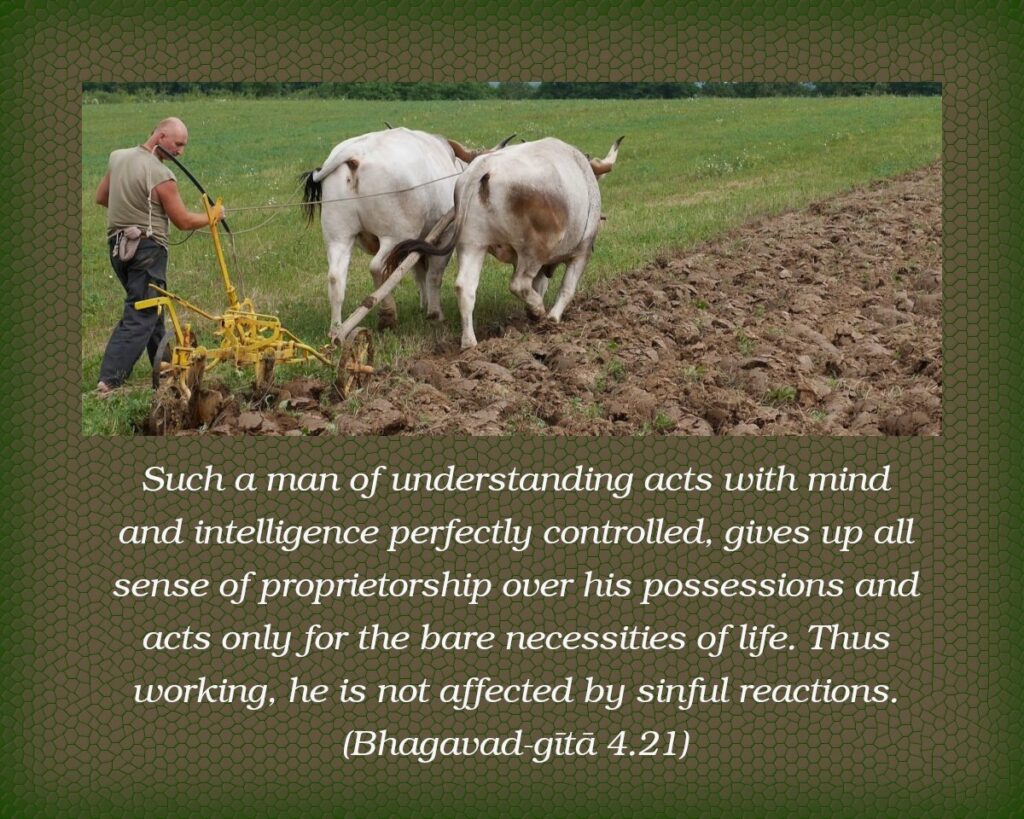
निराशीर्यतचित्तात्मा त्यक्तसर्वपरिग्रह: |
शारीरं केवलं कर्म कुर्वन्नाप्नोति किल्बिषम् || 21||
nirāśhīr yata-chittātmā tyakta-sarva-parigrahaḥ
śhārīraṁ kevalaṁ karma kurvan nāpnoti kilbiṣham
nirāśhīḥ—free from expectations; yata—controlled; chitta-ātmā—mind and intellect; tyakta—having abandoned; sarva—all; parigrahaḥ—the sense of ownership; śhārīram—bodily; kevalam—only; karma—actions; kurvan—performing; na—never; āpnoti—incurs; kilbiṣham—sin
Translation:
He who is free from hope, who is self-controlled, who has abandoned all possessions, though working merely with the body, does not incur sin.
Commentary:
Three attributes of the Jivanmukta are mentioned here – (1 ) desireless, (2) self-controlled (3) abandoning all possessions. The man who has no desire to enjoy the pleasures of the objective world has his mind turned inwards in the contemplation of Atma. He finds all happiness there. So even though he works he cannot have any attachment for the fruits of work. Self-control leads to Atmajnana. When the senses and the mind are restrained, naturally man becomes free from the enticing temptation of the material world with all its glamour and attraction. When such a man works, he has no feeling of attachment for any material object at all. The third attribute `aparigraha‘ should be carefully noted by the aspirant. Non-receiving of gifts and possessions is enjoined by the Sastras as a very important discipline for the seeker. When one receives gifts from others he takes with them part of the karma of the giver. The very purpose of the seeker (i.e.) to get rid of karma is defeated. Why should he add to his own load the sins of others by receiving worthless possessions of material things? Non-receiving (Aparigraha) is therefore enjoined as the rule of conduct for all spiritual aspirants.
SAGE DATTATREYA AND THE EAGLE
We come across a beautiful anecdote about this in the Bhagavata. Once, the avadhūta Dattatreya was blissfully walking in the forest, immersed in his Self. Suddenly, he heard a raucous noise up in the sky. When he looked up, he saw an eagle being followed by a large number of crows. The crows were chasing the eagle wherever it went. It sat on a banyan tree, but the crows followed it there. It flew and sat on a neem tree, but the crows followed it again. It tried to escape by flying high in the sky. But the crows encircled the eagle and prevented it from doing so. Suddenly, the eagle dropped something on the ground, and immediately, all the crows swooped down to pick it up. It was a piece of meat. Then the eagle flew away joyfully! Seeing this, the avadhūta had a satori-like insight. He stood there overwhelmed and sang in joy,
परिग्रहो हि दुःखाय यद्यत्प्रियतमं नृणाम्।
अनन्तं सुखमाप्नोति तद्विद्वान्यस्त्वकिञ्चनः॥ SB 11.9.1
This is certain! Possessions always bring sorrow. If you hold on to possessions, all sorts of sufferings and miseries will chase and attack you wherever you go. Give up the possessions; then, free you are, like a child.
Just like the eagle, we too are holding on to the flesh, the body. This is our first and foremost possession. Give up the body-identity to be free of this shackle. Emotional possessions too haunt us wherever we go. Giving up the mine-ness is the way to get rid of them. The primal possession that binds us to all other possessions such as the body and the emotions is the ego-identity the—‘I’-‘I’. Once there is freedom from that possession, you are free, totally free. There is no border for your existence. (Source: Srimad Bhagavad Gita – Elixir of Eternal Wisdom | Vol 1)
Bhagavad Gita: Chapter 4 🔻 (42 Verses)