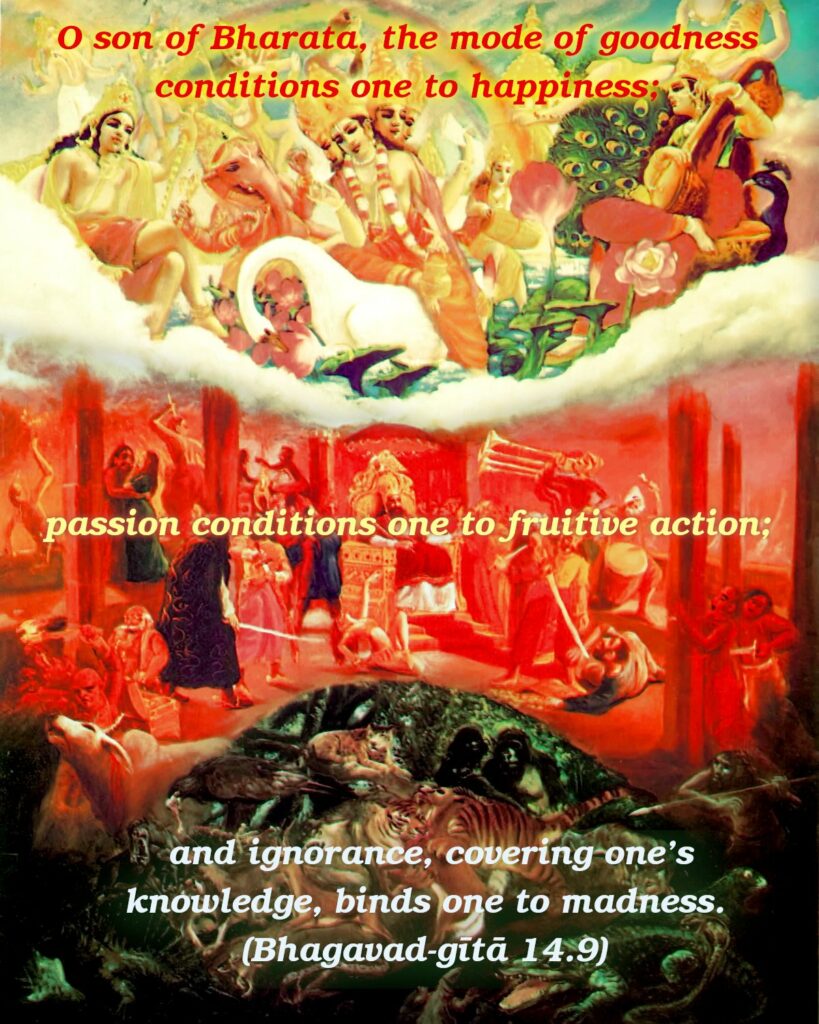
सत्त्वं सुखे सञ्जयति रज: कर्मणि भारत |
ज्ञानमावृत्य तु तम: प्रमादे सञ्जयत्युत || 9||
sattvaṁ sukhe sañjayati rajaḥ karmaṇi bhārata
jñānam āvṛitya tu tamaḥ pramāde sañjayaty uta
sattvam—mode of goodness; sukhe—to happiness; sañjayati—binds; rajaḥ—mode of passion; karmaṇi—toward actions; bhārata—Arjun, the son of Bharat; jñānam—wisdom; āvṛitya—clouds; tu—but; tamaḥ—mode of ignorance; pramāde—to delusion; sañjayati—binds; uta—indeed
Translation:
Sattva binds one to happiness, and rajas to action, Ο Bhārata; whereas tamas veils knowledge and binds one to inadvertence.
Commentary:
This verse is just a summary of the above three verses. The three Gunas and their main qualities are restated for easy understanding. Sattva guna leads man to knowledge and happiness of a worldly nature; Rajoguna prompts man to worldly action prompted by selfishness and Tamoguna leads to wrong understanding, sleeep and laziness. Sattvaguna is like the covering of a pure glass over the light, Rajoguna is like the covering of cane-basket over the light; and Tamoguna is like the covering of a pot over the light. In the first instance, light comes out through the glass, the medium being quite pure. In the second instance, some rays of light escape through the chinks of the basket. But in the third instance, the pot being opaque, the light within is totally covered. The state of Tamas is utter darkness. The man in darkness stumbles and falls, mistakes objects, takes one thing to be another, and thus commits a number of mistakes.
The pure light of Atma, a blissful and ever blessed, is thus shrouded by the three Gunas. Man is bound by them. The Lord expresses wonder, how deluded man suffers on account of the powerful influence of Prakriti and its qualities.
Sri Ramakrishna(To the sub-judge): “Let me ask you one thing. Are vanity and egotism the result of knowledge or of ignorance? Egotism is of the nature of tamas; it is begotten by ignorance. On account of the barrier of ego one does not see God. ‘All troubles come to an end when the ego dies.’ It is futile to be egotistic. Neither body nor wealth will last. Once a drunkard was looking at the image of Durga. At the sight of Her decorations, he said, ‘Well, Mother! However You may fix Yourself up, after two or three days they will drag You out and throw You into the Ganges.’ (All laugh.)
“So I say to you all, you may be a judge or anybody else, but it is all for two days only. Therefore you should give up vanity and pride.
“The characteristics of sattva, rajas, and tamas are very different. Egotism, sleep, gluttony, lust, anger, and the like, are the traits of people with tamas. Men with rajas entangle themselves in many activities. Such a man has clothes all spick and span. His house is immaculately clean. A portrait of the Queen (Queen Victoria.) hangs on a wall in his drawing-room. When he worships God he wears a silk cloth. He has a string of rudraksha beads around his neck, and in between the beads he puts a few gold ones. When someone comes to visit the worship hall in his house, he himself acts as guide. After showing the hall, he says to the visitor: ‘Please come this way, sir. There are other things too — the floor of white marble and the natmandir with its exquisite carvings.’ When he gives in charity he makes a show of it. But a man endowed with sattva is quiet and peaceful. So far as dress is concerned, anything will do. He earns only enough money to give his stomach the simplest of food; he never flatters men to get money. His house is out of repair. He never worries about his children’s clothing. He does not hanker for name and fame. His worship, charity, and meditation are all done in secret; people do not know about them at all. He meditates inside his mosquito curtain. People think he doesn’t sleep well at night and for that reason sleeps late in the morning. Sattva is the last step of the stairs; next is the roof. As soon as sattva is acquired there is no further delay in attaining God. One step forward and God is realised. (To the sub-judge) Didn’t you say that all men were equal? Now you see that there are so many varieties of human nature. (Source: Gospel of Sri Ramakrishna)
Bhagavad Gita: Chapter 14 🔻 (27 Verses)