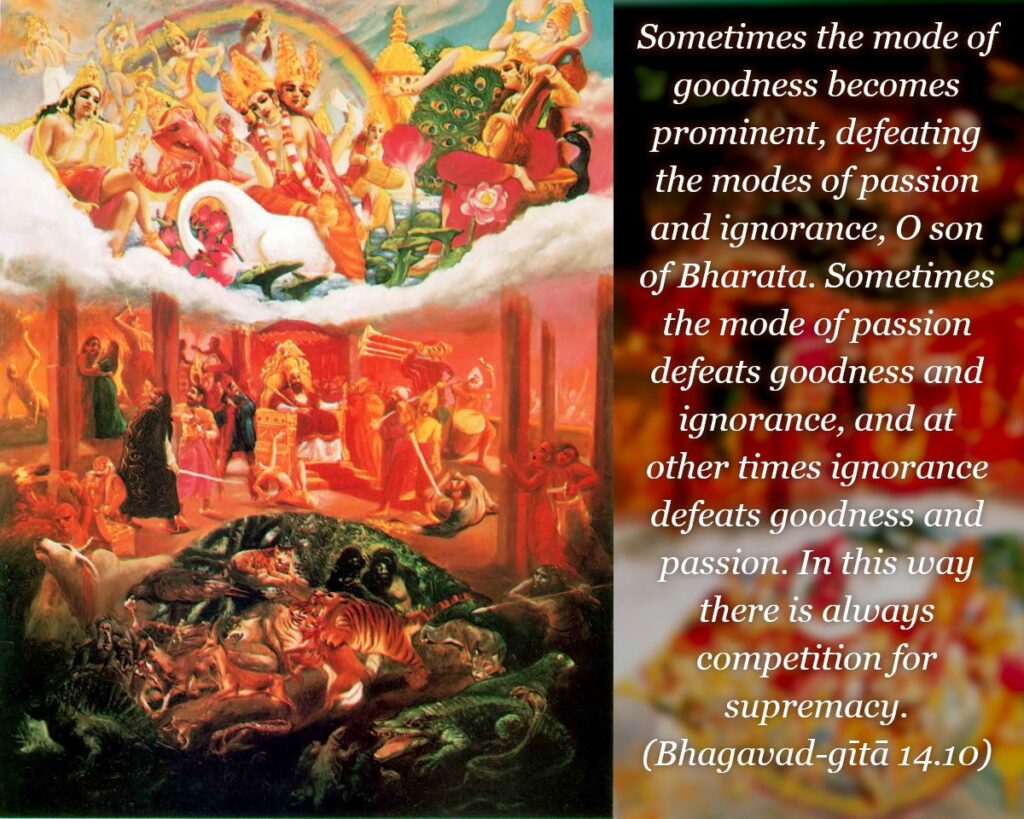
रजस्तमश्चाभिभूय सत्त्वं भवति भारत |
रज: सत्त्वं तमश्चैव तम: सत्त्वं रजस्तथा || 10||
rajas tamaśh chābhibhūya sattvaṁ bhavati bhārata
rajaḥ sattvaṁ tamaśh chaiva tamaḥ sattvaṁ rajas tathā
rajaḥ—mode of passion; tamaḥ—mode of ignorance; cha—and; abhibhūya—prevails; sattvam—mode of goodness; bhavati—becomes; bhārata—Arjun, the son of Bharat; rajaḥ—mode of passion; sattvam—mode of goodness; tamaḥ—mode of ignorance; cha—and; eva—indeed; tamaḥ—mode of ignorance; sattvam—mode of goodness; rajaḥ—mode of passion; tathā—also
Translation:
Sattva asserts itself by prevailing over rajas and tamas, Ο Bhārata; rajas asserts itself by prevailing over sattva and tamas; and tamas asserts itself by prevailing over sattva and rajas.
Commentary:
It is a psychological truth that the three qualities function alternately in every individual, although each man is characterised by the predominance of one of the three qualities. When Sattvaguna functions, the other two gunas are over-powered. So also when Rajoguna functions, the other two are suppressed; when Tamoguna is powerful the other two gunas are overpowered. Therefore the seekers have to strengthen Sattvaguna and by its power suppress the other two Gunas. That is the first thing to be done in spiritual practice. Rajas and Tamas should be eliminated and it can be done only by nourishing Sattvaguna at all times. If Sattva dominates the seeker has ascended to a very high plane, and from there, it would not be far away to rise above it in the realisation of God.
Swami Vivekananda Says —
With the prevalence of the sattvika essence, man becomes inactive and rests always in a state of deep dhyana or contemplation; with the prevalence of the rajas, he does bad as well as good works; and with the prevalence of the tamas again, he becomes inactive and inert. Now, tell me, looking from outside, how are we to understand, whether you are in a state wherein the sattva or the tamas prevails? Whether we are in a state of sattvika calmness, beyond all pleasure and pain, and past all work and activity, or whether we are in the lowest tamasika state, lifeless, passive, dull as dead matter, and doing no work, because there is no power in us to do it, and are, thus, silently and by degrees, getting rotten and corrupted within — I seriously ask you this question and demand an answer. Ask your own mind, and you shall know what the reality is.[Source]
Sattva binds through the search for happiness and knowledge, rajas binds through desire, tamas binds through wrong perception and laziness. Conquer the two lower by sattva, and then give up all to the Lord and be free.[Source]
KING PARIKSHIT DISHONOURS SAGE SHAMIKA
Even if a person is of sāttvik-nature, at times, due to his destiny, rajo-guṇa or tamo-guṇa overpowers him and makes him blunder. In the Bhagavata, we see Parikshit, the devout king who had the blessing of Krishna while he was yet in his mother’s womb, committing such a blunder. Once, while hunting in the forest, Parikshit came across the ashram of the great sage Shamika. He went into the ashram, parched and famished, hoping to get food and water. The sage was in samādhi at the time and was unaware of the king’s arrival. Parikshit thought that the sage was just pretending. Prompted by a sudden fit of rage, he took a dead snake, hung it around the sage’s neck and returned to his palace.
Once back at the palace, he realised his great folly. He repented, “Oh, what have I done! For this puerile act, let all the curses fall on me. Let me lose my kingdom and everything else.” This belated wisdom came to him only much after the blunder was committed. At the time of the action, it was tamo-guṇa that was predominant.
The nature of tamo-guṇa is that it completely clouds the understanding and makes a person lose his discriminating power. It makes one forget one’s position and lose his integrity. From being a noble and a highly cultured person, one falls to the level of a mean human being. (Source: Srimad Bhagavad Gita – Elixir of Eternal Wisdom | Vol 3)
Bhagavad Gita: Chapter 14 🔻 (27 Verses)