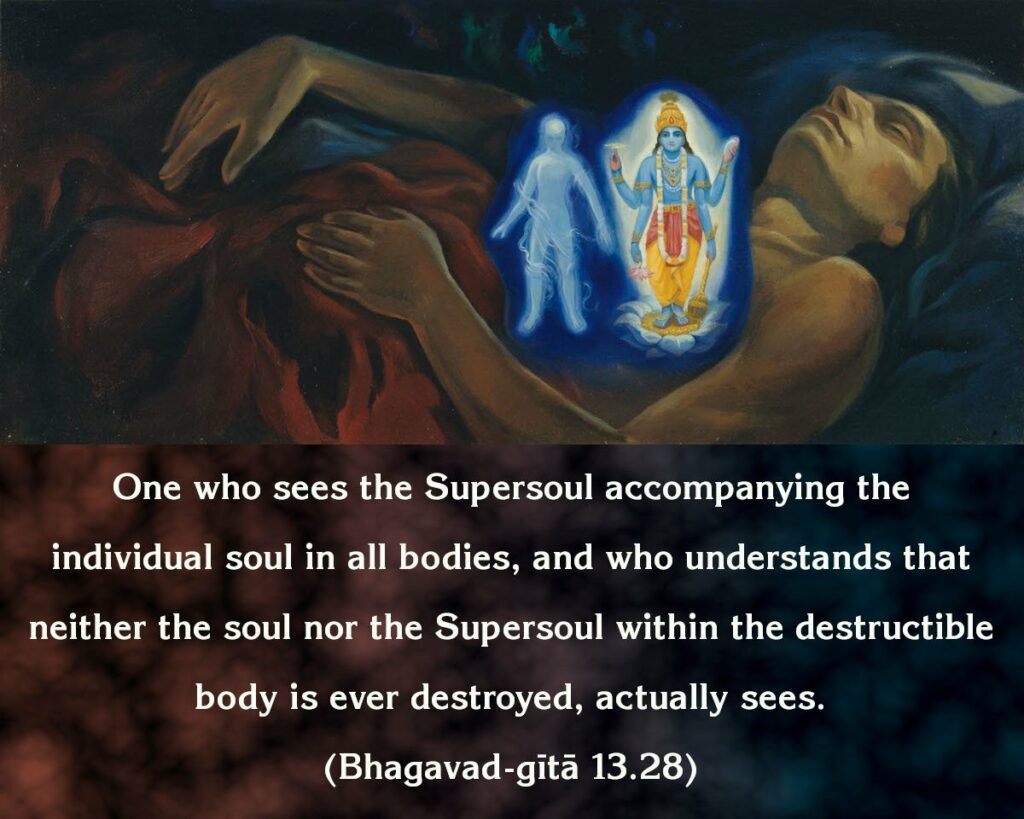
समं सर्वेषु भूतेषु तिष्ठन्तं परमेश्वरम् |
विनश्यत्स्वविनश्यन्तं य: पश्यति स पश्यति || 28||
samaṁ sarveṣhu bhūteṣhu tiṣhṭhantaṁ parameśhvaram
vinaśhyatsv avinaśhyantaṁ yaḥ paśhyati sa paśhyati
samam—equally; sarveṣhu—in all; bhūteṣhu—beings; tiṣhṭhan-tam—accompanying; parama-īśhvaram—Supreme Soul; vinaśhyatsu—amongst the perishable; avinaśhyantam—the imperishable; yaḥ—who; paśhyati—see; saḥ—they; paśhyati—perceive
Translation:
He who sees the Supreme Lord abiding alike in all beings, and not perishing when they perish— verily he alone sees.
Commentary:
Paramatma is present in all beings equally. It is not that He is more present in some and less present in others. He is like the string inside a garland of flowers.
The supreme Lord is present in all equally.
avinasyantam: The vehicles of the body, Prana, mind etc., perish at the time of death. But Atma, the Lord is indestructible. He exists. It is clear that the whole of the objective world perishes and the Drik, Atma, the Lord alone is eternal. Therefore to let go of the bond of attachment to the perishable things, and to strengthen the firm hold of the Lord, is the duty of all thoughtful men.
yah pasyati sa pasyati: The physical eyes are formed to see material things only. They cannot see any thing more. But the vision of the seer goes deeper and discovers the eternal principle of life, the Supreme Lord, in the midst of the destruction of phenomenal nature. It is the eye of Knowledge that sees Atma, the Lord. He alone sees, because he sees the truth. All others, though having eyes, do not see the truth whatever their power and position, wealth and beauty may be. So, the aspirants should open the inner eye of knowledge, see the truth and become fearless of death. They would realise that what is perishing is only the body, and the Lord, Atma is Eternal, pure and perfect. This knowledge alone saves man from the terrors of death.
One day the swami Vivekananda came downstairs and sat on the canvas cot under the mango tree in the courtyard, facing west, as he often did. His eyes were luminous; his whole frame seemed alive with some strange spiritual consciousness. Pointing to the sannyasins and brahmacharins about him, he exclaimed [to Sharat Chandra]:
And where will you go to seek Brahman? He is immanent in all beings. Here, here is the visible Brahman! Shame on those who, disregarding the visible Brahman, set their minds on other things! Here is the Brahman before you as tangible as a fruit in your hand! Can’t you see! Here — here — here is the Brahman!” He spoke these words in such an inspiring way, that over all present there came the peace and insight of deep meditation. They stood like marble statues, so motionless and hushed in silence had they become! Swami Premananda, after his bath in the Ganges, was on his way to the shrine for worship. Hearing the words of his brother monk he fell into a state of ecstasy and became motionless. After a quarter of an hour the swami said to him, “Now go for worship.” Then only did Premananda regain normal consciousness. That scene was unforgettable. Everyone in the monastery was struck with amazement at the power of the beloved Leader who, with a word, could raise the minds of all present to the heights of the transcendental realm …
Source: Vivekananda: East Meets West (a Pictorial Biography), by Swami Chetanananda
Ch IX “I Shall Never See Forty”, p 157
SANT NAMADEVA AND LAMBAKNATH
This is a most unusual incident related about Saint Namadeva when he visited a village and decided to stay in a deserted house. The simple village folk warned him with great concern that the house was haunted by a fearsome ghost—a brahmarakshas. Namadeva heard them out peacefully but kept quiet. He continued to stay there, chanting the name of the Lord and meditating. In the middle of the night, there was a sudden sound, with a horrific presence creeping in. The terrifying form of the ghost appeared in front of the saint; it was colossal. The monstrous brahmarakshas opened its mouth as if to swallow everything in front. Instead of being afraid, Namadeva came out from his samādhi and started dancing and singing in ecstasy, addressing the ghost as Vittala. He beheld the delightful Lord in the form of the frightful ghost and sang this abhang.
Earth as your feet,
Heaven as your head,
and yojanas of long hands,
O Siva! Even sages like Sanaka are unable to cross beyond,
Yet here, Namadeva beholds you as his own companion!
After this nectarine spiritual vision of the saint, the hideous form of the ghost transfigured and melted into the divine presence of Panduranga. In fact, the vision of the saint worked as a mahāvākya-upadeśa for that spirit. No words were needed. Just by profoundly looking at the frightful form as Panduranga, the saint transformed the evil spirit into a divine one.
“When you worship the terrible, you transcend the terrible,” says Swami Vivekananda.
(Source: Srimad Bhagavad Gita – Elixir of Eternal Wisdom | Vol 3)
SRI KRISHNA’S INSTRUCTIONS TO UDDHAVA
In the eleventh skandha of the Bhagavata is the Uddhava Gita, where Krishna teaches the profound Brahmavidyā to Uddhava. Along with this, Krishna also teaches the elaborate process of sādhanā, kriyā-yoga. After listening to various methods of yogas and upāsanās, Uddhava confessed, “O Lord, I am already old and do not know how many more days I am left with. And now, You are teaching me kriyā-yoga! O Lord, I have seen many yogis and been associated with them; even after toiling all their lives to curb the mind, they have not found fulfilment. The older they grow, their minds grow stronger. I have found many who end their life in stress. Hence I do not want to learn any technique or method. Please teach me how I can behold Thee now, here!” Then the Lord’s face was lit with the enchanting radiance of His smile—smita-śobhitānanaḥ.
And here, the Maharashtra saint Eknath Swami says in his commentary: With all His love and compassion, suddenly two more arms of Krishna manifested. He appeared as the four-armed Vishnu to hug Uddhava and said, “My dear Uddhava! Behold here and now; behold in the Brahmin; behold in the unclean dog-eater; behold in a dog; behold in a donkey; behold in the stars; in the splendour of the Sun; in the coolness of the Moon; in the waves of the ocean—everywhere, behold Me, O Uddhava! They are all Me! Bow down low and do namaskāra to Me in each of these forms. Train yourself thus to see everything as God. Here and now, just accept that I have happened as all these names and forms; whatever you see is Me.” Hearing this, tears rolled down Uddhava’s eyes. He absorbed Krishna’s words, and with the power of those words, wherever he looked, he beheld the Lord alone. He no longer beheld anything as good or bad, living or non-living. The whole of nature appeared just like an outer garment within which the indweller was Krishna. Wherever he looked, he saw Īśvara alone. (Source: Srimad Bhagavad Gita – Elixir of Eternal Wisdom | Vol 3)
The incident occurred when Paramahamsa Yogananda traveled all the way from the USA specifically to meet Anandamayi Ma. At the time of their meeting, Anandamayi Ma was much younger and displayed the behavior of a “little girl”.
When Yogananda arrived, she ran toward him, greeting him affectionately by asking, “Father, where were you? Baba, where were you so long? I waited for you”.
Evidently taken aback by this enthusiastic and childlike greeting, Yogananda asked her, “Tell me something about yourself, mother”.
Her response was a profound declaration of her enlightened state, transcending the physical changes of life. She told him:
“There’s nothing much to say… I was the same then, I was born as a little girl but I was the same, and now I am this young woman, now I am still the same. One day this body will go, I will still be the [same]. That’s all there, nothing more to say”.
The story is often shared to illustrate how an enlightened person (a Brahmagyani) remains centered in the truth, viewing their existence as unchanging consciousness regardless of the body’s age or condition.
Related Articles:
- Its hands and feet are everywhere; Its eyes, heads, and faces are everywhere; Its ears are everywhere; Its existence envelops all. (BG 13.14)
- The sage harmonised in yoga sees the Self in all beings, and all beings in the Self; he sees the same everywhere. (BG 6.29)
- He who sees Me in all beings and all beings in me never becomes lost to me, nor do I become lost to him. (BG 6.30)
- The Yogi who worships Me abiding in all beings and who is established in unity abides in me in whatever manner he is acting. (BG 6.31)
- The wise man beholds all beings in the Self and the Self in all beings; for that reason he does not hate anyone. (Isha Upanishad, Verse 6)
- O Arjuna! Having obtained this knowledge, you will not thus be deluded again and by this Knowledge, you will see all beings in your Self and also in Me. (BG 4.35)
- Seeing the Atman in all beings, and all beings in the Atman, one attains the highest Brahman – not by any other means. (Kaivalya Upanishad, Verse 10)
- See God in All
Note: Ornaments may be destroyed, but not the gold. Waves may collapse and vanish, but not the water. Similarly, Brahman is the ultimate substratum of the manifest and unmanifest universe. Yet, while Brahman is independent of the world of name and form, the entire world is dependent on Brahman. Therefore, Brahman is not destroyed when the world is destroyed. Microcosm and Macrocosm are built on Same Reality. One and Many are Same Reality.
Question: Where is Paramatma?
Answer: In all beings.
Question: How?
Answer: Equally in all beings.
Question: What is the nature of the body etc., ?
Answer: The body, Prana and mind are subject to death.
Question: What is the nature of Atma?
Answer: It is Immortal; Though the body and other vehicles die, it exists.
Question: Who is the real seer?
Answer: Who knows that Atma exists, in the midst of the perishing phenomenal world, he is the real seer, because he has opened the eye of Knowledge.
Bhagavad Gita: Chapter 13 🔻 (35 Verses)