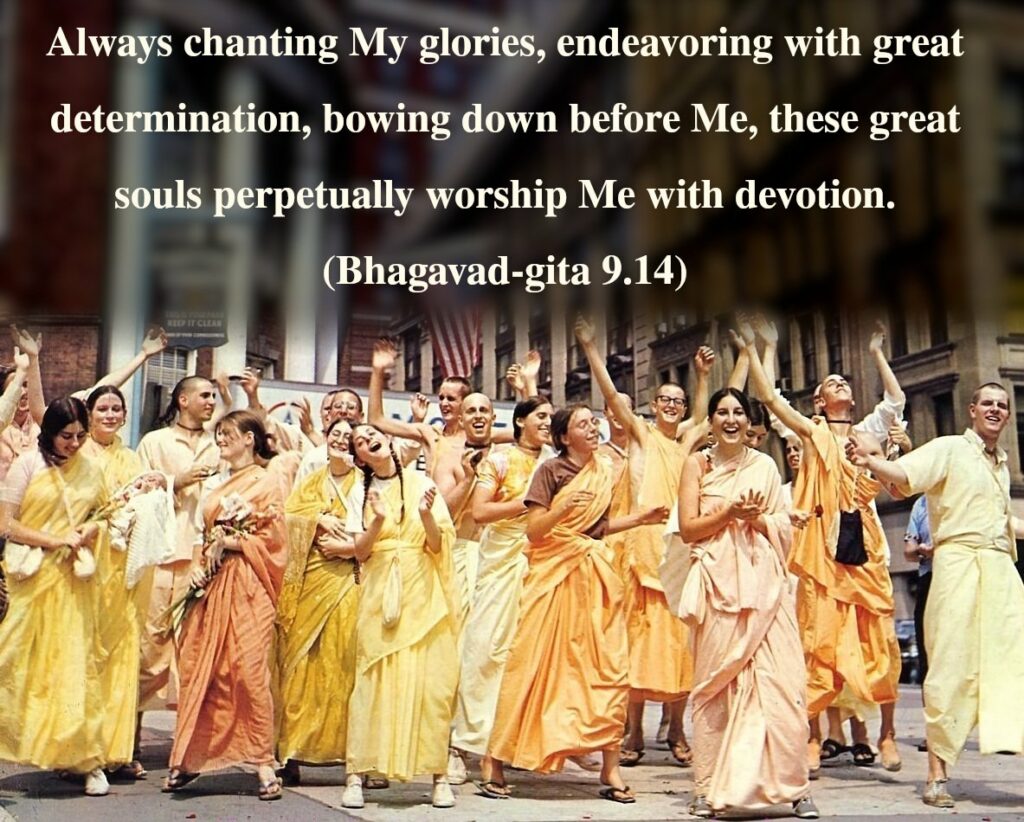
सततं कीर्तयन्तो मां यतन्तश्च दृढव्रता: |
नमस्यन्तश्च मां भक्त्या नित्ययुक्ता उपासते || 14||
satataṁ kīrtayanto māṁ yatantaśh cha dṛiḍha-vratāḥ
namasyantaśh cha māṁ bhaktyā nitya-yuktā upāsate
satatam—always; kīrtayantaḥ—singing divine glories; mām—Me; yatantaḥ—striving; cha—and; dṛiḍha-vratāḥ—with great determination; namasyantaḥ—humbly bowing down; cha—and; mām—Me; bhaktyā—loving devotion; nitya-yuktāḥ—constantly united; upāsate—worship
Translation:
Ever glorifying Me, always striving with self-control, remaining firm in their vows, bowing before Me, they worship Me with love and unwavering steadiness.
Commentary:
In the previous verse, it is declared that the mahatmas worship the Lord with single-minded devotion. Here the manner of worship is explained. They think, sing and speak of the Lord’s glory always. Such adoration comes through constant striving. The striving is not intermittent but continuous. They are steadfast in vows.
The Lord emphasises firmness many times. The mind is saturated with powerful past samskaras, impurities of raga and dvesha, acquired through several births. They cannot be eliminated except by firmness and steadfast striving. The seeker has to practice certain vows to purify the body and mind (fasting, silence, japa, dhyana, brahmacharya). These vows should be followed with cheerfulness, courage and determination. Otherwise, progress on the spiritual path is obstructed and the seekers are drawn away from the goal by the force of ignorance (avidya). Firm vows are strong weapons with which avidya could be defeated and overcome.
Nitya yuktah: They are always attached to the Lord, with devotion. Their worship is illumined by devotion. It is noteworthy how the Lord emphasises devotion to Him at every step. It is merely intellectual understanding but deep emotional realisation which leads to the Lord. Patanjali says :
Devotional acts of Dhyana continued for a long time without any break leads the aspirant to the firmly established state in God.
—–
—–
THE ŚIVA-DEVOTEE SUNDARAR
All great saints have sung about their experience of the Divine in heart-melting language. Sundarar, a Śiva devotee, when caught under the net of Lord’s Grace, asked, “Lord, my worldly life has come to an end now. What should I do?” The Lord said, “Sing about Me. Sing My glory.” And the Lord Himself gave him the leading word to begin the song. He sang about the Lord addressing Him thus, “O Mad ancient one! O the being with the crescent moon on matted locks! My beloved!” (Source: Srimad Bhagavad Gita – Elixir of Eternal Wisdom | Vol 1)
MEERABAI’S KĪRTANAS
Reading holy books such as the Gita and the Bhagavata is also kīrtana. Meerabai, the ecstatic saint, is the best example of kīrtana. She sang thousands of songs on her beloved Giridhāri. In one of them, she sings, “People ask what I do in solitude. In solitude, I read the Gita and the Bhagavata and then dance in ecstasy around my Giridhāri, with His name on my lips. In the streets, I dance and roam with saints singing His glory.”
During the sādhanā period, devotees eulogise the Lord constantly by chanting His name. Doing nāma-japa is a prominent part of kīrtana. Let the lips move day and night—chanting, throbbing with the nāma. It purifies the mind, and every cell in the body gets divinised. The intellect becomes thoroughly cleansed and gains the power to know the Atman. Thus, by mere kīrtana—satata-kīrtana—one can attain Enlightenment, God-realisation. Constantly singing His glories, chanting His name and speaking about Him—these are all kīrtana. (Source: Srimad Bhagavad Gita – Elixir of Eternal Wisdom | Vol 1)
BEHOLD THE DIVINE IN ALL
“namasyantaśca māṃ bhaktyā—they worship Me with devotion.” Whenever the ego arises, whenever it usurps and asserts itself, the devotee bows down to the Lord with devotion. This is the greatest of all spiritual sādhanās. In the Bhagavata, when Uddhava prays to Bhagavan ‘I want God-realisation now,’ Bhagavan says, “Uddhava, what exists is God-realisation. The Sun is God; the Moon is God; the stars are God; the Brahmin is God; the outcaste is God; the donkey is God; the horse is God. Fall at their feet and worship them! Do namaskāra; do namaskāra again and again. Do this sādhanā until you behold only God everywhere. Do this with full love—with heart-melting love—until you see the splendour of the Divine in every name and form.” (Source: Srimad Bhagavad Gita – Elixir of Eternal Wisdom | Vol 1)
Question: How do the mahatmas worship God?
Answer: They glorify Him, steadfast in vows they strive, they worship Him with devotion, and they keep the mind steady in Him.
Question: From this, what do we understand as the way to God realisation?
Answer: (1) Continuous memory of God, (2) firmness in vows, (3) devotion, (4) concentrated thought of God.
Question: How should one remember God?
Answer: Always.
Question: How should the vows be practised?
Answer: Firm and steadfast.
Question: How should one worship God?
Answer: With devotion.
Bhagavad Gita: Chapter 9 🔻 (34 Verses)